


















Tanvi Upadhyay



OKR Examples for HRs
Bring the best out of Human Resource & People teams by connecting their goals with business goals
- Make HR teams part of the business strategy
- Help HR teams build an outcome driven culture


Trusted by 600+ companies building high-performance cultures

















How Peoplebox Keeps OKRs Alive
Example: 1
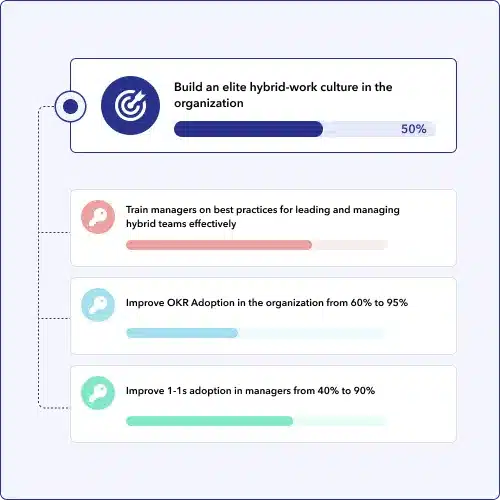
Objective: Build an elite hybrid-work culture in the organization
Create a work environment that effectively combines remote and in-office work, fostering collaboration, flexibility, and productivity for all employees.
- Improve OKR Adoption in the organization from 60% to 95%
- Improve 1-1s adoption in managers from 40% to 90
- At-least 80% of the teams score above 8 for manager support driver
- Equip 100% of workspaces with the necessary technology and tools to support remote collaboration
- Train managers on best practices for leading and managing hybrid teams effectively
Example: 2
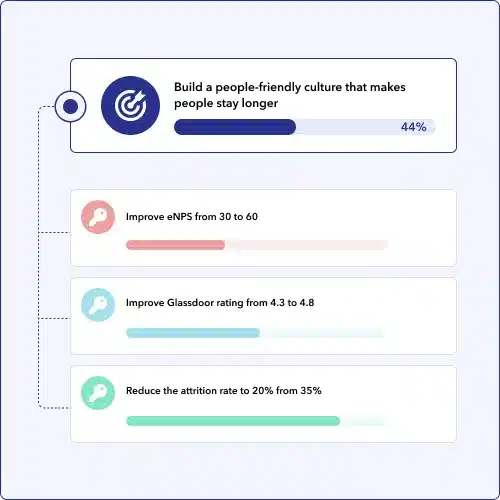
Objective: Build a people-friendly culture that makes people stay longer
Foster a supportive and nurturing work environment where employees feel valued, connected, and motivated, leading to increased employee retention and job satisfaction.
- Improve eNPS from 30 to 60
- Improve Glassdoor rating from 4.3 to 4.8
- Reduce the attrition rate to 20% from 35%
- Increase employee satisfaction scores by 20%
- Establish a mentorship program, matching 75% of employees with mentors within their first six months
Example: 3
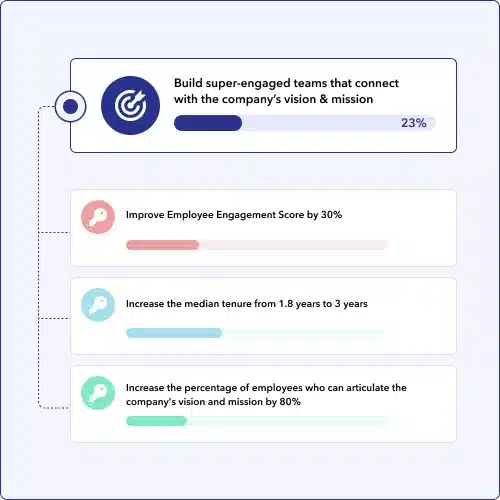
Objective: Build super-engaged teams that connect with the company’s vision & mission
Create a strong sense of alignment and purpose among employees by connecting their work to the company’s vision and mission, resulting in highly engaged and motivated teams.
- Improve Employee Engagement Score by 30%
- Increase the percentage of employees who can articulate the company's vision and mission by 80%
- Increase the percentage of employees who can articulate the company's vision and mission by 80%
- Increase the percentage of employees who can articulate the company's vision and mission by 80%
- Increase employee engagement scores related to company vision and mission alignment by 25%
Example: 4
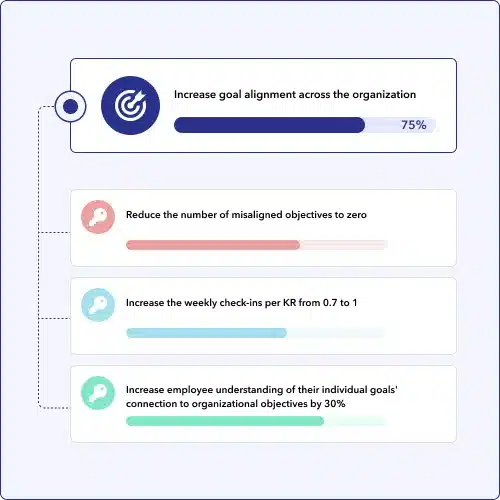
Objective: Increase goal alignment across the organization
Ensure that departmental and individual goals are aligned with the company’s strategic objectives, fostering a cohesive and focused work environment that drives organizational success.
- Increase OKR adoption to 100% by ensuring everyone owns OKR in the organization
- Reduce the number of misaligned objectives to zero
- Increase the weekly check-ins per KR from 0.7 to 1
- Train 100% of managers on effective goal-setting techniques
- Increase employee understanding of their individual goals' connection to organizational objectives by 30%
Example: 5
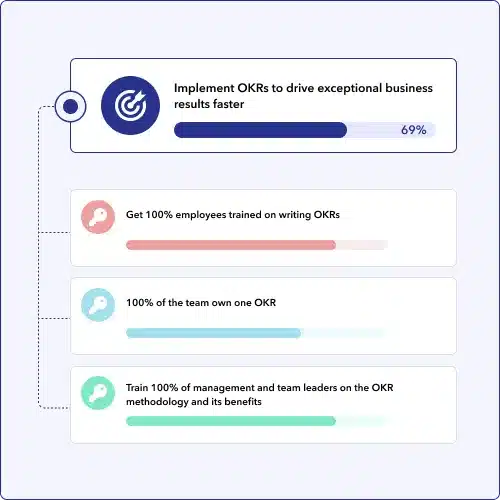
Objective: Implement OKRs to drive exceptional business results faster
Adopt the Objectives and Key Results (OKR) framework throughout the organization to accelerate progress towards strategic goals and improve overall business performance.
- Get 100% employees trained on writing OKRs
- 100% of the team own one OKR
- Ensure every OKR has at least 2 key result
- Train 100% of management and team leaders on the OKR methodology and its benefits
- Achieve at least 80% alignment between team and individual OKRs and the organization's strategic objectives
Example: 6
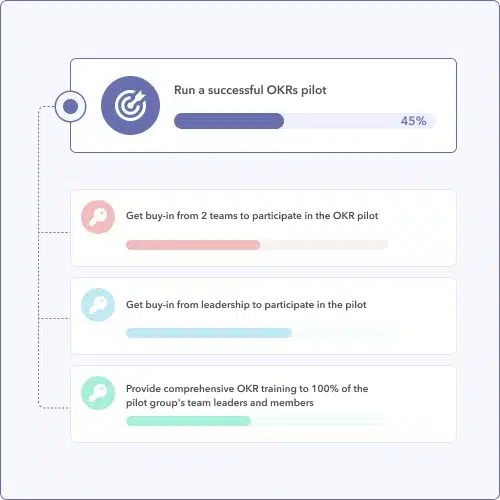
Objective: Run a successful OKRs pilot
Conduct a pilot program to test the effectiveness of the Objectives and Key Results (OKR) framework within the organization, refining the process and gathering valuable insights to facilitate a seamless company-wide adoption.
- Get buy-in from 2 teams to participate in the OKR pilot
- Get buy-in from leadership to participate in the pilot
- Complete the pilot with a 90% success rate
- Achieve a minimum of 70% alignment between pilot group OKRs and the organization's strategic objectives
- Provide comprehensive OKR training to 100% of the pilot group's team leaders and members
Example: 7
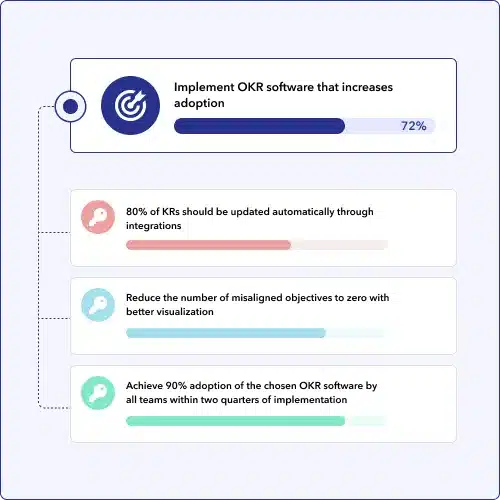
Objective: Implement OKR software that increases adoption
Introduce a user-friendly OKR software solution that simplifies the process of setting, tracking, and managing objectives and key results, leading to increased adoption and engagement throughout the organization.
- 80% of KRs should be updated automatically through integrations
- Reduce the number of misaligned objectives to zero with better visualization
- Reduce the time in preparing for business review to 10 mins
- Achieve 90% adoption of the chosen OKR software by all teams within two quarters of implementation
- Achieve 90% adoption of the chosen OKR software by all teams within two quarters of implementation
Example: 8
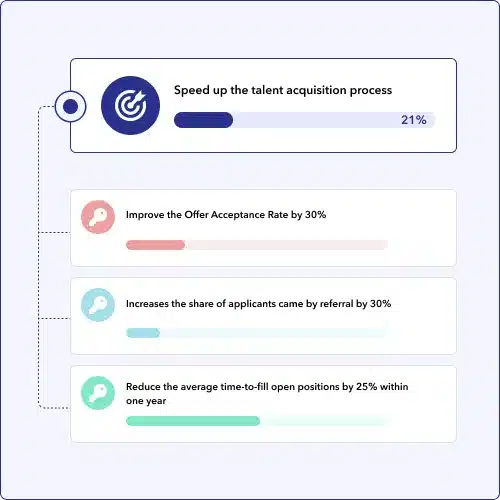
Objective: Speed up the talent acquisition process
Streamline and optimize the talent acquisition process to reduce time-to-fill and ensure the organization attracts and hires high-quality candidates more efficiently.
- Improve the Offer Acceptance Rate by 30%
- Increases the share of applicants came by referral by 30%
- Reduce time to hire by 50%
- Reduce the average time-to-fill open positions by 25% within one year
- Train 100% of hiring managers on best practices for interviewing and candidate evaluation
Example: 9
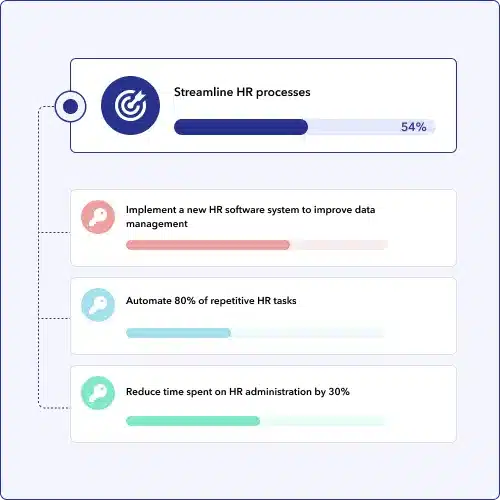
Objective: Streamline HR processes
Improve efficiency and effectiveness of HR processes to better support employees and the business.
- Automate 80% of repetitive HR tasks
- Reduce time spent on HR administration by 30%
- Implement a new HR software system to improve data management
- Standardize HR policies and procedures across all departments
- Train all HR staff in Lean Six Sigma methodologies
Example: 10
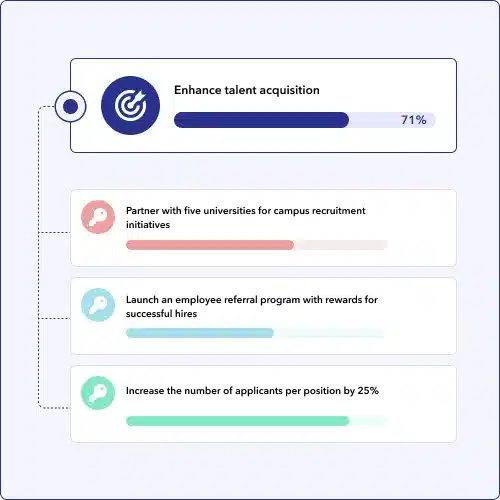
Objective: Enhance talent acquisition
Attract and hire top talent to support the company’s growth and success.
- Reduce average time-to-fill open positions by 20%
- Increase the number of applicants per position by 25%
- Improve offer acceptance rate to 90%
- Improve offer acceptance rate to 90%
- Launch an employee referral program with rewards for successful hires
Peoplebox integrates with your HRIS (Workday, BambooHR, Darwin Box, SAP) and replaces only the performance module.
Request a DemoFrequently Asked Questions
Why are OKRs important for HR teams?
OKRs are important for HR teams because they provide a structured and measurable approach to achieving HR goals that support the organization’s broader business objectives. By setting specific and measurable HR objectives and key results, HR teams can track progress towards achieving their goals and measure their impact on the organization.
How do I write effective HR OKRs?
Effective HR OKRs should be specific, measurable, and aligned with the overall business strategy. HR OKRs should focus on outcomes, such as employee engagement, retention, or talent acquisition, rather than outputs like the number of job postings or resumes received. HR OKRs should be regularly reviewed and updated to reflect changes in business needs and ensure continued relevance.
How many OKRs should I set for my HR team?
The number of OKRs you set for your HR team will depend on the size of your team and the scope of your initiatives. It’s generally recommended to limit the number of objectives to three to five per quarter to ensure focus and clarity.
How do I measure the success of my HR OKRs?
The success of HR OKRs should be measured by the progress made towards achieving key results. This can be done through regular tracking and reporting, as well as employee surveys and feedback. HR OKRs should be reviewed and adjusted as needed to ensure they remain relevant and achievable. By setting and achieving HR OKRs, HR teams can drive meaningful change and make a positive impact on the organization’s overall success.
How do I ensure my HR OKRs are aligned with the overall business strategy?
To ensure HR OKRs are aligned with the overall business strategy, HR teams should engage in regular communication and collaboration with other departments and leadership. This can involve attending cross-functional meetings, seeking input from other departments, and regularly reviewing and updating HR OKRs to ensure alignment with broader business objectives.