





Biswashree Roy


Home / HR Toolkit / Exit Interview Template
● Free HR template · Word, Google Docs, PDF
Exit Interview Template
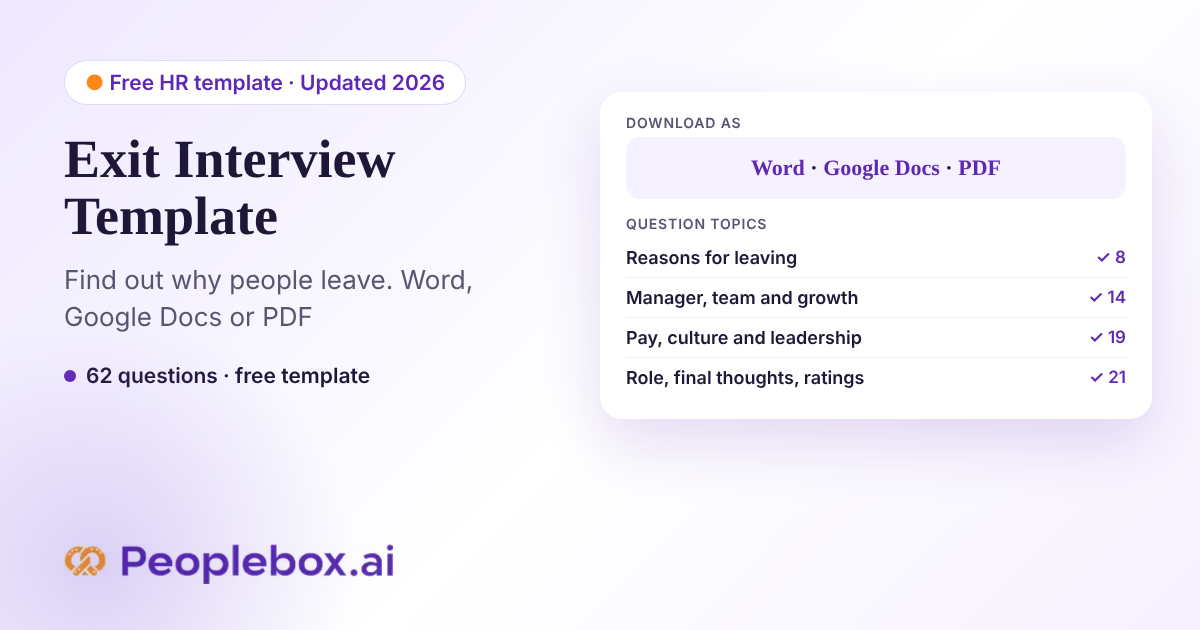
A free exit interview template and form for HR teams. Pick from 62 questions, add the employee details and download it in Word or PDF, or copy it into Google Docs.
- 62 questions across 8 topics, plus a rating scale
- Exit interview form or self-fill exit survey
- Download in Word or PDF, or copy into Google Docs
Build your exit interview
Pick the format and the questions. The form below updates as you go.
Choose questions (15 selected)
Reasons for leaving
The role and day-to-day work
Manager and team
Growth and development
Pay, benefits and recognition
Culture, workload and wellbeing
Company and leadership
Final thoughts
More details (optional)
Settling final dues? Use the free gratuity calculator →
What is an exit interview? An exit interview is a short conversation or survey with an employee who is leaving. HR asks why they are leaving, what worked and what the company could do better, so it can spot patterns behind attrition and fix them before more people leave.
Exit interview form: preview and edit
This is the Exit interview form. Fill in the details and pick questions in the builder above, then edit any text after you download it.
[Company name]
EXIT INTERVIEW FORM
| Employee name | [Employee name] |
|---|---|
| Job title | [Job title] |
| Department | [Department] |
| Manager | [Manager] |
| Last working day | [Last working day] |
| Interviewer | [Interviewer] |
| Interview date | [Interview date] |
Interviewer notes: Thank the employee for their time. Explain that the conversation is confidential, that answers are used to improve the workplace, and that it takes about 30 minutes. Listen more than you talk and do not argue with the feedback.
Primary reason for leaving (tick one or more)
Better pay or benefits Career growth Manager or leadership Work-life balance The role or the work Company culture Relocation Personal or family reasons Further studies Retirement Other
Reasons for leaving
1. What made you start looking for a new job?
Notes:
2. What is the main reason you decided to leave?
Notes:
3. What does your new role offer that you did not have here?
Notes:
4. Is there anything we could have done to keep you?
Notes:
The role and day-to-day work
5. Did the job match the description you were given when you were hired?
Notes:
6. Did you have the tools, training and resources you needed to do your job well?
Notes:
Manager and team
7. How would you describe your relationship with your manager?
Notes:
8. Did your manager give you regular, useful feedback?
Notes:
Growth and development
9. Did you see a clear path to grow your career here?
Notes:
Pay, benefits and recognition
10. Do you feel you were paid fairly for the work you did?
Notes:
Culture, workload and wellbeing
11. How would you describe the company culture to a friend?
Notes:
Company and leadership
12. What is one thing the company should change?
Notes:
Final thoughts
13. Would you recommend this company to a friend looking for a job? Why or why not?
Notes:
14. Would you consider coming back to work here in the future?
Notes:
15. Is there anything else you would like to share?
Notes:
Rate your experience (1 = very poor, 5 = excellent)
| 1 | 2 | 3 | 4 | 5 | |
|---|---|---|---|---|---|
| Overall experience working here | |||||
| Support from your manager | |||||
| Opportunities to learn and grow | |||||
| Fairness of pay and benefits | |||||
| Work-life balance | |||||
| Teamwork and collaboration |
On a scale of 0 to 10, how likely are you to recommend [Company name] as a place to work?
0 1 2 3 4 5 6 7 8 9 10
Sign-off
| Employee signature (optional) | |
|---|---|
| Interviewer signature | |
| Date |
Confidential. Exit feedback is shared with leadership only in summary form, without names, and is never used in references.
Your template is unlocked. Use Download Word, Download PDF or Copy for Google Docs above any time. Want to hear why people leave before they resign?
What is an exit interview?
An exit interview is a short, structured conversation with an employee who is leaving. HR asks why they are leaving and what the company could do better. Done well, exit interviews show the real reasons behind attrition, such as a manager, a lack of growth or pay, and give you time to fix them before more people leave.
You can run it as a live interview or as a self-fill exit survey. This template supports both.
Exit interview formats
Exit interview form
A guide for HR to run a 20 to 30 minute conversation, with notes space under each question.
Use this format →Exit survey
A form the employee fills in on their own, with answer lines, tick boxes and a rating scale.
Open the exit survey template →Exit interview questions
All 62 questions in one list, grouped by topic, with tips on what to ask and what to avoid.
See all 62 questions →What to include in an exit interview form
The template above already covers each section.
| Section | What to include |
|---|---|
| Employee details | Name, job title, department, manager and last working day. |
| Interview details | Interviewer and date, so you can track feedback over time. |
| Confidentiality note | A short line on how the answers will and will not be used. |
| Reason for leaving | A tick box list so you can count reasons across leavers. |
| Open questions | Role, manager, growth, pay, culture and final thoughts. |
| Rating scale | A 1 to 5 scale on a few areas, plus a 0 to 10 recommend question, so answers are easy to compare. |
| Sign-off | Optional employee signature and HR sign-off with the date. |
How to conduct an exit interview
- Ask early and make it optional: Invite the employee once the resignation is accepted, explain why you ask and that it is optional.
- Pick a neutral interviewer: HR or an HR business partner, not the direct manager.
- Choose the format: A live exit interview for depth, or an exit survey for speed and scale.
- Use the same questions every time: A standard set lets you compare answers across teams and months.
- Listen, do not defend: Ask follow-up questions, take notes and do not argue with the feedback.
- Close on a good note: Thank them, explain next steps and leave the door open to return.
- Act on the patterns: Share themes with leaders every quarter, without names, and track what changes.
Sample exit interview questions
The recommended set in the template starts with these. See the full list of exit interview questions.
- What made you start looking for a new job?
- What is the main reason you decided to leave?
- Is there anything we could have done to keep you?
- How would you describe your relationship with your manager?
- Did you see a clear path to grow your career here?
- Would you recommend this company to a friend looking for a job? Why or why not?
- Would you consider coming back to work here in the future?
- Is there anything else you would like to share?
How to use exit interview results
- Count the reasons from the tick boxes every quarter, by team and manager.
- Track the rating scale over time to see if changes are working.
- Look for repeats: the same manager, role or policy named by several leavers.
- Share themes, not names, with leadership, and agree one or two fixes.
- Ask the people who stay with regular engagement surveys, so you hear about problems before the resignation letter.
Tips for honest answers
- Promise confidentiality and keep it: share feedback only in summary form.
- Hold it in a private space or on a video call, not at their desk.
- Start with easy questions about the role before asking about the manager.
- Ask “what would have made you stay?” and wait for the answer.
- Offer a written survey too, since some people are more open in writing.
Hear why people leave before they resign
Peoplebox runs pulse and engagement surveys, 1:1s and reviews in Slack and Microsoft Teams, so you spot attrition risk early. Nova screens and interviews applicants with AI when you hire a replacement.
Related HR guides
- What is talent retention?
Ways to keep good people from leaving.
- Employee attrition
What attrition is, how to measure it and how to bring it down.
- Turnover vs attrition
The difference between the two and why it matters.
- One-on-one meeting questions
Questions managers can ask before an employee thinks about leaving.
Exit interview FAQs
What is an exit interview?
An exit interview is a conversation, or a short survey, with an employee who is leaving the company. HR asks why they are leaving, what worked, what did not and what the company could do better, so it can fix problems before more people leave.
What is the purpose of an exit interview?
To learn the real reasons people leave and spot patterns: a manager, a team, pay, growth or workload. It also ends the relationship on a good note, collects feedback on the role for the next hire and keeps the door open for the person to come back.
Who should conduct the exit interview?
Someone neutral, usually HR or an HR business partner. Avoid the employee’s direct manager, since people are rarely honest about a manager who is sitting across the table.
When should you hold an exit interview?
In the last one or two weeks before the last working day, after the notice is accepted but before the final day rush. Some companies also send a short survey one to three months after the person leaves, when they may feel freer to speak.
How long should an exit interview take?
About 20 to 30 minutes for an interview and 5 to 10 minutes for a survey. The recommended set in this template has 15 questions plus a short rating scale, which fits that time.
Is an exit interview mandatory?
No. In most countries employees can decline an exit interview, and they should be told it is optional. Make it easy to say yes: keep it short, private and confidential.
What is the difference between an exit interview and an exit survey?
An exit interview is a live conversation led by HR, which gives more detail and follow-up questions. An exit survey is a form the employee fills in on their own, which is faster to run at scale and easier to compare. Pick either format in the template, or see the exit survey template.
What should you not ask in an exit interview?
Avoid questions about other employees’ personal lives, the new employer’s confidential details, the person’s health or family plans, and anything that sounds like you are trying to change their mind or argue with their feedback.
Is this exit interview template free?
Yes. You can build and edit the form on this page for free. To download it in Word or PDF, or copy it for Google Docs, you share your name, work email and phone number once. After that, every toolkit download stays unlocked in your browser.
Is the information I type stored?
No. The form is built in your browser and the details you type are not sent anywhere. Only the name, work email and phone number in the download form are shared with Peoplebox.
Get your exit interview template
Share a few details with your work email to download the template. We will also send you useful HR resources.
Work emails only. By continuing you agree to Peoplebox’s Privacy Policy. The details in your form never leave your browser.
✓ Your exit interview form is downloading
See Peoplebox.ai in action
Loading the form…
Trusted by 600+ organizations across 60+ countries
Since we started using Peoplebox.ai, we have been able to bring all of our leadership across the organization together and show them how all of our goals align

Jaclyn HooverSenior Director HR, Propel School