
TL;DR
Structured interviews help you hire faster and more fairly by asking every candidate the same role-relevant questions and scoring them consistently. This removes guesswork, reduces bias, and makes hiring decisions easier to compare and defend especially at scale.
When you are hiring hundreds or thousands of frontline roles, interviews can’t be left to gut feel or casual conversations. You need decisions that are fast, fair, and easy to defend across shifts, locations, and multiple interviewers.
That’s where structured interviews make the difference. By asking the same role specific questions and scoring every candidate against clear criteria, you remove guesswork, reduce bias, and make it far easier to compare candidates at scale. The result isn’t just fairness, it’s better hiring accuracy and fewer costly mistakes.
In this guide, we will walk you step by step through how to run structured interviews in 2026 designed specifically for high volume hiring.
What Is a Structured Interview?
A structured interview is a standardized way to interview candidates where you ask the same role relevant questions, in the same order, and evaluate answers using clear, consistent criteria. Instead of relying on gut feel, you assess candidates based on the skills and behaviors that actually matter for the job.
By keeping interviews consistent and evidence based, structured interviews reduce bias, improve comparability, and lead to more reliable hiring decisions especially when you’re hiring at scale.
Structured vs Semi-Structured vs Unstructured Interviews
Interviews vary in how much structure they apply. Understanding the differences helps you choose the right approach based on hiring volume, consistency needs, and decision risk.
| Aspect | Structured Interviews | Semi-Structured Interviews | Unstructured Interviews |
| Definition | Uses predefined questions asked in the same order to all candidates | Combines a few predefined questions with flexible follow-ups | No predefined questions; conversation flows freely |
| Question Consistency | High – same questions for every candidate | Medium – some consistency, some variation | Low – questions vary by candidate |
| Evaluation Method | Candidates are evaluated using standardized criteria | Partial comparison with some subjective judgment | Highly subjective, based on interviewer impressions |
| Ease of Comparison | Very easy to compare candidates objectively | Moderately easy | Difficult to compare fairly |
| Bias & Fairness | Lowest risk of bias; most fair and consistent | Moderate risk of bias | Highest risk of bias |
| Candidate Experience | Can feel formal or impersonal if poorly designed | Balanced and conversational | Feels natural and personalized |
| Legal Defensibility | Strongest and most defensible | Moderate | Weak |
| Implementation Effort | High – requires design, testing, and interviewer discipline | Medium | Low |
| Best Used When | You need fairness, scale, and repeatability | You want structure with flexibility | You are exploring backgrounds or building rapport |
Why Structured Interviews Work
As hiring scales and more interviewers get involved, consistency starts to break down. Different candidates get different questions, interviewers focus on different signals, and feedback becomes hard to compare. Decisions take longer, and confidence in those decisions quietly drops.
This isn’t a people problem. It’s what happens when interviews rely too heavily on personal style, memory, and instinct. Subtle preferences begin to influence outcomes, often favoring familiarity over true job fit. This “similar-to-me” effect, also known as affinity bias, is one of the most common reasons capable candidates get overlooked.
The cost of this inconsistency adds up fast. A wrong hire doesn’t just impact morale, it affects productivity, delivery, and revenue.
Structured interviews address this by giving you a shared framework for evaluation. They don’t remove human judgment; they make it more reliable. By asking the same job relevant questions and using clear scoring criteria, interviews become easier to compare, fairer to run, and simpler to defend.
With structured interviews:
- Candidates are assessed on the same role specific questions
- Feedback is grounded in consistent, objective criteria
- Interviewers align on skills and performance, not personal chemistry
In 2026, structure isn’t about proving one interview style is better than another. It’s about bringing clarity and consistency to hiring decisions that already carry real consequences.
How Structured Interviews Work in High-Volume Hiring
When hiring volume increases, the challenge isn’t understanding why structure matters, it’s applying it without slowing everything down.
In high-volume hiring, structured interviews work because they move effort away from live conversations and into upfront design. Instead of interviewers deciding questions on the spot, everything is defined in advance.
Here’s what changes when you apply structure at scale:
- Interview design happens once, not per candidate
You define role relevant questions, scoring criteria, and expectations upfront. This removes personal or off topic questions and ensures every candidate is assessed on the same job related factors. - Interviewers spend time evaluating, not interviewing
Your team focuses on reviewing responses and scoring consistently, rather than scheduling and running repetitive first round calls. Decisions are based on evidence, not individual interviewer preference. - Signals become easier to compare
Because candidates answer the same questions under the same conditions, comparisons are clean and fair. There’s no room for subjective judgment based on personality, background, or personal answers. - Speed increases without cutting corners
Structure allows you to move faster because decisions are clearer not because steps are skipped. Bias is reduced, consistency improves, and confidence in outcomes increases.
Structured interviews work best when they are part of a strong candidate screening process that filters for skills and role fit early, before time is wasted on deep interviews.
This approach is especially effective in the first round, where the goal isn’t deep discussion, but filtering for role relevant signals at scale. When structured interviews are designed for volume, they don’t add process, they remove friction.
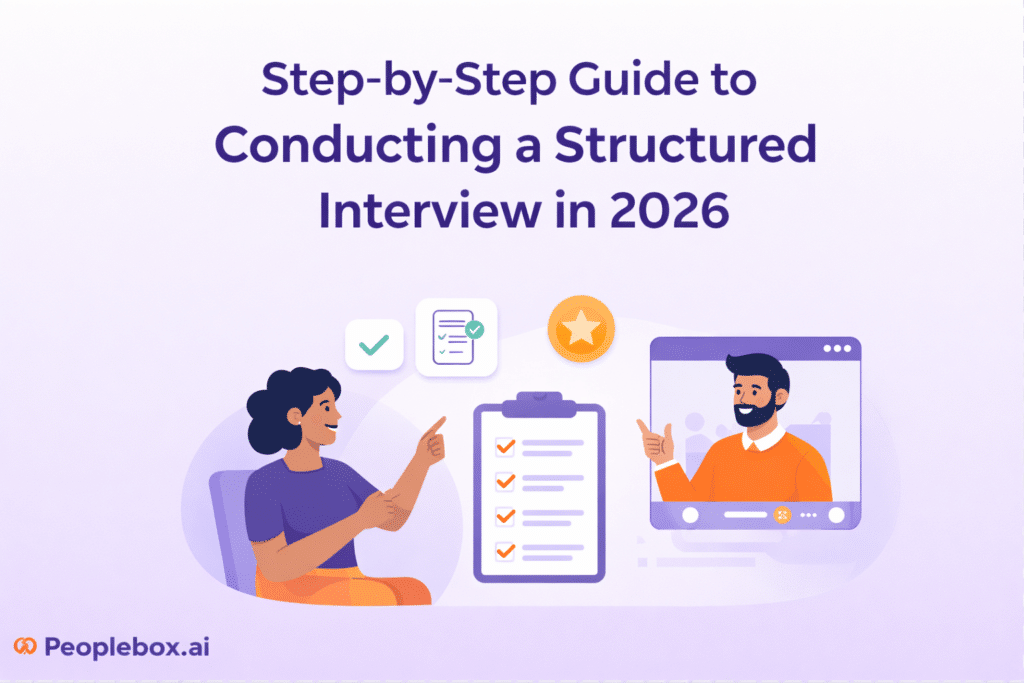
Step-by-Step Guide to Conducting a Structured Interview in 2026
A clear, repeatable way to interview candidates fairly and make confident hiring decisions at scale.
Step 1: Start With the Role, Not the Resume
Before writing any questions, get clear on what success looks like in this role.
Ask yourself:
- What will this person need to do well in the first 6-12 months?
- Which skills are must haves vs. nice to haves?
- What behaviors separate top performers from average ones?
This clarity ensures your interview measures job performance not pedigree or confidence.
Step 2: Define the Competencies You will Evaluate
Once the role is clear, translate it into 4-6 core competencies you want to assess consistently.
Examples:
- Problem solving
- Communication
- Technical depth
- Ownership
- Stakeholder management
Be specific. Instead of “communication,” define what good communication looks like for this role. This will matter later when you score responses.
Step 3: Design Role Relevant Interview Questions
Now build your interview questions around those competencies.
- Use behavioral questions to understand past actions
- Use situational questions to assess judgment and decision making
- Keep questions job related and repeatable
Every candidate should get:
- The same screening questions
- In the same order
- With the same expectations
This is what creates fairness and comparability.
Step 4: Decide How You will Evaluate Answers
A structured interview only works if evaluation is structured too.
Before interviewing:
- Define what a strong, average, and weak answer looks like
- Use a simple scoring scale (e.g., 1-5)
- Align interviewers on what each score means
This removes guesswork and prevents “gut feel” decisions from taking over later.
Step 5: Run the Interview Consistently
When interviews begin, consistency matters more than style.
Make sure you:
- Ask questions exactly as written
- Avoid leading or follow-up questions that are not predefined
- Keep tone and reactions neutral
- Focus on listening, not selling the role
Step 6: Review and Decide Using Evidence
After interviews:
- Review scores and notes side by side
- Compare candidates on competencies not impressions
- Align with other interviewers using the same criteria
This makes hiring decisions clearer, easier to defend, and faster to finalize.
Types of Structured Interview Questions
When you are designing a structured interview, the hardest part isn’t agreeing that structure matters, it’s deciding which questions actually give you signal.
You don’t need dozens of questions. You need the right mix that helps you evaluate candidates consistently, especially when you’re hiring at scale. Below are the most common types of structured interview questions and when you should use each one.
1. Situational Questions
When to use: To understand how a candidate thinks before they have done the job.Situational questions ask candidates how they would handle a hypothetical scenario relevant to the role.
For example:“How would you handle a conflict between two team members?”
You use these questions to evaluate decision making, judgment, and adaptability, especially useful when candidates don’t have direct experience in a similar role.
Best for: Entry level roles, leadership potential, new responsibilities
2. Behavioral Questions
When to use: To predict future performance based on past behavior.Behavioral questions focus on real experiences.
For example:“Tell me about a time you had to overcome a major obstacle at work.”
These questions help you assess how candidates have handled challenges, worked with others, and delivered results using evidence, not assumptions.
Best for: Core competencies, teamwork, ownership, reliability
3. Skills Based Questions
When to use: To validate job critical abilities early.Skills based questions test how candidates approach their actual work.
For example:“How do you typically debug a production issue?”
For technical or role specific positions, these questions help you move beyond resumes and see how candidates think through real tasks.
Best for: Engineering, sales, operations, specialist roles
| Tip: Pair practical questions with explanation based follow ups to understand how they work, not just what they know. |
4. Job Knowledge Questions
When to use: To confirm baseline expertise.These questions check whether a candidate understands core concepts required for the role.
For example:“Can you explain the difference between cash based and accrual accounting?”
You should focus only on knowledge that is essential on day one, not things that can be learned quickly on the job.
Best for: Regulated roles, domain-heavy positions
5. Problem-Solving Questions
When to use: To evaluate thinking under uncertainty.Problem solving questions assess how candidates break down ambiguous situations.
For example:“How would you respond to a sudden drop in sales performance?”
These questions are especially useful when the role requires analysis, prioritization, and trade off decisions.
Best for: Strategy, leadership, operations, growth roles
6. Motivation Questions
When to use: To understand alignment and long term intent.Motivation questions help you learn what drives a candidate.
For example:“What about this role excites you most?”
You are not looking for “right” answers, you’re looking for signals of genuine interest, role fit, and commitment.
Best for: Retention risk, growth roles, career path clarity
7. Organizational Fit Questions
When to use: To assess working style not “culture fit.”These questions focus on how a candidate prefers to work, not whether they “feel like your team.”
For example:“Describe the kind of work environment where you do your best work.”
Use correctly, these questions help you understand alignment without introducing bias.
Best for: Team dynamics, remote or cross functional roles
Common Mistakes That Break Structured Interviews
Even the best structured interview process can fall apart if avoidable mistakes sneak in. When you are hiring at scale, these pitfalls not only reduce fairness and effectiveness, they make it harder to compare candidates and can lead you back to the same problems you were trying to solve.
1. Asking Biased or Irrelevant Questions
If questions are not directly tied to job competencies, you risk evaluating candidates on irrelevant traits. Leading or irrelevant questions introduce personal bias and reduce the value of structured scoring. To be effective, every question should map back to the specific skills or behaviors you are hiring for.
2. Not Following a Consistent Scoring System
Without clear scoring guidelines, evaluations become subjective. Interviewers may rely on gut feel or compare candidates unevenly, which breaks the purpose of a structured interview. Consistent scoring is needed to fairly compare candidates.
3. Failing to Train Interviewers on the Process
Even with well designed questions, inconsistent execution can break the structure. Interviewers need alignment on how to ask questions, how to score responses, and how to avoid unconscious influence during the interview. Training and calibration ensure everyone evaluates fairly.
How Peoplebox.ai Helps You Run Structured Interviews
Watch Nova, our AI interviewer, in action
Peoplebox.ai is built to replace manual resume screening and inconsistent first round interviews with a structured process that works at scale.
You define must-have criteria upfront such as experience level, core skills, and role requirements,so interviews focus only on relevant candidates. Interview questions are mapped directly to the job description, including real challenges candidates will face in the role.
Nova AI then conducts the interview and asks role specific follow up questions about past work, projects, and challenges. This helps validate real-world experience instead of surface level answers.This is where modern AI video interview software plays a key role, helping teams apply structure without adding manual effort or scheduling delays.
Human-Like Interviews, Not Static Video Prompts
Peoplebox.ai’s Nova runs conversational voice and video interviews that feel natural, not robotic. Candidates interact with a human-like AI interviewer instead of recording answers to fixed prompts.
This helps you see how candidates think and communicate, not just how confidently they perform for a camera.
Structured and Bias-Free by Design
With Peoplebox.ai, interviews don’t depend on personal style or individual interviewer preferences.
Every candidate is asked only role relevant questions, in the same order, with no room for personal or off topic questions that can influence decisions.
Because questions are predefined, hiring decisions are based on skills, experience, and job fit not background, personality, or gut feel. This reduces unconscious bias and keeps evaluations fair.
Consistent Evaluation Across Every Candidate
Nova uses structured scoring and the same evaluation criteria for everyone. Scores and notes are captured in one place, making it easy to compare candidates side by side.Decisions are based on evidence, not memory or personal preference.
Built for High-Volume, Early Stage Screening
Peoplebox.ai is purpose built for early stage screening where volume is high and time is limited.
Interviews run asynchronously, so candidates respond on their own schedule and your team reviews when ready. This removes scheduling bottlenecks without breaking structure.
Reliable and Defensible Hiring Decisions
With structured questions, consistent scoring, and integrity checks, Peoplebox.ai helps you make decisions that are easier to explain and defend.You can clearly show why one candidate moved forward and another didn’t.
Designed for Teams Hiring at Scale
Peoplebox.ai scales easily across roles and locations while keeping recruiter effort low. It works especially well for:
- High-volume hiring teams
- TA leaders replacing resume screening and phone screens
- Engineering teams needing realistic technical evaluation
- Companies prioritizing speed, fairness, and candidate experience
| Running structured interviews at scale? Peoplebox.ai helps teams replace resume screening and first-round calls with AI-led, structured interviews that stay fair, consistent, and role-focused even at high volume. 👉 Book a Demo now |
How to Measure If Your Structured Interviews Are Working
It’s not enough to run structured interviews. You need to know if they’re actually improving hiring outcomes. Without measurement, it’s easy to fall back into the same delays, bias, and inconsistent decisions you were trying to fix.
Here’s how to check if your structured interviews are delivering real value:
1. Time-to-Hire and Interview Efficiency
Track how long it takes from when a candidate enters interviews to when they get an offer. If this time goes down, it shows your structured interviews are removing delays.
Also track how many interviews it takes to make one hire. If you’re interviewing too many people for each role, your screening may still be too broad.
2. Quality of Hire
After candidates join, track early performance, manager satisfaction, and retention. If quality improves over time, it means your interviews are selecting the right people, not just confident speakers.
3. Candidate Experience Feedback
Ask candidates if the interview felt clear, fair, and job relevant. If feedback improves, it shows your process is both efficient and respectful, especially important in high-volume hiring.
4. Consistency in Evaluation
Structured interviews should reduce variation between interviewers. Track whether interviewers:
- Ask the same role specific questions
- Complete scorecards fully
- Use the same scoring criteria
More consistency means decisions are based on evidence, not memory or personal style.
5. Fairness and Bias Reduction
Check whether decisions are being made on skills and role fit not personal preference.
You should see:
- Fewer subjective comments in feedback
- Less variation in scores for similar answers
- Clear reasons for why candidates move forward or get rejected
If interview outcomes are easier to explain and defend, your process is working as intended.
6. Downstream Hiring Metrics
Look at results that improve when decisions are fair and consistent:
- Offer acceptance rate (higher is better)
- Candidate drop off rate (lower is better)
- New hires leaving within the first 90-180 days
Conclusion: Structured Interviews Help You Hire Faster, Fairer, and With Confidence
When you are responsible for hiring at scale, interviews can’t depend on who’s asking the questions or how much time they have that day. You need a process that works consistently across locations, shifts, and interviewers without slowing hiring down.
Structured interviews give you that control. They replace instinct with evidence, reduce variation between interviewers, and make it easier to move candidates forward with confidence. Instead of debating opinions after the fact, your teams evaluate the same signals, using the same criteria, every time.
The real value isn’t just fairness. It’s speed, predictability, and fewer costly mistakes. When interviews are designed upfront and executed consistently, decisions become clearer, hiring cycles shorten, and quality improves without adding complexity.
Frequently Asked Questions(FAQs)
What is a structured interview?
A structured interview is an interview where every candidate is asked the same job relevant questions, in the same order, and evaluated using the same scoring criteria. Decisions are based on skills and role fit, not gut feel or personal impressions.
What are the steps in a structured interview process?
A structured interview typically follows these steps:
- Define what success looks like for the role
- Identify 4-6 core skills or competencies to assess
- Create role-specific interview questions
- Decide how answers will be scored
- Ask the same questions to every candidate
- Compare candidates using scores and evidence
This keeps interviews fair, repeatable, and easy to compare.
How is a structured interview scored?
Each answer is scored using predefined criteria, usually on a simple scale (for example, 1-5).Before interviews begin, teams define what a strong, average, and weak answer looks like. This ensures all candidates are evaluated the same way, without relying on memory or personal opinion.
Do structured interviews reduce bias?
Yes. Structured interviews reduce bias by:
- Removing personal or off topic questions
- Asking every candidate the same questions
- Using clear scoring instead of gut feel
- Focusing decisions on skills and job requirements
Because interviewers don’t decide questions on the spot, personal preferences have less influence.
What are common structured interview questions?
common structured interview questions include:
- Behavioral questions (past work and experiences)
- Situational questions (how a candidate would handle real job scenarios)
- Skills based questions (how they approach role-specific tasks)
- Problem solving questions (how they think through challenges)
All questions are tied directly to the role and asked consistently across candidates.