
The first round is where things slow down. Interview calendars fill up, interviewers keep asking the same screening questions, and candidates wait days just to get a basic conversation. By the time you’re ready to move, some of the best candidates are already gone.
The numbers reflect this. Glassdoor puts the average time-to-hire at 23.8 days, and for high-demand roles, it’s often longer. A big part of that delay comes from how first-round interviews are handled today, live scheduling, limited interviewer availability, and one-to-one calls that don’t scale.
The issue isn’t candidate volume. It’s the time and coordination required to run early interviews in real time. Every screening call pulls interviewers away from their work and slows the funnel at the stage where speed matters most.
That’s why teams are changing how they run the first round. 43% of companies are already using or planning to adopt AI-powered interview tools. One-way video interviews let you move first-round screening off the calendar. You ask the questions once, candidates respond on their own time, and your team reviews interviews when it actually fits into the day.
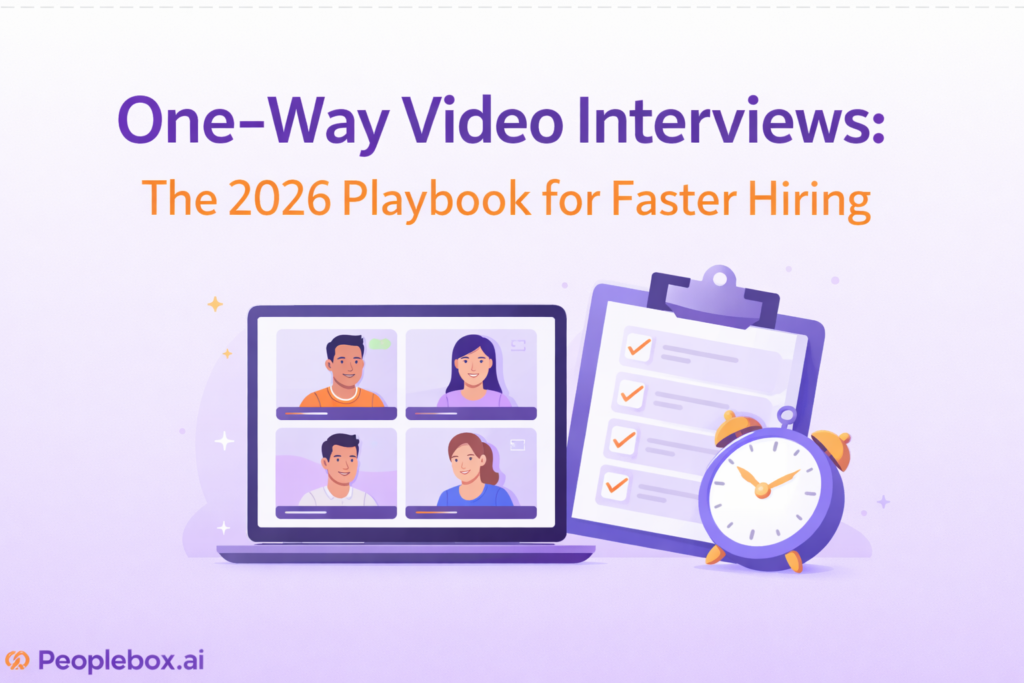
In this blog we will discuss how one-way video interviews are transforming the hiring process, making it faster, more efficient, and perfect for the fast-paced demands of 2026.
What Is a One-Way Video Interview and How Does It Work?
A one-way video interview lets you screen candidates without coordinating live interview schedules. Instead of hopping on repetitive first-round calls, you share a fixed set of interview questions upfront, and candidates record their responses on video within a defined time limit at a time that works for them.
Once candidates submit their responses, you can review them asynchronously, from anywhere. This helps you quickly assess communication skills, role fit, and overall potential before moving candidates to the next round. It’s especially useful if you’re hiring at scale or want to speed up early-stage screening without lowering quality.
Because these interviews are asynchronous, neither candidates nor interviewers need to align calendars. As hiring becomes more global and high-volume, this flexibility is one of the main reasons teams are moving away from live first-round screens.
How the Process Works
- You create structured interview questions aligned to the role
- Candidates receive an interview invite and record video responses
- Responses are automatically saved on the platform
- You review, rate, and shortlist candidates with your hiring team
Why You’d Use One-Way Video Interviews
- Screen faster without scheduling delays
- Deliver a consistent candidate experience across roles and regions
- See communication and personality early, not just resumes
- Reduce screening costs by cutting repetitive calls
By removing time and location constraints, one-way video interviews help you move faster while keeping hiring fair and structured. They act as a practical bridge between resume screening and live interviews giving you a stronger signal early in the process without adding operational complexity.
Traditional Interviews vs One-Way Video Interviews: A Quick Comparison
The table below highlights how one-way video interviews compare to traditional live interviews especially in terms of scheduling effort, interview format, and the time your team spends at the first screening stage.
| Aspect | Traditional Live Interview | One-Way Video Interview |
| Scheduling | Requires aligning availability across recruiters, candidates, and interviewers | Asynchronous-no live scheduling required |
| Interview Format | Live, two-way conversation (in person or video call) | Pre-recorded video responses to structured questions |
| Time Spent in First Round | Around 30–60 minutes per candidate | Typically 10–15 minutes to review recorded responses |
What this means for you:
By shifting the first screening round to a one-way video format, you significantly reduce time spent on scheduling and repetitive conversations, freeing your team to focus on deeper evaluations and faster decision-making.
Comparison of Top 5 One-Way Video Interview Software & Platforms (2026)
Below is a practical comparison of widely used one-way video interview platforms, focusing on real hiring needs not just feature lists.
| Platform | Best For | Key Strengths | AI Support | Ideal Company Size |
| HireVue | Enterprise hiring | Structured interviews, strong compliance | Yes | Large enterprises |
| Spark Hire | SMB & mid-market | Easy setup, good UX | Limited | SMB–Mid |
| VidCruiter | Process-heavy teams | Custom workflows, automation | Yes | Mid–Enterprise |
| myInterview | Fast-moving teams | Simple, candidate-friendly | Basic | SMB |
| Willo | Startups | Clean UI, quick deployment | No | Startups–SMB |
Top 5 One-Way Video Interview Software & Platforms
Not all one-way video interview tools are built for the same hiring needs. Some are designed for enterprise-scale hiring, while others work best for startups or remote-first teams. Below is a practical breakdown to help you choose based on your hiring volume, team size, and complexity.
1. HireVue – Advanced AI & Global Hiring at Scale
HireVue is one of the most established enterprise platforms, combining one-way video interviews with AI-driven assessments.
Key Features
- AI-powered interview insights
- One-way and live video interviews
- Game-based assessments
- Advanced analytics and reporting
- Multi-language and global support
- Enterprise security standards
| Pros | Cons |
| Extremely powerful for large-scale hiring | Premium pricing |
| Global-ready platform | Longer onboarding and training |
| Advanced AI and analytics | Best value only at high hiring volumes |
Best Suited For
- Global enterprises
- Fortune 500 companies
- Campus and high-volume hiring programs
2. Spark Hire – Enterprise-Grade Video Interviewing
Spark Hire is a mature video interviewing platform built for organizations that need scalable, secure, and collaborative hiring workflows.
Key Features
- Live and one-way video interviews
- Hiring team collaboration and shared evaluations
- Custom employer branding
- Advanced scheduling tools
- Mobile apps for candidates and recruiters
- Enterprise-level security controls
| Pros | Cons |
| Strong enterprise feature set | Higher cost compared to SMB tools |
| Scales well for high-volume hiring | Setup and onboarding can be complex |
| Detailed reporting and controls | Overkill if your hiring volume is low |
Best Suited For
- Large enterprises
- Corporate TA teams
- Organizations hiring at scale across regions
3. VidCruiter – Best for Structured & Compliance-Driven Hiring
VidCruiter focuses heavily on structured interviews, compliance, and consistency—making it popular in regulated industries.
Key Features
- Structured one-way interviews
- AI-assisted candidate scoring
- Automated scheduling
- Custom workflow builder
- Skills and technical assessments
- Multi-language support
- Compliance tracking
| Pros | Cons |
| Highly customizable workflows | Longer implementation time |
| Strong compliance and audit readiness | Requires training and change management |
| Suitable for complex hiring processes | Not ideal for lean recruiting teams |
Best Suited For
- Mid-to-large enterprises
- Government and healthcare organizations
- Compliance-heavy industries
4. myInterview – Best for Small Businesses & Startups
myInterview offers a simple, accessible way for smaller teams to adopt video screening without heavy setup.
Key Features
- One-way video interviews
- AI-based candidate insights (basic)
- Simple question library
- Team collaboration features
- Mobile-friendly candidate experience
| Pros | Cons |
| Very easy to use | Limited customization |
| Quick to get started | Basic analytics only |
| Budget-friendly for small teams | Not built for complex enterprise workflows |
Best Suited For
- Small businesses
- Startups
- Teams hiring their first few roles
5. Willo – Best for Remote & Distributed Teams
Willo is designed for simplicity and speed, especially for teams hiring remotely across time zones.
Key Features
- One-way interview templates
- Simple recording experience
- Team collaboration
- Interview template library
- Mobile-optimized experience
| Pros | Cons |
| Very clean and intuitive UI | Limited integrations |
| Quick setup and easy onboarding | Minimal analytics |
| Works well for remote hiring | Fewer advanced features |
Best Suited For
- Remote-first companies
- Digital agencies
- Small to mid-sized distributed teams
Best Practices to Get One-Way Video Interviews Right
Using one-way video interviews effectively isn’t just about speed, it’s about how you run them. Poor execution can increase drop-offs, while thoughtful design helps candidates show their true potential.
To get better results:
- Be explicit about the process
Clearly explain what candidates should expect, number of questions, time limits, and next steps. - Reduce pressure wherever possible
Practice questions and clear instructions help candidates focus on answers, not the format. - Ask questions that reveal real skills
Use behavioral and role-specific prompts instead of generic questions to get meaningful signals. - Evaluate consistently
Use a simple scoring rubric so candidates are assessed fairly, not based on camera confidence alone.
When done right, one-way video interviews become a high-signal, low-friction screening step not a barrier for good candidates.
How Peoplebox.ai Nova Fits into Modern One-Way Video Interviewing
Watch Nova, our AI interviewer, in action
One-way video interviews work best when they’re structured, fair, and high-signal. This is where Peoplebox.ai Nova fits naturally.While many tools focus on collecting video responses, Nova goes a step further by running structured, human-like AI interviews that evaluate candidates beyond recorded answers.
Nova is built specifically for early-stage screening, helping you replace manual resume reviews and repetitive first-round calls with human-like, structured AI interviews. Candidates interview asynchronously, while you get a consistent, job-relevant signal fast.
What sets Nova apart is that it behaves more like a strong interviewer than a static video tool. Nova runs conversational voice and video interviews, asks context-aware follow-up questions, and evaluates candidates across resume fit, interview performance, and integrity checks all in one flow.
With Nova, you can:
- Run human-like AI interviews instead of static video prompts
- Get deeper signal through intelligent follow-up questions
- Screen technical candidates with real problem-solving, not auto-graded tests
- Reduce bias with consistent, criteria-based evaluation
- Let candidates interview on their own schedule without slowing hiring
For teams hiring at scale or across roles, Nova becomes the bridge between resumes and live interviews bringing speed, fairness, and clarity to early-stage hiring without increasing recruiter workload.
| Turn one-way video interviews into real hiring signals. Peoplebox.ai Nova runs human-like AI interviews with intelligent follow-up questions so you screen faster without relying on static video prompts or repetitive calls. 👉Book a Demo now |
How to Choose the Right One-Way Video Interview Software
Choosing a one-way video interview platform isn’t about picking the most popular tool, it’s about finding the one that fits how you hire today and how you plan to hire tomorrow. Before evaluating features or pricing, step back and assess what will actually help you reduce time-to-hire, improve screening quality, and scale without friction.
1. Start With Your Hiring Reality
Begin by clarifying the problems you’re trying to solve in your current process.
Ask yourself:
- Where do you lose the most time during early-stage screening?
- How many hours does your team spend each week on first-round interviews?
- Which roles or stages cause the biggest bottlenecks?
- Are you struggling more with volume, quality, or speed?
Also consider scale:
- How many roles are typically open at once?
- How many applications do you receive per role?
- Does your hiring spike seasonally or fluctuate across teams?
The clearer you are here, the easier it is to eliminate tools that don’t fit your reality.
2. Prioritize Candidate Experience (Not Just Recruiter Features)
If the experience feels clumsy, candidates will drop off especially for high-demand roles.
Make sure the platform works well for:
- Mobile-first candidates
- Candidates across different geographies
- Varying levels of technical comfort
Look for a tool that lets you deliver a consistent, simple, and respectful interview experience without long instructions, downloads, or complicated setups.
3. Check How Well It Fits Your Tech Stack
A good tool should slot into your existing workflow not force your team to change how they work.
Evaluate:
- Compatibility with your ATS and HR systems
- Email and calendar integrations
- Ease of setup and rollout
- Training effort required for recruiters and hiring managers
If your team needs heavy IT involvement just to get started, adoption will slow down.
4. Look Beyond the Sticker Price
Don’t evaluate cost in isolation, focus on overall impact.
Consider:
- Implementation and onboarding effort
- Per-user or per-role pricing as hiring scales
- Time saved per hire
- Reduction in repetitive screening calls
The right tool should clearly help you save recruiter time, shorten hiring cycles, and improve throughput, not just add another line item to your budget.
5. Plan for Growth and Change
Even if your hiring needs are simple today, they won’t stay that way.
Ask:
- Will this platform scale if your hiring volume doubles?
- Can it support global hiring or multiple languages?
- Does it offer flexibility for future workflows, analytics, or compliance needs?
Choosing a scalable platform now helps you avoid switching tools later when hiring pressure is even higher.
Conclusion: One-Way Video Interviews Are a Force Multiplier- If Used Right
One-way video interviews aren’t about replacing human judgment, they’re about using it more effectively. When applied at the right stage, they help you screen faster, reduce operational drag, and focus live conversations on candidates who truly deserve deeper evaluation.
The difference between success and failure comes down to how you implement them. Structured questions, consistent evaluation, thoughtful candidate experience, and the right tooling all matter. Without these, speed gains can quickly turn into poor signal and candidate drop-offs.
As hiring volumes increase and timelines tighten, one-way video interviews will continue to play a bigger role in modern recruiting. Used thoughtfully, one-way video interviews become more than a time-saver. They become a scalable, fair, and high-impact hiring advantage.
Frequently Asked Questions(FAQs)
What is a one-way video interview?
A one-way video interview is an asynchronous interview format where candidates record responses to predefined questions without a live interviewer present. Hiring teams review the recordings later, which removes scheduling delays and makes early-stage screening faster and more scalable especially for high-volume roles.
How do I choose the right one-way video interview software?
Start by looking at where your hiring process slows down today. The right tool should fit your hiring volume, be easy for candidates to use, integrate with your existing ATS, and help you evaluate candidates consistently. Focus less on feature checklists and more on whether the platform actually reduces time-to-hire and recruiter workload.
What are the best one-way video interview platforms?
The best platform depends on your hiring needs.
- HireVue works well for large, enterprise-scale hiring.
- Spark Hire and VidCruiter suit structured or process-heavy teams.
- myInterview and Willo are better for small teams and startups.
- Peoplebox.ai Nova stands out for teams that want human-like AI interviews with deeper signals through intelligent follow-up questions.
Can one-way video interviews replace live interviews?
No and they shouldn’t. One-way video interviews work best as an early-stage screening step. They help you identify strong candidates faster, so live interviews can focus on deeper discussions, collaboration, and final decision-making. Used together, they make the overall hiring process more efficient and effective.