





















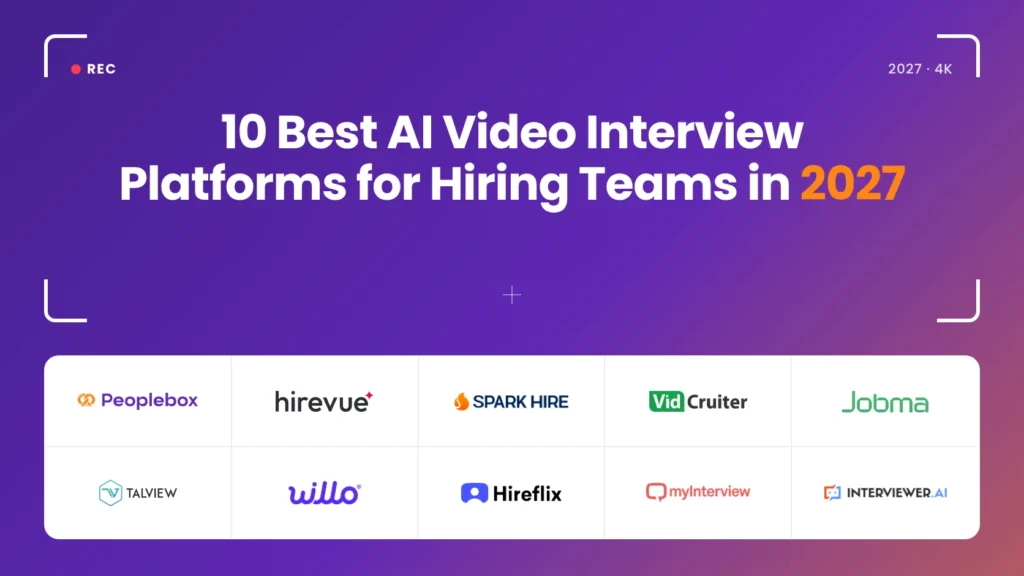

Best AI video interview platforms, by need
- Peoplebox.ai: Best for enterprise teams wanting video or phone AI interviews on 50+ ATSs.
- HireVue: Best for enterprise teams on Workday, SAP or Oracle wanting an AI interviewer plus assessments.
- Spark Hire: Best for lean HR teams on its built-in ATS that want AI to auto-advance one-way candidates.
- Jobma: Best for mid-size staffing agencies on Bullhorn wanting AI interview ratings with multilingual transcripts.
- Hireflix: Best for small teams on Lever or Greenhouse wanting one-way video with an open API.
An AI video interview platform is hiring software in which an AI interviewer asks candidates questions on video, follows up when an answer is thin, and scores each answer against your criteria. Platforms differ in how the AI talks, what it scores, and how much a recruiter can review or override. The best fit depends on your hiring volume and roles. This guide compares 10 platforms, then covers fit, candidates, AI cheating, choosing, and cost.
Quick comparison: AI video interview platforms
This table compares the 10 best AI video interview platforms on who each one suits, how its AI interviews candidates, how it scores answers, public pricing, and G2 rating.
| Tool | Best for | AI runs the interview? | AI scores answers? | Public pricing | G2 rating |
|---|---|---|---|---|---|
| Peoplebox.ai | Enterprise teams wanting video or phone AI interviews on 50+ ATSs | Yes, by video or phone | Yes | From $7/user/mo | 4.5 out of 5 |
| HireVue | Enterprise teams on Workday, SAP or Oracle wanting an AI interviewer plus assessments | Yes | Yes | Contact sales | 4.1 out of 5 |
| Spark Hire | Lean HR teams on its built-in ATS that want AI to auto-advance one-way candidates | No, one-way recording | Yes | From $299/mo | 4.7 out of 5 |
| VidCruiter | Large public-sector and healthcare employers on Workday or UKG needing audit-ready structured interviews | No, live or recorded | Yes, with reasons | From $5,000/yr | 4.8 out of 5 |
| Jobma | Mid-size staffing agencies on Bullhorn wanting AI interview ratings with multilingual transcripts | Yes, with follow-ups | Yes, percentage score | Contact sales | 4.7 out of 5 |
| Talview | Enterprise and campus teams on SuccessFactors needing AI interviews inside a locked secure browser | Yes, voice or video, with follow-ups | Yes, against your criteria | From $25,000/yr | 4.4 out of 5 |
| Willo | Small frontline teams on Workable letting candidates answer by video, audio or text | No, one-way recording | No, people decide | Contact sales | 4.6 out of 5 |
| Hireflix | Small teams on Lever or Greenhouse wanting one-way video with an open API | No, one-way recording | No, people score | From $150/mo | 5.0 out of 5 |
| myInterview (bought by Radancy) | Large employers already on Radancy wanting one-way video screening in the same platform | No, one-way recording | Yes, screening score | N/A | N/A |
| Interviewer.AI | Global volume and agency teams wanting avatar-led AI interviews, connected by API | Yes, avatar-led | Yes, explained | From $10/yr | 4.6 out of 5 |
This evaluation reflects the highest editorial standards. Every tool is reviewed under the same criteria, and no vendor paid for placement or ranking. Read more about the evaluation framework here.
What is an AI video interview platform?
An AI video interview platform is AI video interview software in which an AI interviewer, not a recruiter, runs the first-round interview on video. It asks your structured questions, follows up when an answer is vague, and scores each answer against criteria you set. Recruiters review the scores and recordings, then decide who moves forward.
What types of AI video interview platforms are there?
There are four types, and they differ in who asks the questions and who scores first. Some platforms run a two-way AI interview. Others add AI scoring to recorded answers, assist a human interviewer with notes, or only transcribe. Check which type a vendor sells before you compare prices.
| Type | Who asks | Follow-up questions | Who scores first | Suits |
|---|---|---|---|---|
| AI interviewer, two-way | The AI | Yes | AI, then recruiter | High volume, roles where vague answers hide fit |
| AI-scored recording (also called an automated video interview) | Fixed prompts | No | AI, then recruiter | Steady volume, same questions every time |
| AI assistant for human interviewers | Recruiter or manager | Yes, by the person | Interviewer, with AI notes | Later rounds |
| Transcription only | Fixed prompts | No | Recruiter | Small volumes, simple roles |
How is an AI video interview different from a one-way video interview?
In a one-way video interview, candidates record answers to fixed questions and a person watches later. In an AI video interview, the AI listens during the interview and asks a follow-up when an answer is vague. Some platforms only add AI scoring to one-way recordings, with no follow-ups.
Compare recorded formats in one-way video interview software, or every format in video interview software.
What is changing in AI video interviews?
AI video interviews are moving from recorded one-way questions to live, adaptive conversations by video or voice. Two other shifts matter for buyers: more candidates use AI tools or stand-ins during interviews, and more states and cities now regulate AI in hiring. Ask every vendor how it handles all three.
- Live, adaptive interviews: the AI picks its next question based on the last answer, instead of reading a fixed list.
- Candidate fraud: stand-in candidates, deepfakes, and answers read aloud from an AI tool are now a real screening risk.
- AI hiring rules: Illinois and New York City already set notice, consent, and audit rules for AI in hiring.
How does an AI video interviewer run and score an interview?
AI-driven video interviews follow four steps: the candidate gets a link, the AI asks structured questions on video, it follows up based on each answer, and it writes a scored report. The recruiter sets the questions and scoring criteria before launch and makes the hiring decision after the report arrives.
- Invite: the candidate gets a link by text, email, or the careers page and starts on a phone or laptop.
- Interview: the AI asks the same structured questions of every candidate, on camera, at any hour.
- Follow-up: when an answer is short or vague, the AI asks for an example or a detail.
- Report: each answer gets a score with the reason and the candidate’s words, and the report goes to the ATS.
Does the AI ask follow-up questions, or only fixed ones?
It depends on the platform. A conversational AI interview asks a follow-up when an answer lacks an example, a number, or a clear outcome. AI-scored recordings ask only fixed questions. Follow-ups matter for frontline and customer-facing roles, where a short answer can hide either real experience or none.
Example: A candidate for a warehouse lead role says, “I’m good with teams.” A conversational AI asks, “Tell me about a shift when your team fell behind. What did you change?” A fixed-question tool moves on to the next question, and the recruiter never learns whether the claim holds up.
What does the AI score, and what stays with the recruiter?
The AI scores each answer against your criteria and shows the words behind the score. A good AI interview scoring platform also shows which criteria it used for each answer. The recruiter keeps the decision, the criteria, and every override. Scores do separate candidates: in Peoplebox.ai’s analysis of 50,000+ AI interviews, 41.2% of completed interviews were marked Poor fit (State of AI Interviews 2026).
| The AI handles | The recruiter keeps |
|---|---|
| Asking the same questions of everyone | Writing the questions and the scoring criteria |
| Follow-ups on vague answers | Deciding who moves forward |
| A score per answer with quoted evidence | Overriding any score, with a note |
| A summary and recording in the ATS | Reviewing flags for AI-assisted answers |
Score what the candidate says about the job, not personality read from a face, voice, accent, or background.
Can the AI score both technical and behavioral skills?
Yes for behavioral and role questions, partly for technical skills. An AI interviewer can score how a candidate explains past work, handles a customer scenario, or describes a process. Coding and hands-on skills need a skills test or coding exercise added to the interview, and some platforms include one.
What features should an AI video interview platform have?
An AI video interview platform should run a structured interview, follow up on weak answers, and show the evidence behind every score. It should also work on a phone, sync results to your ATS, flag AI-assisted answers, and let a recruiter override any score.
- Structured questions: the same questions, in the same order, for every candidate in a role.
- Follow-up questions: the AI asks for detail when an answer is vague.
- Evidence behind each score: the candidate’s own words next to every rating.
- Human review and override: a recruiter can change any score and leave a note.
- Audit trail: a record of every score, change, and who made it.
- Mobile first, any hour: candidates interview from a phone at a time they choose. When candidates picked their own slot, 59% chose times outside recruiter hours (State of AI Interviews 2026).
- Accents and more than one language: scoring ignores accent, and interviews run in the languages your applicants speak.
- Two-way ATS sync: scores, recordings, and stage changes write back to your ATS.
- AI-assisted answer and identity checks: flags for tab switching, pasted text, or a mismatched face or voice.
- Analytics, reporting, and branding: reporting on completion, pass rates, and time to first interview by role and location, plus branding you can customize, with your logo and colors on the candidate page.
What are the 10 best AI video interview platforms?
We’ve shortlisted these 10 tools based on their features and limitations. They all have their own strengths and trade-offs when it comes to AI-led video interviews.
Peoplebox.ai
Peoplebox.ai is an AI interviewer for enterprise hiring teams buried in first-round screens. It interviews every applicant for you and hands recruiters a shortlist that’s already scored, so their time goes to candidates who already qualify.
- Interviews every applicant by video or phone, at any hour
- Detects vague answers and contextually follows up
- Scorecard with each answer and feedback, for a recruiter to review and decide
- Results sent to your ATS, with 50+ ATSs supported
- Interviews in multiple languages
- Overkill for teams running under 10 interviews a month
- Score quality depends on how well you write the criteria
- Advanced AI modules may require additional investment beyond base pricing
[Peoplebox.ai] worked as a pull factor. The candidates were so impressed with the bot and the technology that they felt they were joining the right company.
Sumanpreet Bhatia, Chief Operations Officer, Nouveau Labs
HireVue
HireVue is a hiring platform for mid-market and enterprise teams that combines an AI interviewer, video interviews, and assessments. It connects to large HR systems such as Workday, SAP SuccessFactors, Oracle, and iCIMS. HireVue acquired Modern Hire in 2023.
- AI interviewer for first-round screening
- One-way and live video interviews
- Pre-hire assessments alongside interviews
- Cheating and fraud mitigation checks
- One-way interviews may feel impersonal to some candidates
- Video or audio quality could drop on weak connections
- Interview links might fail in some browsers or setups
Spark Hire
Spark Hire is a one-way video interview tool with its own ATS, built for small and midsize teams with lean HR staff. AI scores candidates and can move the top ones to the next stage. It connects to job boards, assessments, and HR systems.
- One-way video interviews candidates record anytime
- AI scoring that auto-advances top candidates
- Built-in ATS with custom hiring workflows
- Interviewer self-scheduling and feedback prompts
- Access permissions may be hard to set per candidate
- Extra interview rounds in one job could feel limited
- Built-in analytics might be too basic for some teams
VidCruiter
VidCruiter is a structured interviewing platform for large employers, including government, healthcare, and contact centers. It runs live and pre-recorded video interviews and scores answers against your rating guide, with a written reason for each score. It connects to Workday, UKG, ADP, Dayforce, SAP, Oracle, and iCIMS.
- Live and pre-recorded structured interviews
- AI scoring with a written reason
- Audit trails for regulated hiring
- Self-scheduling and automated reference checks
- Workflow steps may stop working if one is missed
- Scoring could feel standard and hard to customize
- Sorting selected candidates might take extra manual work
Take a 2-minute tour of an AI video interview
Click through a self-guided tour of how Peoplebox.ai runs a first-round AI video interview, from invite to scored report.
Jobma
Jobma is an AI interviewing platform for enterprises, mid-market teams, and staffing firms. Its AI interviewer asks follow-up questions based on each answer and gives a percentage score recommendation, with multilingual transcripts, and a person makes the final decision. It connects to Bullhorn, Workday, Greenhouse, iCIMS, and other ATSs.
- AI rating recommendations for each interview
- Multilingual transcripts and AI summaries
- AI proctoring and identity verification
- Native Bullhorn and Ceipal connections
- Advanced features may need a higher-priced plan
- ATS integrations could be unreliable for some systems
- Video access might end when your contract expires
Talview
Talview pairs an AI interview agent, Ivy, with remote proctoring and identity checks. Ivy interviews by voice or video, asks follow-up questions in real time, and scores each answer against your criteria for a recruiter to review. It serves enterprise hiring, campus hiring, and certification programs, and connects to Workday, SAP SuccessFactors, Taleo, iCIMS, and Greenhouse.
- Ivy AI interview agent
- Locked secure browser during interviews
- ID match and proxy candidate checks
- Live and AI proctoring options
- Platform may load slowly on weaker internet connections
- Multiple admin layers could make setup feel complex
- Report downloads might need extra manual steps
Willo
Willo is an asynchronous interview tool where candidates answer by video, audio, or text. Its AI transcribes, summarizes, and benchmarks answers, and people make the decisions. It connects natively to Workable, Teamtailor, Bullhorn, Greenhouse, and other ATSs.
- Answers by video, audio, or text
- AI insights with human-led decisions
- Identity and right-to-work checks
- Native ATS links plus Zapier
- Sorting candidates after review may feel rigid
- Reviewing many recorded answers could still take hours
- Candidates might read answers with no built-in check
AI Resume Screening Tool
Paste a job description, add resumes, and get a ranked shortlist with a match score and reasons for each candidate, so only the right applicants get an AI interview invite.
Hireflix
Hireflix is a one-way video interview tool for small and midsize teams. Candidates record answers on their own time, AI writes transcripts and summaries, and recruiters do the scoring. It connects natively to Lever, Greenhouse, Workable, and other ATSs, or by API.
- One-way video interviews candidates take anytime
- AI transcripts and summaries for reviewers
- Open video interview API and webhooks
- Native Lever, Greenhouse, and Workable links
- ATS integrations may be limited or costly to set up
- Shared interview links could expire after a set time
- New users might face a short learning curve
myInterview (bought by Radancy)
myInterview is a one-way video interview tool that Radancy acquired in September 2025. Its screening now sits inside Radancy’s recruiting platform, where AI transcribes recorded answers and adds them to a screening score.
- One-way video with retakes before submitting
- AI transcription feeds the screening score
- Scheduling synced with Outlook and Teams
- Part of Radancy’s recruiting platform
- N/A
Interviewer.AI
Interviewer.AI runs avatar-led AI interviews that ask follow-up questions and explain each score. It serves volume hiring, staffing agencies, and universities. It connects to ATS and admissions systems, or by API.
- Avatar-led conversational AI interviews
- Dynamic follow-up questions
- Explainable score breakdown per candidate
- Custom scoring criteria
- Transcripts may contain errors for non-native English speakers
- The interface could feel less intuitive for some users
- Some candidates might skip video interviews and drop out
How did we evaluate AI video interview platforms?
We reviewed every AI video interview platform on the same criteria, using data checked in November 2026. No vendor paid for placement or ranking. Peoplebox.ai makes one of the tools on this list, so every entry, including Peoplebox.ai’s, lists real limitations next to its features. The order is not a score.
Data sources
- Product pages and help docs: read in November 2026 for every tool.
- G2 profiles and recent reviews: ratings and review themes checked in November 2026.
- Public pricing: G2 pricing tabs and vendor pricing pages, with contact-sales tools labeled.
- Independent lists: review-site rankings and AI search answers for this topic.
Selection framework
- AI-led video: the AI asks the questions on video, or scores or summarizes recorded video answers.
- Interview quality: structured questions and follow-ups on vague answers.
- Evidence and control: scores show the reason, and recruiters can override them.
- ATS connection: results reach the ATS without manual copying.
- Candidate access: works on a phone, at any hour, without an app download.
Which AI video interview platform fits your hiring volume and roles?
An AI video interview platform fits when its interview format matches your volume and roles. High-volume hourly hiring needs short mobile interviews, a phone fallback, and fast ATS sync. Salaried and technical roles need deeper follow-ups and role-specific scoring. Staffing agencies need separate question sets for each client.
By monthly interviews: choose software that has these features for your volume.
| Interviews a month | Features to look for |
|---|---|
| Under 500 | Simple setup, published pricing, recruiter review of every report |
| 500 to 1,000 | Follow-up questions, shared question templates by role, ATS write-back |
| 1,000 to 10,000 | Multiple locations and brands in one account, 24/7 interviews, reports by location |
| Over 10,000 | Audit trail, SSO, data retention controls, deep two-way ATS sync |
Which AI video interview platforms fit enterprise and compliance-heavy hiring?
Enterprise and regulated employers need an audit trail of every score, support for bias audits, single sign-on, data retention controls, and deep two-way sync with large HR systems. Check that each score can be explained to a candidate or auditor.
| Tool on this list | Built for |
|---|---|
| Peoplebox.ai | Enterprise teams wanting video or phone AI interviews on 50+ ATSs |
| HireVue | Enterprise teams on Workday, SAP or Oracle wanting an AI interviewer plus assessments |
| VidCruiter | Large public-sector and healthcare employers on Workday or UKG needing audit-ready structured interviews |
| Talview | Enterprise and campus teams on SuccessFactors needing AI interviews inside a locked secure browser |
| myInterview (bought by Radancy) | Large employers already on Radancy wanting one-way video screening in the same platform |
Which AI video interview platforms fit high-volume and frontline hiring?
High-volume and frontline hiring needs interviews candidates can start on a phone at any hour, short question sets, invites and reminders by text, and one account across many locations. A phone or voice option keeps applicants without stable video in the funnel.
| Tool on this list | Built for |
|---|---|
| Willo | Small frontline teams on Workable letting candidates answer by video, audio or text |
| Interviewer.AI | Global volume and agency teams wanting avatar-led AI interviews, connected by API |
Which AI video interview platforms also reach candidates by text?
Text matters for hourly applicants, who often miss email. Look for text invites and reminders, apply by text, and a two-way text chat that answers candidate questions before the video interview.
| Tool on this list | Built for |
|---|---|
| Willo | Small frontline teams on Workable letting candidates answer by video, audio or text |
Which AI video interview platforms fit SMBs and startups?
Small teams need self-serve setup, published pricing, a free trial, and a simple connection to the ATS they already use. A built-in ATS can replace a separate tool when hiring volume is low.
| Tool on this list | Built for |
|---|---|
| Spark Hire | Lean HR teams on its built-in ATS that want AI to auto-advance one-way candidates |
| Hireflix | Small teams on Lever or Greenhouse wanting one-way video with an open API |
| Willo | Small frontline teams on Workable letting candidates answer by video, audio or text |
Which AI video interview platforms fit staffing agencies?
Staffing agencies need separate question sets for each client, bulk invites, sync with Bullhorn or another agency ATS, and reports they can share with clients. Check that client-facing reports carry your brand.
| Tool on this list | Built for |
|---|---|
| Jobma | Mid-size staffing agencies on Bullhorn wanting AI interview ratings with multilingual transcripts |
| Interviewer.AI | Global volume and agency teams wanting avatar-led AI interviews, connected by API |
Which AI video interview platforms fit technical and skill-based roles?
Technical roles need a coding or skills test alongside the interview, deeper follow-up questions, and proctoring or a secure browser so the result reflects the candidate’s own work.
| Tool on this list | Built for |
|---|---|
| Talview | Enterprise and campus teams on SuccessFactors needing AI interviews inside a locked secure browser |
| HireVue | Enterprise teams on Workday, SAP or Oracle wanting an AI interviewer plus assessments |
How do candidates respond to an AI interviewer on video?
Most candidates who start an AI video interview finish it. In Peoplebox.ai’s analysis of 50,000+ AI interviews, 92.9% of candidates who started an AI interview finished and received a score. Completion depends on three things you control: a short interview, a phone-friendly format, and the freedom to start at any hour.
- Keep it under 20 minutes.
- Let candidates retry a question once if their connection drops.
- Offer a phone or voice option.
- Send reminders by text.
97%
of candidates who answered the feedback survey said they accept the AI interview format.
Source: State of AI Interviews 2026, Peoplebox.ai
Do candidates have to be told an AI is interviewing them?
Yes, tell them. Say in the invite that an AI will ask the questions, what it scores, and that a person makes the hiring decision. Illinois’ Artificial Intelligence Video Interview Act requires employers to notify applicants, explain how the AI works, and get consent before AI analyzes a video interview (820 ILCS 42/5).
This is information, not legal advice. For bias audits and other state and city rules, see the compliance section of our video interview software guide and check with counsel.
Do candidates see an AI interview as a red flag?
Some do, when the AI feels like a gate with no person behind it. Candidates trust the process more when the invite names the role, says how long the interview takes, explains that a recruiter reviews every result, and gives a way to ask a person a question.
Invite wording that builds trust (text message example):
Hi Maria, thanks for applying for the shift lead role at our Austin store. Your first interview is a 15-minute AI interview you can take on your phone any time in the next 3 days. An AI asks the questions and scores your answers against the job. A recruiter reviews every result and makes the decision. Reply to this text to reach a person.
What candidate settings should an AI video interview platform offer?
In AI video interviewing, candidates finish more often when the platform works on a phone, gives clear instructions before the first question, allows one retake per question, sets sensible time limits, and offers accessibility options and accommodations on request.
How should you choose an AI video interview platform?
Choose an AI video interview platform by starting with your slowest screening step, then testing the AI yourself as a candidate before you sign. Check that it follows up on vague answers, shows evidence for each score, writes results to your ATS, and lets recruiters override it.
What should you decide before you compare platforms?
Decide three things first: what the AI must do (run the interview, score recordings, or assist your interviewers), how many interviews you run each month, and your budget. These three answers cut most lists down to two or three platforms.
| Problem | What to look for | Question to ask the vendor |
|---|---|---|
| Recruiters spend hours on first-round calls | Conversational AI interview at any hour | Can the AI interview every applicant within 24 hours of applying? |
| Short answers hide real fit | Dynamic follow-up questions | Does the AI ask a follow-up when an answer is vague, and can I see it? |
| Roles need both skills and behavior checked | Technical and behavioral scoring | Can it score both role skills and behavior questions in one interview? |
| Scores feel like a black box | Per-candidate report with quoted answers | Does each score show the candidate’s words that led to it? |
| Applicants speak different languages | Accents and language support | Does it interview in my applicants’ languages and ignore accent in scoring? |
| Results sit outside the ATS | Two-way ATS sync | Do scores and recordings write back to my ATS automatically? |
| Audits need a record | Audit trail | Does it log every score, change, and who made it? |
How do you test an AI interviewer before you buy?
Test an AI interviewer by taking the interview yourself three times: once with a strong answer, once with a vague answer, and once reading an AI-written answer. Compare the scores, follow-ups, and flags. Then have two recruiters score the same recordings and check whether the AI agrees with them.
- Ask for a sandbox with your own role.
- Run one role at 2 or 3 locations for two weeks.
- Track completion, time to first interview, and pass rate.
- Review 20 reports by hand.
- Keep your current process running until the numbers hold.
When is an AI video interview platform the wrong choice?
An AI video interview platform is the wrong choice when you hire fewer than 10 people a month, when a role needs a hands-on skills test more than a conversation, or when your team will not review AI scores. In those cases, a phone screen or a skills assessment works better.
Signs your team is not ready yet:
- No written scoring criteria for the role.
- No one assigned to review AI reports within 48 hours.
- ATS stages are not set up to receive scores and recordings.
What are the red flags when choosing an AI video interview platform?
Walk away, or ask harder questions, when a vendor shows any of these:
- No quoted evidence behind scores.
- No way for a recruiter to override a score.
- Scores built from face, voice, or accent.
- No way to delete candidate videos on request.
- A demo only on the vendor’s sample role, never yours.
AI Video Interviewer Test-Drive Kit
Test any AI interviewer as a candidate, score vendors on the same criteria, and run a 2-week pilot.
- 6 mock-candidate scripts, with what a good AI should do
- 12 yes-or-no vendor questions with a weighted scorecard
- A candidate notice checklist and a 2-week pilot tracker
Can AI video interview platforms tell when a candidate uses AI?
Some can, but none catches everything. AI video interview platforms spot AI-assisted answers in three ways: follow-up questions a script cannot predict, behavior signals such as tab switching or pasted text, and identity checks that match the face on video to the applicant. Treat every flag as a reason for human review, not a rejection.
| Signal | What it catches | Limit |
|---|---|---|
| Unscripted follow-up questions | Candidates reading prepared or AI-written answers | A fast reader can still keep up |
| Tab switches and pasted text | Looking up answers during the interview | Misses a second device |
| Second voice or face on camera | Someone coaching the candidate | Background noise causes false flags |
| Identity match to the application | A different person taking the interview | Needs candidate consent and good lighting |
| Answer pattern checks | Answers that read like generated text | Fluent writers can trip it |
Do these platforms record the screen or track eye movement?
Most record the camera and audio, and some log tab switches or pasted text; few record the full screen. Eye tracking and facial expression analysis carry bias risk. HireVue stopped using candidates’ facial expressions in its scoring, as reported in January 2021 (Fortune).
Can AI video interview platforms catch deepfakes and stand-in candidates?
Some can. Look for an identity match between the face on video and the application photo or ID, liveness checks that confirm a real person is on camera, and a rule of one face and one voice per session. Treat a mismatch as a reason for a live follow-up call, not an automatic rejection.
How much do AI video interview platforms cost?
AI video interview platform prices differ by tool because of interview volume, recruiter seats, and add-ons such as assessments or extra languages. Budget for the platform fee, per-interview or credit charges, ATS integration, setup time for questions and criteria, and recruiter review time. Compare the tools above on these factors, then choose the one that fits best.
| Pricing model | How it works | Watch for |
|---|---|---|
| Per recruiter seat, monthly | A fee per user each month | Seat count grows with each location |
| Per interview or credit | You pay for each completed interview | Overage rates in busy seasons |
| Annual license | A yearly contract sized by volume | Minimum volumes and setup fees |
| Bundled in an ATS | Video interviews included in an ATS plan | AI follow-ups and scoring may be missing |
What hidden costs come with an AI video interview platform?
The quoted price rarely covers everything. Ask about setup or onboarding fees, overage rates above your plan’s interview limit, charges for extra languages, proctoring or assessment add-ons, and ATS integration fees. Then add recruiter time spent reviewing reports.
Quick cost check: multiply your monthly interviews by the per-interview price, add the monthly platform fee and any setup fee spread over 12 months, then compare that total with the recruiter hours you spend on first-round calls today.
Get hiring insights in your inbox
One email a month with new research, templates, and tools for recruiters and HR teams.
Which AI video interview platform is right for your team?
The best AI video interview platform is the one whose AI interviews the way your roles need. High-volume hourly teams need short mobile interviews, a phone option, and fast ATS sync. Salaried and technical teams need deeper follow-ups, scores backed by quoted answers, and checks for AI-assisted answers.
Start with your slowest screening step and fix that first. Take the AI interview yourself, then run it at 2 or 3 locations before a full rollout. To see how an AI first-round interview works by video or phone, look at Peoplebox.ai.
FAQs
1. Can AI run a video interview on its own?
Yes. An AI interviewer can ask structured questions on video, follow up on vague answers, and score each answer without a recruiter on the call. A person should still review the scores and make the hiring decision. See how AI interview software runs a first round from invite to report.
2. Which AI is best for video interviews?
It depends on your roles and volume. High-volume hourly teams need short mobile interviews and fast ATS sync. Salaried and technical teams need deeper follow-ups and scores backed by evidence. If you also run live or recorded interviews, compare formats in our guide to video interview software.
3. What is an AI-based video interview?
An AI-based video interview is a first-round interview in which AI asks the questions, scores the answers, or both. The candidate takes it on their own time. Some tools score fixed recorded answers, while others hold a two-way conversation. See how one-way video interviews differ from AI-led ones.
4. Can an AI interviewer hire better than a human?
No. An AI interviewer screens; it does not hire. It asks every candidate the same questions and scores them on the same criteria, which makes first rounds more consistent. Recruiters and hiring managers still make the final call, and a well-designed structured interview matters more than the tool.
5. Can AI video interview platforms tell if a candidate is using ChatGPT?
Sometimes. Unscripted follow-up questions, tab-switch and pasted-text logs, and identity checks catch many AI-assisted answers, but no single method catches all of them. Treat every flag as a reason for human review, not an automatic rejection. Compare how other AI interview tools handle candidate fraud.
6. Is there a free AI video interview platform?
Mostly no. Most AI video interview platforms offer a free trial or a few free interviews rather than a permanent free plan. Free tiers usually limit interview volume, AI scoring, or ATS sync. For recorded interviews without AI, compare free plans in our free video interview software section.
7. How much does an AI video interview platform cost?
It varies by tool. Some charge per recruiter seat each month, some per interview or credit, and enterprise tools sell annual licenses through sales. Budget for setup, ATS integration, and recruiter review time as well. Compare pricing models across AI recruiting software before you ask for quotes.
8. Do candidates need to be told an AI is interviewing them?
Yes, tell them. Say in the invite that an AI asks the questions, what it scores, and that a person decides. Illinois requires notice, an explanation, and consent before AI analyzes a video interview, and other rules may apply. Ask counsel, and see how to run video interviews for bulk hiring fairly.
9. How does HireVue work, and is it an AI tool?
Yes, it is. HireVue sells an AI interviewer, video interviews with summaries and scores, assessments, and cheating and fraud checks, for mid-market and enterprise teams. It acquired Modern Hire in 2023. Teams that want simpler pricing or phone-first interviews often compare HireVue alternatives before they buy.
10. Do AI video interviews work for hourly and frontline roles?
Yes, when the interview is short and works on a phone. Hourly applicants often apply from mobile, so an AI interview they can start at any hour, with a phone-call option, fits restaurant, retail, healthcare, and warehouse hiring. See what else to look for in high-volume hiring software.
11. Are video interviews scored by AI?
Sometimes. Many video interview tools only record answers for a recruiter to watch. AI video interview platforms add scoring, and some also ask follow-up questions. Ask each vendor what the AI scores, whether it shows the reason, and who makes the decision. See candidate screening software for other scoring methods.
12. Is AI transcription the same as an AI interviewer?
No. Transcription and summaries turn a recorded answer into text for a recruiter to read. An AI interviewer asks the questions, follows up when an answer is vague, and scores each answer against your criteria. Check which one a vendor sells before you compare prices, and see how recorded one-way interviews work.
13. Do AI video interviews need a bias audit?
In New York City, yes. Local Law 144 requires a bias audit done within the past year, a public summary of the results, and notice to candidates 10 business days before the tool is used. Other places have their own rules. Ask counsel, and read about video interview compliance.
14. Can AI video interviews handle accents and more than one language?
Many can, but check two things. The AI should score what the candidate says, not their accent, and it should interview in the languages your applicants speak. Test it with a non-native English speaker before you buy, especially for call center and healthcare roles. Compare language support in our video interview software comparison first.
15. How long should an AI video interview be?
About 10 to 20 minutes for a first round. That is long enough for 5 to 8 structured questions plus follow-ups, and short enough for an hourly applicant to finish on a phone during a break. Longer interviews suit salaried roles. Plan the questions with a structured interview guide.
16. How long are AI video interview recordings kept, and can candidates ask for deletion?
It depends on the vendor and the law. Ask where recordings are stored, who can view them, and how long they are kept. In Illinois, employers must delete an applicant’s video within 30 days of a request (820 ILCS 42/15). See our bulk hiring video interview guide.
