

















Biswashree Roy

BLOG / Performance Management
Performance Management Systems : Definition, Components, Types & Examples
August 13, 2026
Expert Reviewed


TL;DR
- A Performance Management System (PMS) is a structured framework for setting goals, tracking progress, and providing continuous feedback to align individual performance with business objectives.
- Modern PMS platforms improve productivity, strengthen employee engagement, and streamline performance tracking with automated and real-time insights.
- Successful implementation requires clear objectives, leadership buy-in, comprehensive training, and a phased rollout that demonstrates quick wins before full-scale adoption.
- Leading companies like Google, Adobe, and Microsoft use different PMS approaches (OKRs, One-on-One meetings, 360-degree feedback, growth mindset) tailored to their unique cultures and goals.
- Choosing the right performance management system is like searching for your soulmate on a dating app. When you find “the one,” it’s magic. But getting there can be tricky.
- What makes a system “right”? A good performance management system does more than track how people are doing. It helps everyone reach their full potential by turning feedback into real improvement.
- When teams stay aligned, engaged, and growing because of the system, your workplace becomes a hub for innovation. Success builds on itself naturally.
- This is why today’s performance systems have moved beyond old yearly reviews. Modern systems work as smart talent management centers. They track progress in real-time, give actionable insights, and integrate smoothly with other HR tools.
- According to research by Gallup, only 14% of employees strongly agree their performance reviews inspire them to improve. This highlights the urgent need for better systems. Meanwhile, companies using structured performance management software see up to 44% better retention rates for top talent.
- Ready to make excellence a regular thing in your workplace? It’s time to commit to better performance and stick with it.
What Is a Performance Management System?
A performance management system (PMS) is a structured framework through which an organization sets expectations, monitors progress, develops capability, and evaluates the contribution of its people. It connects individual effort to business outcomes.
That last part is critical. A performance management system is not a review process. It is not a once-a-year conversation. And it is definitely not a form.
The distinction that matters: A performance review is a point-in-time event. Performance management systems are the ongoing operating mechanisms that make the event meaningful or make it redundant.
Three Things That Define a Modern PMS
- It’s continuous: Goals and feedback are revisited every week or month, not once a year.
- It’s two-directional. Employees have as much visibility into the process as managers do, rather than receiving a rating passed down to them.
- It’s connected to the rest of the business. Individual goals trace back to team and company objectives, and the data feeds decisions on staffing, promotion, and compensation.
The Three Things a PMS Must Do
For a performance management system to generate business value, it needs to accomplish three things:
- Align individual goals to organizational strategy: so every person understands how their work connects to what the business is trying to achieve
- Create a continuous feedback loop: so performance issues are addressed in real time, not 12 months after the fact
- Generate actionable data: so leaders can make informed decisions about talent development, succession, and investment
How a Performance Management System Works
Most platforms, regardless of vendor, run on the same underlying cycle. Understanding this workflow matters more than memorizing any single vendor’s terminology, because it’s what you’re actually evaluating when you compare software.
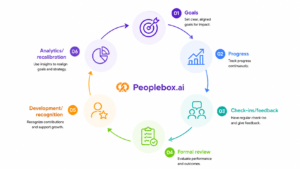
Step 1: Goals are set and cascaded
Company objectives are set at the top, then broken into team and individual goals via OKRs, SMART goals, or an MBO-style agreement. The system should show, in one view, how an individual’s goal ladders up to a team goal and a company goal.
Step 2: Progress is logged in near real time
Employees update their goal status themselves, typically weekly or biweekly, rather than a manager updating it later. This is the step that most differentiates modern platforms from spreadsheets. Status updates happen continuously, not retroactively before a review.
Step 3: Feedback and check-ins happen on a cycle
Structured 1:1s, peer feedback, and manager notes are accumulated throughout the period rather than reconstructed from memory at review time.
Step 4: Formal reviews aggregate the ongoing record
Because feedback and goal data were captured continuously, the quarterly or annual review becomes a summary of a documented period rather than a single point-in-time judgment. This is also where 360-degree input, calibration across managers, and ratings (if used) get applied.
Step 5: Development plans and recognition close the loop
Skill gaps identified during review feed into a development or learning plan. Achievements get logged as recognition, which the next goal-setting cycle then builds on.
Step 6: Analytics inform the next cycle
Leadership reviews aggregate data, including goal completion rates, engagement trends, and flight-risk signals, to adjust the process itself before the cycle repeats.
The cycle typically repeats quarterly for goals and continuously for feedback, with formal reviews landing semi-annually or annually depending on the organization.
Key Components of a PMS
| Component | What It Does | Why It Matters |
| Goal setting & planning | Establishes measurable objectives (OKRs, SMART goals, MBOs) tied to business priorities | Gives employees direction and a basis for later evaluation |
| Performance monitoring | Tracks progress in real time and flags roadblocks early | Enables correction mid-cycle instead of waiting for a year-end surprise |
| Feedback & communication | Structured 1:1s, peer feedback, manager notes | Builds trust and gives employees a running account of where they stand |
| Employee development | Identifies skill gaps, recommends training, plans career paths | Turns evaluation into growth rather than just a scorecard |
| Performance review & rating | Formal assessment against goals and competencies | Creates a documented, often compensation-linked record |
| Recognition & rewards | Acknowledges achievement, sometimes tied to incentives | Reinforces the behaviors the system is meant to encourage |
No single component makes a PMS effective. The value comes from how tightly they’re linked. A system with strong goal-setting but no feedback loop just produces well-documented objectives nobody revisits.
Types of Performance Management Systems
| Type | Core Mechanic | Best Fit |
| Traditional annual review | Manager rates employee once or twice a year against set objectives | Stable, low-change environments; compensation cycles tied to a single event |
| Continuous performance management | Ongoing check-ins, real-time tracking, frequent lightweight feedback | Fast-moving teams, tech companies, remote/hybrid workforces |
| 360-degree feedback | Input gathered from managers, peers, direct reports, and sometimes clients | Leadership development, roles with heavy cross-functional collaboration |
| Management by Objectives (MBO) | Manager and employee jointly set specific objectives at the start of the period | Results-driven, output-measurable roles (sales, operations) |
| OKR-based management | Objectives plus measurable Key Results, often shared across teams | High-growth companies and startups want stretch goals and transparency |
| Development-focused platforms | Prioritizes competency gaps, mentorship, and career pathing over ratings | Organizations optimizing for internal mobility and retention |
| Competency-based management | Evaluates how work gets done against defined behavioral/technical competencies | Regulated or professional-services environments (healthcare, finance, consulting) |
Most mature organizations don’t pick exactly one. They run a base framework, often OKRs or continuous check-ins, supplemented by periodic 360 input and a competency layer for people-manager roles. Most organizations treat performance management as an HR obligation. Annual reviews, rating scales, a folder of completed forms. The data says this is an expensive mistake.
McKinsey research finds that companies prioritizing performance management are 4.2 times more likely to outperform their peers, with 30% higher revenue growth and a 5-percentage-point lower attrition rate. That is not an HR outcome. That is a P&L outcome.
The real cost of inaction:
Replacing a skilled employee costs 150-200% of their annual salary, according to SHRM. For a business with 50 people and average salaries of $100,000, a 10% annual turnover rate carries a replacement cost of $750,000 to $1 million per year. A well-implemented performance management system directly attacks that number.
PMS vs. Performance Appraisal vs. Performance Review
These three terms get used almost interchangeably, which causes real confusion when evaluating software or explaining the process to employees.
Performance Management System vs. Performance Appraisal
| Performance Management System | Performance Appraisal | |
| Scope | Ongoing process spanning goal-setting, feedback, development, and review | A single evaluation event within that process |
| Frequency | Continuous (weekly/monthly touchpoints) | Typically, once or twice a year |
| Purpose | Improve performance and develop people over time | Judge and document past performance |
| Output | Goals, feedback records, development plans, ratings | A rating or written assessment |
An appraisal is one artifact a PMS produces, not the system itself. Organizations that treat the appraisal as the whole system tend to end up with exactly the annual-review fatigue this category was built to fix.
Performance Management System vs. Performance Review
| Performance Management System | Performance Review | |
| Nature | The framework and platform | A specific meeting/document within that framework |
| Timing | Always running | Occurs at defined intervals (quarterly, annually) |
| Data source | Aggregates check-ins, feedback, and goal data over time | Draws on the PMS’s accumulated data to produce a summary |
In short, the review is a snapshot. The system is the camera that’s been running the whole time.
Traditional PMS vs. Modern PMS
| Dimension | Traditional PMS | Modern PMS |
| Cadence | Annual or semi-annual | Continuous, real-time |
| Feedback direction | Top-down | Multi-directional (peer, manager, self, sometimes client) |
| Goal visibility | Often private, siloed by manager | Transparent, cascaded across teams (especially with OKRs) |
| Data use | Backward-looking, used mainly for compensation | Forward-looking feeds coaching and predictive analytics |
| Technology | Spreadsheets, static forms, HRIS add-ons | Purpose-built platforms with dashboards, integrations, and increasingly AI-assisted drafting |
| Employee experience | Anxiety-inducing “performance review season” | Ongoing, lower-stakes conversations |
Framework Comparison: OKRs vs. SMART Goals vs. MBOs
| Framework | Structure | Strength | Watch out |
| OKRs | 1 Objective + 3 to 5 measurable Key Results | Drives ambitious, transparent, company-wide alignment | Can feel abstract for individual contributors if not translated into daily tasks |
| SMART goals | Specific, Measurable, Achievable, Relevant, Time-bound | Easy to understand and apply at the individual level | Can encourage safe, incremental targets rather than stretch goals |
| MBOs | The manager and employee jointly negotiate objectives | Strong buy-in since goals are co-created | Less standardized across teams, harder to roll up into company-wide reporting |
Why It Matters: Benefits and ROI
The business case for a PMS isn’t abstract. It shows up in retention, productivity, and financial performance data.
Retention
Organizations with consistent, structured feedback systems report lower turnover than those without one.
- Gallup has linked strengths-based feedback to roughly a 15% lower turnover rate.
- Recognition programs have been associated with turnover reductions of 25-30% in industry benchmarking studies.
- Replacing an employee typically costs half to twice their annual salary in hiring and ramp-up time, so even modest retention gains compound quickly.
Productivity
Regular feedback cycles have been associated with productivity gains in the range of 14 to 21% in benchmarking research. Employees spend less time guessing what “good” looks like and more time acting on clear, current input.
Engagement
Gallup’s 2026 State of the Global Workplace found global engagement at 20%, the lowest since 2020, with a widening gap between manager and individual-contributor engagement.
The same report notes that “best-practice organizations” (those with structured, well-run people-management processes) have manager engagement rates around 79%, nearly four times the global average (Gallup, 2026). That gap is a reasonable proxy for the value of a well-run PMS.
Financial Performance
Companies that prioritize structured performance management have been found to be several times more likely to outperform industry peers financially. Employees with clearly defined expectations also report substantially higher engagement than those without (Sci-Tech Today, 2025).
A simple way to frame the math internally
ROI (%) = [(Gain from Investment – Cost of Investment) / Cost of Investment] × 100
Example: 500 employees each generate $100,000 in annual value. A continuous-feedback rollout lifts productivity by up to 5% (conservative compared with the 14 to 21% range cited above). That’s $2.5M in additional value against a software cost that, per the software evaluation checklist, typically runs $50 to $150 per employee per year.
The math tends to favor the system even under conservative assumptions. The harder part is execution, covered in Sections 10 and 11.
Real-World Examples
Google: OKRs
Google assigns roughly four to six Objectives and Key Results per employee each quarter. Notably, it makes most OKRs visible company-wide rather than keeping them private between manager and employee.
- An individual contributor can trace their quarterly goals directly to a company-level objective.
- This is the alignment benefit that OKRs are specifically designed to produce.
Adobe: Check-In
Adobe eliminated annual performance reviews in 2012 in favor of “Check-In”: lightweight, manager-led conversations about expectations, feedback, and growth, held on an ongoing basis rather than once a year.
- Within two years, Adobe reported roughly a 30% drop in voluntary attrition.
- The company attributed part of that drop to stronger manager-employee relationships under the new model (PerformYard).
Deloitte: Performance Snapshot
Rather than rating employees on past behavior, Deloitte’s team leads answer a small set of forward-looking questions about each team member (essentially: would I promote this person, pay them more, or want them on my team again).
- Those answers feed succession planning and development decisions.
- Deloitte found that this forward-looking approach reduced rater bias and significantly shortened the review cycle.
GE: PD@GE
GE moved away from its famous forced-ranking system to “Performance Development at GE,” built around a mobile app that facilitates frequent, informal check-ins (voice or text) between managers and employees.
- Even organizations with deeply entrenched, decades-old ranking cultures can move to continuous models with the right tooling and change management.
Microsoft: Growth mindset
Microsoft retired stack ranking in favor of a system built around Carol Dweck’s growth-mindset framework, explicitly rewarding collaboration and learning rather than only individual output.
- The company has pointed to improved cross-team collaboration as a direct result of removing forced-curve ratings.
- Forced-curve ratings previously incentivized employees to withhold help from peers competing for the same rating slots.
Netflix: Context, not control
Netflix’s stated philosophy is to give employees clear context about goals and constraints, then trust them to make decisions without heavy process overhead.
- Performance is judged on outcomes and contribution rather than adherence to a rigid review cycle.
- This model works well for senior, autonomous teams but doesn’t translate cleanly to large, less experienced workforces without significant adaptation.
The pattern across all six: none adopted a system wholesale from a vendor’s playbook. Each adapted a general framework (OKRs, continuous feedback, forward-looking review, competency-based development) to their existing culture rather than forcing culture to fit the software.
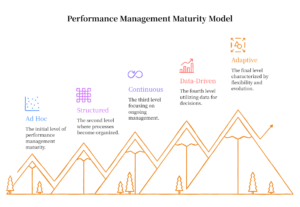
The Performance Management Maturity Model
Use this model to diagnose your current state before choosing software. It will change what you should prioritize in a vendor.
| Level | Name | Characteristics | Primary Risk |
| 1 | Ad Hoc | No formal cadence; feedback happens only during conflict or the annual review; goals live in individual heads or scattered documents | Reviews feel arbitrary; no defensible record for promotion/compensation decisions |
| 2 | Structured / Compliance-Driven | Formal annual or semi-annual review exists; goals are documented but rarely revisited between cycles | Process exists but is seen as bureaucratic box-checking rather than useful |
| 3 | Continuous / Feedback-Oriented | Regular 1:1s and check-ins; goals tracked in a shared system; feedback happens in the flow of work | Volume of data can outpace the org’s ability to act on it (see Section 11) |
| 4 | Data-Driven / Predictive | Dashboards surface engagement and flight-risk trends; ratings are calibrated across managers to reduce bias; goal data informs workforce planning | Requires genuine manager training; data without coaching skill just produces better-documented bad conversations |
| 5 | Adaptive / Growth-Integrated | Performance management is inseparable from how the company operates day to day; AI-assisted drafting and coaching nudges are standard; goals recalibrate dynamically as priorities shift | Requires sustained leadership commitment; this level is easy to slip backward from if ownership lapses |
How to use this:
Most organizations buying their first real PMS software are moving from Level 1 or 2 to Level 3.
Trying to buy Level 4 to 5 tooling (heavy predictive analytics, AI coaching) before the organization has established basic check-in habits usually means the advanced features go unused.
Match the software to your actual maturity level, not your aspirational one.
The Technology Layer: Where Your System Actually Runs
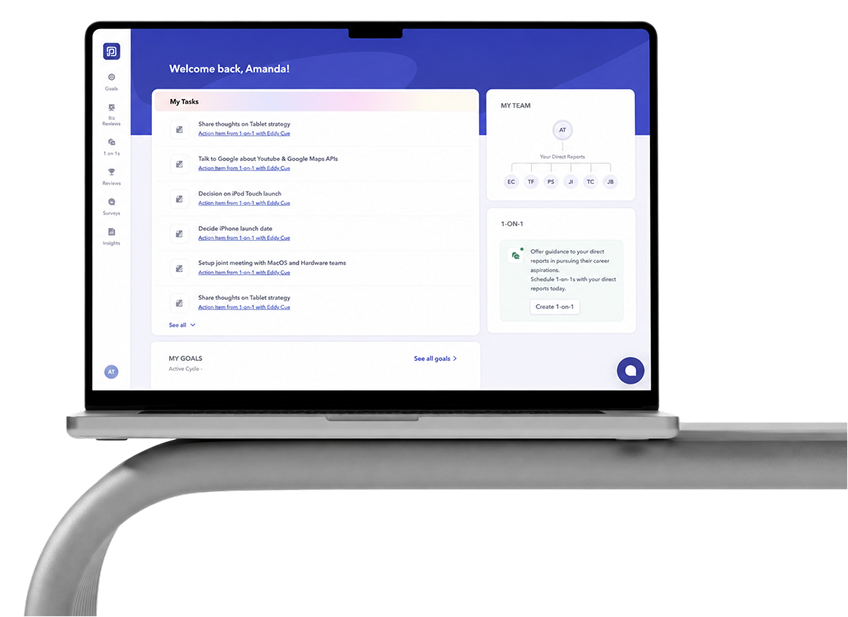
Instead of being spread over various tools that nobody will update, a platform keeps all of the objectives, reviews, comments, and 1:1s in one location. From goal setting and continuous feedback to performance reviews and analytics, performance management software brings the performance cycle into one system.
The best platforms interface with HRIS and offer a presence in Slack or Teams so that managers don’t need to open another tab; the poorest ones subtly undermine the process itself. The best platforms keep all of OKRs, review cycles, engagement pulses, and 1:1s in one system. After six months, there are no more check-ins, 40% of reviews are finished, and HR is once again pursuing individuals via email.
When assessing, two aspects are crucial: does it align with the system you’ve created (not the reverse), and does it decrease the workload for managers instead of increasing it? For a side-by-side comparison of the top tools in 2026, pricing, best-fit use cases, and where each one falls short, head to our → best performance management tools of 2026

Ready to Build a High-Performing Team?
Stop relying on annual reviews. Align goals, automate performance reviews, run 360° feedback, and give continuous feedback: all from one AI-powered platform.
Common Mistakes (and How to Avoid Them)
Buying software before fixing the process
A platform can’t fix a culture that doesn’t value feedback. Diagnose your maturity level (Section 8) before shopping.
Rolling out every module at once
Overwhelmed managers default to doing the minimum. Launch with goal-setting and check-ins, then add 360 feedback, calibration, and analytics in later phases.
Skipping manager training on feedback itself
Software adoption doesn’t fix a manager who’s never learned to give constructive feedback. Train the skill, not just the tool.
Letting data pile up without a review cadence
Dashboards nobody looks at are worse than no dashboard. They create a false sense that the process is “handled.”
No named owner after launch
Without a specific person accountable for quarterly reviews of how the system is being used, configuration drifts, and adoption quietly erodes.
Ignoring integration debt
A PMS that requires manual data entry alongside the HRIS will lose the adoption battle within two quarters.
FAQs
What are the 4 phases of performance management system?
The four phases of a performance management system are planning, monitoring, developing, and reviewing and rewarding, repeating every cycle rather than running once a year. Planning sets goals, monitoring tracks progress, developing closes skill gaps, and review links results to recognition or pay.
What is the difference between performance management and performance appraisal?
Performance management is the continuous process of setting goals, coaching, and developing people; performance appraisal is the periodic evaluation event inside that process. The appraisal produces a rating at one point in time. Performance management is what happens in the months around it.
What is the PMS system in HR?
PMS in HR stands for performance management system: the software and process a company uses to set goals, track progress, give feedback, and run reviews. It differs from an HRIS, which stores employee records, payroll, and benefits. The PMS covers performance; the HRIS covers administration.
What is PMS in KPI?
PMS is not a KPI: a performance management system is the framework where KPIs are set, tracked, and reviewed, while a KPI is a single measure of progress inside it. The confusion is common because both appear in appraisal paperwork. KPIs are the metrics; the PMS acts on them.
What is the best performance management software?
The best performance management software is the one your managers actually use, so weigh ease of adoption, goal alignment, and HRIS integration above feature count. Peoplebox combines OKRs, reviews, 360 feedback, and 1:1s in one platform. Expect $5 to $50 per employee per month.
What are the 5 best tools for performance management?
The five essentials in a performance management stack are goal or OKR tracking, review cycles, 360-degree feedback, one-on-one agendas, and analytics dashboards. Buying them separately creates data silos, so most teams now consolidate into one platform holding a single performance record.
Author

Content Writer & SEO Specialist
Aditi Jain is a Content Writer at Peoplebox.ai, where she creates clear, engaging content on the world of HR, people management, and workplace technology. She brings 6 months of hands-on experience in writing for HR audiences, contributing to articles that simplify complex HR concepts for leaders, managers, and recruiters.
Aditi completed her MBA from Jain University, where she developed a strong foundation in business strategy, employee experience, and modern HR practices. At Peoplebox.ai, she focuses on topics such as performance management, employee engagement, AI in HR, and the future of work, turning research and trends into actionable insights for people teams.
When she’s not writing, Aditi enjoys exploring new ideas in HR tech and finding fresh ways to make content more relatable and impactful for readers.
View profile 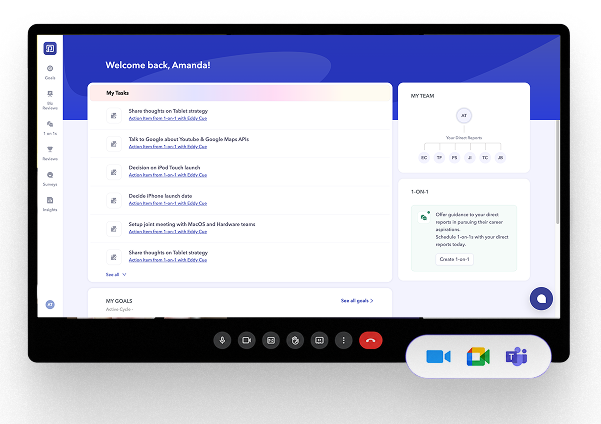
Top Picks




YOU'VE READ THE PLAYBOOK
Now see it running - live, on your org chart
A 30-minute walkthrough of reviews, goals and 1:1s inside Slack & MS Teams. No slides, just the product.
Request a Demo