


















Biswashree Roy

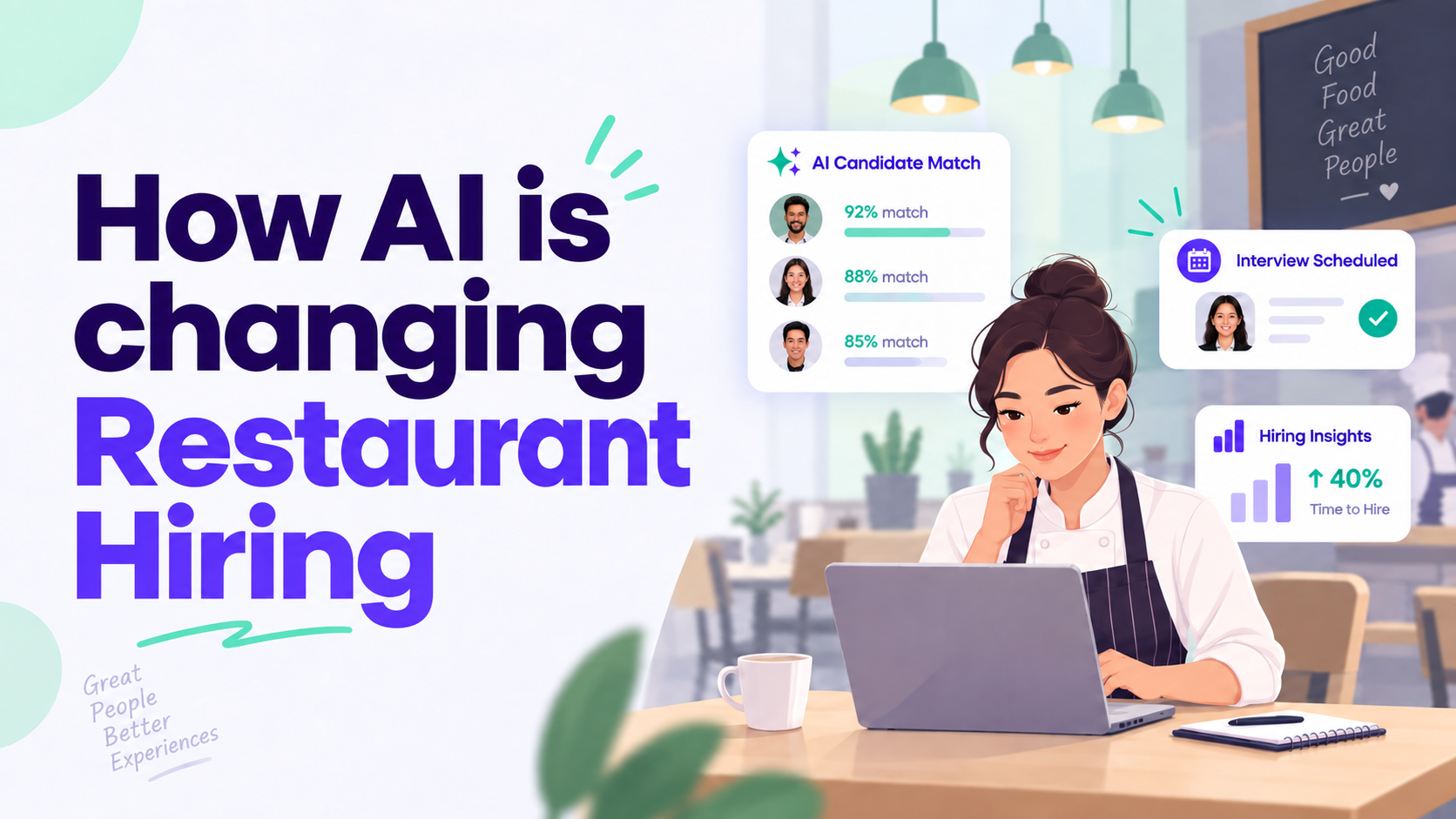


Restaurant hiring has always been hard. But what operators are dealing with in 2026 is different in kind, not just in degree.
Managers are scheduling 15 interviews and getting 3 people to show up. Some locations go weeks without a single application. And when candidates do apply, they’re often already committed to whoever responded first, because that response came 30 minutes after they hit submit, not 5 days later.
The process is broken on both sides. And the standard fixes, posting on more job boards, raising wages, adding a sign-on bonus, don’t address the actual problem: the hiring workflow itself is too slow for the labour market it operates in.
AI is changing that. Not by replacing hiring managers, but by fixing the specific bottlenecks that make restaurant hiring so painful: slow response times, interview no-shows, unscreened application piles, and managers spending 15-20 hours a week on admin instead of running their restaurants.
This piece covers the real problems, what AI is actually doing about them, what the data shows from 10,000 real AI interviews, and what operators at every size need to know before the gap between early adopters and everyone else gets too wide to close.
Key stats at a glance:
- 79.6% average annual restaurant turnover over the past decade (BLS/Toast analysis)
- 33% of operators say recruiting and retention is now their #1 challenge, up from 18% at the start of 2026 (Restaurant365 Mid-Year Report)
- 985,000 open positions in restaurants and accommodations as of October 2025 (BLS JOLTS)
- $2,706 hard cost to replace a single hourly worker; $11,940 for a manager (Black Box Intelligence, 2025)
How AI Is Changing Restaurant Hiring
AI doesn’t solve the restaurant labor shortage. It solves the process problems that make the shortage worse than it needs to be. Here’s where the meaningful change is happening.
Automated Sourcing and Screening: From 6% to 100% Coverage
The most immediate impact is coverage. A manual team processes roughly 6% of inbound applicants. AI-powered screening can engage all of them.
What that looks like in practice: A busy QSR location gets 120 applications on a Monday. The hiring manager has time to call maybe 8 people between shifts.
The other 112 applications sit in an inbox until Wednesday, by which point most of those candidates have already accepted offers elsewhere. With AI screening, all 120 get a structured qualification conversation within minutes of applying.
By Tuesday morning, the manager has a shortlist of 14 pre-qualified candidates – without making a single call.
When a candidate applies, an AI system can respond within minutes (not days), conduct a structured qualification conversation, confirm shift availability, and filter for role-specific criteria.
Automated screening eliminates 78% of unqualified applications before human review, so the candidates who do reach a manager are already pre-qualified.
The time-to-hire impact is significant: AI-powered recruitment platforms reduce hiring cycles from 14-21 days to 2-5 days. For a restaurant that’s been operating short-staffed for three weeks, that’s not a marginal improvement. It’s the difference between staying open for full service or not.
AI Interviewers: First Rounds That Actually Happen
The interview no-show problem has a structural cause: scheduling friction. When a candidate has to wait for a human to find a slot, confirm it by email, and then show up at a specific time, the drop-off rate is high. AI interviewers remove that friction entirely.
AI interview systems conduct structured first-round conversations via phone, video, or chat, available 24/7, with no scheduling required. Candidates complete the interview on their own schedule. The system scores responses against role-specific criteria and delivers a decision-ready report to the hiring manager.
To see how fast this can move in practice: a candidate scans a QR code on a “Now Hiring” poster outside a restaurant, gets an immediate AI-driven screening conversation on their phone, and receives confirmation and next steps within minutes. No email chains. No waiting for a manager to be available.
The entire first-round interaction happens before the candidate has walked to their car.
What Peoplebox NOVA’s data shows from 10,000 real interviews:
Across 10,000 NOVA AI interviews conducted between June 2025 and July 2026, spanning 100+ hiring teams and 124 roles:
- 92.9% of candidates who start an AI interview complete it
- 59% of interviews happen outside standard 9am-7pm hours, with off-hours completion reaching 93.4% (slightly above the 92.1% rate during staffed hours)
- 41.2% of candidates are assessed as Not a Fit, meaning the system discriminates rather than rubber-stamping everyone
- Only 3% of candidates who provided feedback preferred a human interviewer; 97% accepted the AI format or suggested product improvements
- At scale, AI interviewing reduces screening cost from approximately $130,000 to $47,500 per 10,000 screens, avoiding around 4,580 recruiter hours
Candidates don’t just tolerate AI interviews. They complete them at nearly the same rate as human-led interviews, and they do it at 11 pm on a Saturday when no recruiter is available. The capacity constraint that slows restaurant hiring is the human calendar, not candidates’ willingness.
The rejection data is equally important. NOVA’s top rejection drivers are insufficient role-specific depth, unclear communication, and weak evidence of previous work. Not logistics. Not basic keyword matching. The same reasons a good human interviewer would reject someone. That’s what makes the screening credible.
Self-Service Scheduling: Eliminating the Drop-Off Window
For candidates who pass AI screening and need an in-person interview, self-service scheduling is the bridge. Candidates see real-time calendar availability and book a slot themselves, often on the same day or the next day.
Industry data show that the time to schedule interviews has dropped from 9 days to under 4 minutes with AI scheduling tools. That compression directly reduces no-show rates, because candidates who book immediately are far more likely to show up than candidates who confirmed an interview slot four days ago.
Predictive Analytics: Hiring for Retention and Speed
The most sophisticated AI applications go beyond the hiring funnel into workforce intelligence. Predictive analytics tools analyze patterns in historical hiring data to flag which candidate profiles correlate with higher 90-day retention, identify turnover risk before an employee quits, and surface high-potential candidates for management tracks.
What that looks like in practice
A multi-unit operator notices their AI platform flagging a pattern: line cooks hired with fewer than 6 months of continuous tenure at their previous job have a 68% chance of leaving within 60 days. That single insight changes how they screen. They don’t reject those candidates outright – they ask one additional question about why the gap exists. Candidates with a clear reason (relocation, school, family) perform fine. Candidates who can’t explain it are deprioritized. Turnover in that role drops by 22% over two quarters.
This matters because speed and retention are often in tension. Hiring fast is only valuable if the hire sticks. AI tools that optimize for 90-day retention, not just time-to-fill, are solving the right problem.
| AI Application | Problem It Solves | Measurable Impact |
| Automated screening | 6% application coverage | Up to 100% of applicants engaged |
| AI interviewers | Interview no-shows, after-hours gaps | 92.9% completion; 59% outside business hours |
| Self-service scheduling | Calendar friction and drop-off | Scheduling time cut from 9 days to under 4 minutes |
| Predictive analytics | Hiring for speed vs. retention | 15-22% improvement in retention rates |
What AI Hiring Looks Like by Restaurant Size
AI adoption in restaurant hiring isn’t one-size-fits-all. The tools, investment levels, and ROI timelines differ meaningfully by size. Here’s what the data shows and what’s realistic for each segment.
Small Operators (0-20 Locations)
For independents and small groups, the barrier to AI hiring has historically been cost and complexity. That’s changing. Cloud-based platforms now scale appropriately for smaller operators, with SME implementations typically running $200-$500/month focused on core screening and scheduling capabilities.
The ROI case is straightforward: if a small operator replaces 20 hourly workers per year at $5,864 per replacement (Cornell’s full-cost figure), that’s $117,280 in annual turnover cost. A platform costing $300/month ($3,600/year) that reduces turnover by even 20% saves $23,000 net. Most operators achieve positive ROI within 4-6 months.
Current adoption: 22.6% of SMEs have adopted AI-driven staffing solutions. The majority are still running manual processes that lose candidates to faster competitors.
Mid-Market Operators (20-200 Locations)
This is where AI hiring delivers the most obvious operational leverage. Multi-unit operators face the same hiring process at every location, and manual processes don’t scale. Hiring a team for a new location while maintaining staffing at existing ones is nearly impossible without automation.
Mid-market operators typically deploy AI screening, scheduling, and first-round interviewing across all locations, with centralized reporting that gives HR leaders visibility across the portfolio. The NOVA data point that matters here: 59% of AI interviews happen outside business hours. For a multi-unit operator with locations in different time zones, that always-on capacity is the difference between a 3-day and a 3-week time-to-hire.
The compounding talent pool advantage: Every completed AI interview adds a scored candidate to the talent pool. At 600 weekly applicants across a portfolio, a mid-market operator using AI interviewing builds a structured, searchable candidate database of 1,800+ scored profiles by month 3, 4,000+ by month 6, and 7,000+ by month 12. That pool becomes a sourcing asset for new location openings and seasonal surges, reducing dependence on job boards over time.
Large Enterprises and Franchise Groups (200+ Locations)
Large chains are already the most advanced adopters. 58.3% of large restaurant enterprises have deployed AI-driven staffing solutions, with total annual software and services spending ranging from $200,000 to $2.8 million, depending on the number of locations.
Flynn Group is one of the largest restaurant franchise operators in the U.S., running 75,000+ employees across seven brands, including Applebee’s, Panera, and Pizza Hut. With that many locations and that much hiring volume, manual processes weren’t just slow—they were unsustainable.
The problem: Hiring managers across hundreds of locations were each running their own fragmented process. No consistency, no visibility, and no way to move fast enough to compete for candidates who were applying to dozens of jobs at once.
What they did: Implemented a conversational AI hiring system to automate first-round screening, scheduling, and candidate communication across all locations.
The results:
- 90% of the hiring process automated
- 900,000 hours saved annually across the organization
- 21% decrease in time-to-hire
The takeaway: At that scale, a 21% reduction in time-to-hire means thousands of roles filled weeks earlier each year. Managers got their time back. Candidates got faster responses. And the organization stopped losing qualified applicants to competitors who simply moved faster.
The longer smaller operators delay, the harder it becomes to close that gap. Large chains are accumulating AI hiring data, optimizing their screening criteria, and reducing turnover while smaller operators are still relying on manual processes. Every year that gap persists, it becomes harder to close.
The Business Case: Speed, Cost, and Retention
The business case for AI hiring in restaurants isn’t theoretical. Here’s what operators are reporting across the key metrics that matter.
Speed
Time-to-hire is the most immediate and visible improvement. Industry benchmarks show:
- AI-powered platforms reduce hiring cycles from 14-21 days to 2-5 days
- Interview scheduling drops from 9 days to under 4 minutes
- Decision-ready shortlists are available within 24-48 hours of job posting
For context: a restaurant running one cook short for three weeks is absorbing overtime costs, reduced covers, and declining guest experience simultaneously. Cutting time-to-hire from 21 days to 3 days shows up directly on the P&L.
Cost Reduction
According to market data, restaurants deploying AI hiring tools typically achieve:
- 12-18% labor cost reduction in the first year through better staffing optimization
- $18,000-$31,000 annual savings from reduced time-to-hire alone
- $38,000-$92,000 annual savings for full-service establishments from combined scheduling and hiring improvements
- Positive ROI within 4-6 months of deployment
- 3-year cumulative savings of $114,000-$276,000 per location
At 10,000 screens, Peoplebox NOVA’s data shows screening cost dropping from approximately $130,000 to $47,500, a 1.7x return on screening spend, while freeing 4,580 recruiter hours for higher-value work.
Retention
Speed is only valuable if the hire stays. The data on AI-assisted hiring and retention is encouraging:
- AI-assisted hiring improves retention rates by 15-22% in the first year
- Better candidate matching (screening for role-specific depth, not just availability) produces candidates who are more likely to stay past 90 days
- Operators who free managers from hiring admin report that those managers spend more time on onboarding and team development, the activities that actually drive retention
Manager Time
Restaurant managers spending 15-20 hours per week on hiring aren’t running their restaurants. AI hiring tools return that time. Flynn Group reported that managers were able to spend more time with employees and customers after automating 90% of their hiring process. That’s not a soft benefit. Better-managed restaurants have lower turnover, which further reduces the hiring load. Managers who spend less time on hiring paperwork spend more time on the floor, and better-managed restaurants tend to retain staff longer, which reduces the hiring load over time.
What to Watch Out For When Implementing AI Hiring
AI hiring tools deliver real results, but implementation mistakes are common and expensive. Here are the pitfalls that matter most.
Optimizing for Speed at the Expense of Fit
Time-to-hire is the easiest metric to track and the easiest to optimize for. It’s also the wrong primary metric. A hire made in 2 days who leaves in 30 days costs more than a hire made in 7 days who stays for 2 years.
The fix: Set 90-day retention as your primary success metric, not time-to-fill. Configure AI screening criteria around the attributes that predict retention (consistent work history, realistic availability, role-specific knowledge) not just whoever responds fastest.
Bias in Automated Screening
AI screening systems learn from historical hiring data. If that data reflects past biases, favoring candidates from certain zip codes, penalizing non-linear work histories, or over-weighting tenure, the AI will replicate and scale those patterns. This carries real legal exposure under EEOC guidelines.
The fix: Audit your screening criteria before configuring AI tools. Test for disparate impact across demographic groups. Ensure human review remains part of the process for edge cases. The SHRM guidelines on AI in hiring provide a useful framework for compliance.
Generic Outreach That Kills Conversion
Automated candidate outreach that reads like a form letter destroys the candidate experience AI is supposed to improve. Candidates who receive generic messages drop off at higher rates than candidates who receive no message at all.
The fix: Personalize outreach by role type, include the actual pay range, actual shift hours, and actual start date. Messages under 100 words with specific details convert significantly better than template language. The goal is to feel responsive, not robotic.
Treating AI as a Set-and-Forget System
AI hiring tools require ongoing calibration. Screening criteria that work well for line cooks may not work for shift supervisors. Rejection patterns should be reviewed regularly to catch unintended bias or criteria drift.
The fix: Review your AI screening outcomes monthly for the first six months. Check the distribution of outcomes across demographic groups. Adjust criteria based on which hires are actually staying past 90 days.
Skipping Staff Training
The Deloitte survey of restaurant executives found that most restaurant organizations lack readiness when it comes to AI adoption, and that identifying the right use cases and managing risks are the top challenges. The technology is only as good as the team using it.
The fix: Train managers on how to use AI-generated shortlists, interpret structured interview scores, and give feedback that improves the system over time. Managers who understand what the AI is doing and why are far more likely to trust its outputs.
Summary: AI hiring tools are most effective when they handle volume and speed, and humans retain judgment on culture fit, team dynamics, and the decisions that determine whether a hire sticks. The goal is not to remove humans from the hiring process. It’s to remove humans from the parts of hiring they’re bad at.
Where Restaurant Hiring Is Headed
The trajectory is clear. The global AI-driven restaurant staffing market is projected to grow from $3.8 billion in 2025 to $12.4 billion by 2033, at a 15.9% CAGR. Market penetration is projected to reach 52.1% by 2033, up from 28.7% today. The Recruitment & Onboarding segment is the fastest-growing at 18.7% CAGR.
Three shifts are already underway that will define restaurant hiring over the next five years.
First-Round Capacity Becomes Standard Infrastructure
Always-on interviewing will stop being a competitive advantage and become a baseline expectation. Candidates will expect to complete a structured first round on their own schedule. Restaurants routing every first conversation through recruiter calendars will remain constrained by recruiter capacity while competitors clear their entire inbound in 24-48 hours.
The Deloitte survey of restaurant executives found that 8 in 10 say their AI investments will increase in the next fiscal year. The investment is accelerating even as most organizations report feeling underprepared. The operators who build competency now will have a meaningful advantage when AI hiring becomes table stakes.
Job-Board ROI Gets Measured Differently
The useful measure of job-board spend is shifting from applications and clicks purchased to how many paid applicants receive a first-round interview. Under a manual process, $800/month on Indeed produces 600 applications and 36 interviews. Under an AI-enabled process, it produces 600 applications and 600 structured, scored first-round conversations. That’s not a marginal improvement in job-board ROI. It’s a complete reframe of what that spend is worth.
Recruiters Move Upstream
When first-round screening is covered by AI, recruiter time concentrates on closing, hiring-manager partnership, and working from decision-ready shortlists rather than clearing application piles. The bottleneck stops being calendar capacity and becomes how quickly the team acts on scored candidates.
This is already happening at the enterprise level. The question for mid-market and smaller operators is how quickly they make the same shift before the competitive gap becomes structural.
The data from 10,000 real AI interviews makes one thing clear: the constraint in restaurant hiring isn’t candidate willingness. It’s process capacity. Candidates complete AI interviews at 92.9% rates, at 11pm on weekends, and they prefer it over waiting for a human to be available. The restaurants that recognize this and act on it now will spend the next decade hiring faster, retaining longer, and running better operations than the ones still waiting to see how this plays out.
Peoplebox NOVA runs first-round interviews over phone, video, or chat, scores candidates against your role criteria, and delivers a decision-ready shortlist to your ATS in 24-48 hours. Zero scheduling. Zero résumé stacks. Zero wasted screening calls.
FAQs
Author

Top Picks
YOU'VE READ THE PLAYBOOK
Now see it running - live, on your org chart
A 30-minute walkthrough of reviews, goals and 1:1s inside Slack & MS Teams. No slides, just the product.
Request a Demo