


Biswashree Roy


BLOG / Performance Management
Employee Performance Reviews: Process, Types, Examples & Best Practices
Written by:


August 26, 2026
TL;DR
- An employee performance review is a structured conversation where a manager and employee evaluate results, behaviors, goals, and development priorities over a defined period.
- Every effective review follows a six-step lifecycle: define criteria, collect evidence, manager evaluates, calibrate, hold the conversation, and agree on follow-up goals.
- Reviews vary by rater (manager, self, peer, 360), cadence (annual, quarterly, continuous), and purpose (goal-based, project-based, probationary).
- Preparation decides the outcome. Nothing raised in a review should be new information to the employee.
- The most common failure modes are recency bias, vague criteria, and inconsistent standards across managers, all fixable with evidence-based rubrics and calibration.
- Modern reviews are shifting toward continuous, outcome-linked feedback supported by AI-assisted drafting, with human judgment still deciding the rating.
What is an Employee Performance Review?
An employee performance review is a structured conversation in which a manager and employee evaluate results, behaviors, goals, strengths, and development priorities over a defined period. A complete review usually combines performance evidence, self-assessment, manager feedback, and agreed next steps.
Unlike day-to-day feedback or continuous performance management, a review is a formal checkpoint: it documents what happened, calibrates expectations, and produces clear actions for the period ahead. Reviews can take many forms, from annual appraisals to quarterly check-ins, but they all serve the same core purpose: making performance visible, fair, and actionable.
The terms “performance review,” “performance appraisal,” and “performance evaluation” are often used interchangeably, but they are not identical. The terminology section below clarifies the boundaries.
What is a performance review in plain terms? It is a scheduled, documented conversation about how someone performed over a set period, and what should change in the next one.
Employee Performance Review at a Glance
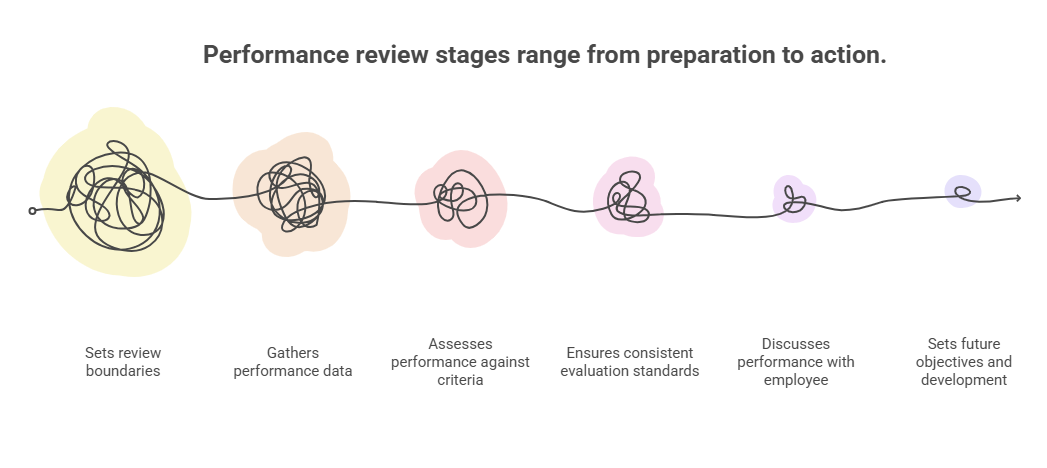
Every effective review follows a six-step lifecycle, regardless of whether it happens annually or quarterly:
| Step | What happens | Who owns it |
|---|---|---|
| 1. Define period and criteria | Set the review window and confirm what will be evaluated (goals, competencies, behaviors). | Manager + HR |
| 2. Collect evidence and input | Gather self-assessments, peer/360 feedback, goal progress data, and project outcomes. | Employee + Manager |
| 3. Manager evaluates | Manager scores or rates performance against criteria using collected evidence. | Manager |
| 4. Calibrate (where applicable) | Leadership and HR compare ratings across teams to reduce bias and ensure consistency. | HR + Leadership |
| 5. Hold the review conversation | Manager and employee discuss results, strengths, gaps, and development in a two-way dialogue. | Manager + Employee |
| 6. Agree on goals, development, and follow-up | Set next-period goals, development actions, and a follow-up schedule. | Manager + Employee |
For a detailed breakdown of review timelines, scheduling, and cycle operations, see the full performance review cycle guide.
Explore performance reviews
This page covers the review entity end to end. When you need depth on one part of it, these are the dedicated guides.
Why Performance Reviews Matter
When done well, performance reviews create outcomes that neither the employee nor the organization can achieve without a structured process:
| Employee outcome | Organization outcome |
|---|---|
| Clear understanding of expectations and standing | Consistent, documented performance data for decisions |
| Targeted feedback that accelerates development | Early identification of skill gaps and succession risks |
| Recognition of contributions and strengths | Stronger alignment between individual work and business goals |
| A voice in shaping their own growth path | Improved retention through meaningful career conversations |
The frequency of feedback matters more than the format of the review. Gallup research covering 13,490 full-time employees found that employees are 3.6 times more likely to strongly agree they are motivated to do outstanding work when their manager gives daily rather than annual feedback, and that 80% of employees who received meaningful feedback in the past week were fully engaged. A once-a-year review carries the whole load only when nothing else is happening in between.
Reviews also create a shared record. When promotion, compensation, or role-change decisions come up, a history of documented reviews provides evidence. That reduces the risk of bias-driven or recency-driven choices.
That said, poorly executed reviews can do harm. Vague feedback, inconsistent standards, or a purely evaluative tone (with no development focus) erodes trust. The process matters as much as the practice.
How much time is your review cycle actually costing?
Drag the slider to your team size and see the hours Peoplebox could give back every cycle.
Team size120 people
You could save 222 hours / cycle ≈ $11,100 in manager time*
Performance Review vs Performance Appraisal vs Performance Evaluation
These terms overlap but are not synonyms. Understanding the boundaries prevents confusion, especially when different teams or vendors use them differently.
| Term | What it means | Typical scope | Key output |
|---|---|---|---|
| Performance Review | A structured conversation between manager and employee to evaluate results, discuss strengths and gaps, and agree on next steps. | One review period (quarterly, semi-annual, or annual). | Documented feedback, agreed goals, development plan. |
| Performance Appraisal | A formal, periodic assessment, often tied to compensation, promotion, or employment decisions. | Usually annual; organization-wide. | Rating or score, compensation recommendation. |
| Performance Evaluation | A broader assessment concept that covers any systematic judgment of performance quality, including reviews, appraisals, project evaluations, or probationary assessments. | Varies: single event, project, or probation. | Assessment outcome (pass/fail, rating, narrative). |
| Performance Management | The ongoing system of setting goals, providing feedback, coaching, and reviewing performance throughout the year. | Continuous and cyclical. | Aligned goals, regular check-ins, review data. |

A review is one event within performance management. An appraisal is typically the most formal version of a review. An evaluation is the broadest term. It describes the act of assessing rather than a specific format.
For more on the broader continuous process, see performance management process.
Performance Reviews Within Performance Management
A review is one event inside a larger system. Performance management is the year-round practice of setting goals, coaching, giving feedback, and checking progress. The review is the scheduled point where that year of activity gets summarized, documented, and turned into decisions.
The vocabulary around this trips people up, so it is worth separating three phrases that sound alike:
- Performance review management means running the process itself: building the schedule, assigning reviewers, sending reminders, and chasing completion.
- Performance management review means stepping back and checking whether the system is working at all, including whether ratings are consistent and whether reviews change anything.
- Performance review programs describe the organization-wide setup: who gets reviewed, how often, against what criteria, and who owns each stage.
The practical takeaway: if reviews feel like an isolated annual event, the problem is usually upstream in the performance management process, not in the review form.
What Should an Employee Performance Review Cover?
A useful review evaluates performance across dimensions that are role-specific, observable, and tied to evidence. Generic check-the-box assessments waste everyone’s time.
| Dimension | What to evaluate | Evidence source |
|---|---|---|
| Goal/results achievement | Did the employee meet, exceed, or fall short of agreed targets? | OKR/goal tracking data, project outcomes |
| Role responsibilities | Are core job duties performed consistently and at the expected level? | Manager observation, work output |
| Competencies and behaviors | Does the employee demonstrate the skills and behaviors the role requires? | Self-assessment, peer feedback, 360 input |
| Strengths | What does the employee do exceptionally well? | Examples from the review period |
| Areas for improvement | Where are the clearest development opportunities? Frame them as specific, observable areas of improvement rather than character judgments. | Specific gaps, not vague impressions |
| Collaboration and teamwork | How effectively does the employee work with others? | Peer feedback, cross-functional outcomes |
| Development progress | Has the employee grown in the areas identified in the last review? | Training completed, skills demonstrated |
| Future goals | What should the employee focus on next? | Business priorities, career aspirations |
The dimensions shift with the role, and so do the employee performance metrics worth tracking against them. A job performance review for a field engineer leans on completed work orders and safety records. A work performance review for a designer leans on shipped projects and stakeholder feedback. A staff performance review in retail or hospitality usually weighs attendance, service standards, and shift reliability more heavily than long-range goals. Same framework, different evidence.
The key principle: every criterion must be observable and evidenced. “Communication skills” is not useful unless it specifies what good communication looks like in this role and how you will know whether it is happening. Teams that struggle to write that language usually borrow it, and established performance review competency examples are a faster starting point than inventing a framework from scratch.
Some organizations also run a personal performance review, where the employee completes the same assessment on themselves before the manager writes anything down.
The Employee Performance Review Process
This section walks through the six canonical steps introduced above, with enough detail for a manager or HR team to execute a review cycle. For a full operational guide to scheduling, configuring timelines, and managing the review cycle end-to-end, see performance review cycle.
Step 1: Define the review period and criteria
Before the cycle begins, confirm the review window (e.g., Q1, H1, full year) and the evaluation framework: which goals, competencies, and behaviors will be assessed? Both managers and employees should know the criteria before the conversation. Surprises in a review mean the process failed earlier.
Step 2: Collect evidence and input
Gather the data that will ground the review: goal completion rates, project outcomes, self-assessments, peer or 360 review feedback, and any notes from regular check-ins. The more specific the evidence, the more useful the conversation.
Step 3: Manager evaluates performance
Using the criteria and evidence, the manager assesses each dimension, typically through a rubric, rating scale, or narrative evaluation. The goal is a fair, evidence-backed assessment, not a gut-feel score.
Step 4: Calibrate across teams (where applicable)
In organizations with multiple teams, calibration sessions let managers and HR compare ratings to correct for inconsistencies. One manager’s “meets expectations” should mean the same thing as another’s. Done well, this step reduces inconsistency and builds trust in the process. Done badly it can import bias rather than remove it: Harvard Business Review reports that calibration meetings can amplify bias when discussion is unstructured and the loudest advocate wins. The fix is to run calibration sessions against written criteria and documented evidence rather than impressions, with someone in the room whose job is to challenge a rating nobody can support.
Step 5: Hold the review conversation
This is the core of the review. It should be a two-way dialogue rather than a one-way report card. The manager shares their assessment, the employee shares their perspective, and both discuss what went well, what needs to change, and what support is needed. Effective conversations are specific, evidence-based, and forward-looking.
Step 6: Agree on goals, development actions, and follow-up
The review ends with clear outputs: next-period goals, a development plan, and a follow-up schedule. Without agreed actions, the review is just a conversation. It does not drive change.
See how Peoplebox runs your review cycle for you
Automate scheduling, reminders, and multi-stage workflows so managers spend time on the conversation, not the admin.
How to Prepare for a Performance Review
Most weak reviews are decided before anyone sits down. Preparation is what separates a conversation that changes behavior from one that reads like a form being filled in. Five steps cover the essentials for both managers and employees.
| Step | What to do | Why it matters |
|---|---|---|
| 1. Schedule early | Book the conversation at least a week ahead and protect the time. Send the agenda with the invite. | Gives both sides time to reflect instead of reacting on the spot. |
| 2. Confirm the criteria | Restate what is being assessed: which goals, which competencies, which behaviors, and over what period. | Removes the single biggest source of review disputes, which is disagreement about the yardstick. |
| 3. Gather the evidence | Pull goal progress, project outcomes, and notes from check-ins across the whole period, not just the last month. | Evidence collected late is evidence skewed by recency. |
| 4. Collect self and peer input | Have the employee complete a self-assessment first. Add peer or 360 input where the role depends on collaboration. | Surfaces context the manager cannot see and gives the employee a voice before any rating exists. |
| 5. Draft an agenda, not a verdict | Plan three or four discussion points: results, strengths, one or two development areas, and next-period goals. | Keeps the meeting a two-way conversation rather than a read-out. |
One rule covers most of it: nothing in a review should be new information. If a performance issue first appears in the review, the preparation failed months earlier. The review documents and formalizes, it does not reveal.
Employees preparing for their own review should do the same work in reverse: collect evidence of what they delivered, note where they fell short and why, and arrive with two or three things they want from the next period. Managers running a full cycle for the first time will want the longer checklist in our guide to preparing for a performance review.
Types of Performance Reviews
Performance reviews vary by who provides feedback, how often they happen, and what they focus on. Here is a useful taxonomy:
By rater source
- Manager review (1:1): The traditional format, where a direct manager evaluates the employee’s performance.
- Self-review: The employee assesses their own work and supplies context the manager cannot see. Writing one well is harder than it looks, and most people do better working from self evaluation examples than from a blank box.
- Peer review: Colleagues evaluate collaboration, communication, and teamwork. Since peers rarely see the full results picture, the peer review comments that actually help tend to describe observable behavior rather than outcomes.
- 360-degree review: Feedback from managers, peers, direct reports, and sometimes external stakeholders. See the full 360 performance review guide.
By cadence
- Annual: A comprehensive look at the full year. Still common, but increasingly supplemented by shorter cycles.
- Semi-annual / Quarterly: More frequent checkpoints that catch issues earlier and keep goals current.
- Continuous: Ongoing feedback integrated into regular 1:1s and check-ins. The review becomes part of the workflow rather than a separate event.
By purpose
- Goal/results-based: Evaluates performance against specific OKRs, KPIs, or targets.

- Project-based: Assesses contributions to a specific initiative or deliverable.
- Probationary: Conducted during a new hire’s probation period to evaluate fit and readiness.
For a detailed comparison of all review types with selection guidance, see types of performance reviews.
Who Participates in a Performance Review?
A performance review is not just a manager-to-employee event. Multiple roles contribute, each with a distinct responsibility.
| Participant | What they provide | What they decide | Typical involvement |
|---|---|---|---|
| Employee | Self-assessment, context on challenges and accomplishments, career aspirations | Usually does not decide the final rating | Every review format |
| Manager | Performance evaluation, specific feedback, development recommendations | Owns the assessment and typically the final rating | Every review format |
| Peers / Direct reports | Feedback on collaboration, behaviors, leadership (in 360 reviews) | Do not decide ratings | 360-degree and peer reviews |
| HR | Review framework, timeline, calibration facilitation, compliance | Decides process rules and fairness standards | Organization-wide cycles |
| Leadership | Calibration input, strategic context for expectations | May adjust ratings during calibration | Calibration sessions |
The most common format involves only the employee and their direct manager. Multi-rater formats (like 360 reviews) add perspectives but also add complexity. Use them where the additional input genuinely improves the assessment.
Ownership shifts with company size. In a small team, the manager runs everything, and there is no formal HR performance review process behind it. Once headcount grows, HR usually owns the calendar, the forms, and the calibration rules, while managers keep ownership of the judgments themselves. A company performance review cycle at that scale is a program with a schedule and an owner, rather than a loose set of individual conversations. A management performance review adds a layer on top, because managers are assessed on how well they developed their teams and not only on their own output.
How Often Should Performance Reviews Happen?
There is no single right cadence. It depends on the organization’s size, culture, and the nature of the work.
| Cadence | Best for | Trade-off |
|---|---|---|
| Annual | Stable roles, organizations with mature goal-setting, compensation-tied reviews | Risk of recency bias; issues discovered too late to correct |
| Semi-annual | Balanced approach: one mid-year check-in plus a year-end review | Doubles the process load without reaching continuous feedback |
| Quarterly | Fast-moving teams, roles with short project cycles, early-career employees | Requires disciplined goal-setting and manager commitment |
| Continuous | Organizations that integrate feedback into weekly/biweekly 1:1s | The “review” becomes less formal, and harder to document consistently |
Many organizations combine formal reviews (annual or semi-annual) with continuous feedback through regular 1:1 meetings. This hybrid approach catches issues in real time while maintaining a documented assessment cadence.
For a complete guide to choosing and configuring review cycles, see performance review cycle guide.
Performance Review Examples, Questions & Templates
Rather than reproducing full libraries here, this section gives you a representative starting point for each resource, then links to the comprehensive guide.
Example review statements
- Exceeds expectations: “Consistently exceeded quarterly targets by 15-20%, while mentoring two junior team members through their onboarding.”
- Meets expectations: “Delivered all project milestones on time and maintained strong cross-functional communication throughout the quarter.”
- Needs improvement: “Missed two of four quarterly goals. We identified unclear prioritization as the root cause and have agreed on a weekly planning check-in.”
For 50+ examples across roles and ratings, see performance review examples.
Common review questions
- What accomplishments are you most proud of this review period?
- Where did you face the biggest challenges, and what would you do differently?
- How well do your current goals align with where you want to grow?
- What support or resources would help you perform at your best?
- How would you describe your working relationship with your team?
- What skills do you want to develop in the next review period?
For a full question bank organized by review type and competency, see performance review questions.
Template preview
A basic review template includes: employee information, review period, goals and results, competency ratings, strengths, development areas, employee comments, and agreed next steps. For ready-to-use forms, see performance review forms.
Free RESOURCE
The Year-End Performance Review Guide
Feeling the pressure of year-end reviews? Download our EBook for proven strategies!

Common Performance Review Challenges and Best Practices
Much of what goes wrong in reviews is structural rather than personal. Stanford researchers writing in Harvard Business Review found that bias shows up most where evaluation forms are vague: open text boxes and broad questions leave managers to fill the gap with impressions, and ambiguous criteria are where bias does its work. Tightening the form is usually a faster fix than trying to correct the reviewer.
Even well-designed review processes can fail in execution. Here are the most common failure modes and how to control for them:
| Challenge | What goes wrong | How to fix it |
|---|---|---|
| Recency bias | Managers remember the last few weeks, not the full review period. | Require evidence collection throughout the period rather than only before the review. Use goal-tracking tools that log progress continuously. |
| Vague or generic feedback | “Good job” or “needs improvement” without specifics leaves the employee with nothing actionable. | Every piece of feedback should answer: what happened, what the impact was, and what should change or continue. Managers who freeze at this point usually need a model more than a training course, which is what constructive criticism examples give them, especially for negative feedback that has to land without shutting someone down. |
| Manager inconsistency | Different managers apply different standards, making cross-team comparisons meaningless. | Run calibration sessions. Define rating anchors with behavioral examples, not just labels. |
| Surprise feedback | Raising an issue for the first time in the annual review instead of addressing it when it happened. | Make ongoing feedback the norm. The review should summarize and formalize rather than reveal. |
| Weak evidence | Ratings based on gut feel or personal rapport rather than observable performance. | Tie every rating to specific examples, data, or outcomes. If you cannot cite evidence, you are not ready to rate. |
| No follow-up | Goals and development plans agreed in the review are never revisited. | Schedule a 30-day follow-up check-in. Track action items in the same system used for goals. |
The simplest best practice: if you would be uncomfortable showing your review to the employee’s skip-level manager and explaining the reasoning, the review is not ready.
How Performance Reviews Are Evolving
Performance reviews are not disappearing, but the way organizations run them is changing.
More frequent, lighter-weight feedback: The annual-review-only model is giving way to continuous check-ins supplemented by periodic formal reviews. This reduces recency bias and catches problems earlier.
Outcome-linked reviews: Reviews are increasingly tied to measurable goals (OKRs, KPIs) rather than trait-based assessments (“good communicator,” “team player”). This makes reviews fairer and more actionable.
Employee-driven reflection: Self-assessments are becoming a standard part of the process rather than an optional add-on. Employees who reflect before the conversation bring better context and take more ownership of their development.
AI-assisted drafting and synthesis: Review tools are beginning to use AI to draft review summaries from check-in notes, suggest development actions, and flag rating inconsistencies. These tools can save time, but they require human oversight. AI should assist the reviewer’s judgment rather than replace it, and every AI-drafted summary should be edited by the manager who owns the rating. The boundary is worth naming: AI in performance management earns its place in synthesis and pattern-spotting, and loses it the moment a judgment has to be defended to an employee.
How Technology Supports Performance Reviews
The right software does not make reviews better, but it removes the friction that makes them worse. Review platforms can automate scheduling and reminders, collect and organize multi-source feedback, provide templates and rating frameworks, track goal progress throughout the cycle, support calibration with side-by-side comparisons, and generate reports for HR and leadership.
Here is how Peoplebox performance review software supports the review workflow:
- Automated review cycles: Configure timelines, reminders, and multi-stage workflows without spreadsheets.
- Integrated goal tracking: Review progress against OKRs and goals in the same place where reviews happen.
- Multi-source feedback: Collect self, manager, peer, and 360 input in one system.
- Calibration views: Compare ratings across teams to catch inconsistencies before reviews are finalized.
- Analytics and reporting: See completion rates, rating distributions, and development trends across the organization.
Ready to make performance reviews actually useful?
Peoplebox helps you run review cycles that are consistent, evidence-based, and tied to real goals, not just a once-a-year formality.
FAQs
What is a performance review?
A performance review is a structured conversation between a manager and employee to evaluate work results, discuss strengths and development areas, and agree on goals for the next period. It is one component of the broader performance management process, not the whole of it.
What should a performance review include?
A complete review covers goal and results achievement, core role responsibilities, competencies and behaviors, strengths, specific areas for improvement, collaboration, progress since the last review, and agreed goals for the next period. Every criterion should be observable and backed by evidence.
How often should performance reviews happen?
There is no single right cadence. Annual reviews suit stable roles but risk recency bias. Semi-annual adds a mid-year checkpoint. Quarterly works for fast-moving teams. Continuous feedback folds review into regular 1:1s. Most organizations combine a formal annual or semi-annual review with continuous feedback in between.
Who participates in a performance review?
The employee and their direct manager are involved in every format. Peers and direct reports contribute in 360-degree and peer reviews but do not decide ratings. HR owns the framework, timeline, and calibration. Leadership contributes calibration input and may adjust ratings.
How long should a performance review take?
Plan 45 to 60 minutes for the conversation itself. Preparation takes longer: gathering evidence, reviewing self and peer input, and drafting the assessment typically takes one to two hours per employee. Calibration, where used, adds a separate session for the management group.
What is the difference between a performance review and a performance appraisal?
A performance review is the structured conversation covering results, strengths, gaps, and next steps. A performance appraisal is the formal, periodic assessment layer, usually annual and more often tied directly to compensation, promotion, or employment decisions. A review emphasizes conversation and development, an appraisal emphasizes the rating.
What are the most common types of performance reviews?
Reviews are grouped three ways. By rater: manager, self, peer, and 360-degree. By cadence: annual, semi-annual, quarterly, and continuous. By purpose: goal or results-based, project-based, and probationary. Most organizations run a manager review paired with a self-assessment as the default.
How should managers prepare for a performance review?
Schedule the conversation at least a week ahead and send the agenda with the invite. Confirm the criteria. Gather evidence across the whole review period. Collect the self-assessment and peer input before writing your own assessment. Draft an agenda rather than a verdict. Nothing in the review should be new information.
TABLE OF CONTENTS
RELEVANT ARTICLES
Our Customers Love us


