
If you’ve landed here, you’re likely in one of two situations: either you’re considering using Paradox for your recruitment requirements, or you’re exploring alternatives.
Either way, this paradox review article is for you.
We’ll break down what Paradox actually offers, its core features, strengths, limitations, real-world considerations, and how it compares to leading alternatives. Whether you’re about to make a decision or are still weighing your options, you’ll have a clear understanding before you commit.
Paradox at a Glance
Paradox is an AI-powered chatbot built for the purpose of automating high-volume hiring processes. It aids in talent acquisition to get organized and keep candidates engaged, have screening conversations, as well as scheduling interviews.
The platform’s core capabilities include:
- AI-driven candidate conversations via SMS and chat
- Automated interview scheduling and reminders
- Hiring event coordination
- It is imperative to specify the underlying HRIS or HCM systems, such as Workday and SAP SuccessFactors.
The most common use of paradox can be found in retail, healthcare, and hospitality, as well as in other headhunting /white-collar hiring industries where speed-to-interview and recruiter efficiency are the key factors.
Despite its primary value not being a workload reducer for the recruiter or even a means of speeding up the hiring processes at an early stage, it still has these advantages.
Key Features of Paradox
Below are the main capacities that decide how Paradox aids the recruiting teams that deal with high volumes of applicants.
- Conversational ATS (Mobile-First Automation)
The contradiction arises if candidates and hiring managers are able to interact through SMS and chat-based workflows, these applications are streamlined, and they are screened specially for front liners, where mobile accessibility is crucial.
- Conversational Scheduling
Automates the interview scheduling process, scheduled confirmations, reminders, and rescheduling, as well as reduces the administrative burdens of recruiters, through this eliminates manual coordination.
- Traitify Assessments
The service offers visual, mobile-friendly behavioral assessments which are made to improve candidate-role fit and reduce early-stage turnover.
- Conversational CRM
Provides talent pipeline management capabilities, helping recruiters re-engage past applicants, organize candidate pools, and maintain ongoing communication through automated messaging.
- Enterprise Integrations
Paradox can interface with popular HR systems such as Workday, SAP SuccessFactors, and Indeed, so it is possible for conversational automation to be added on top of your current ATS.
Pros of Paradox
1. Strong High-Volume Hiring Automation
Paradox performs well in environments where applicant volume is high. Its conversational workflows help move candidates quickly through early stages without requiring constant recruiter involvement.
2. 24/7 Candidate Engagement
The automation of messaging via SMS and chat improves the continuity of communication with candidates and helps to cut response time for a better start in the early stages.
3. Reduced Administrative Burden
By automating screening conversations, interview scheduling, confirmations, and reminders, Paradox significantly reduces manual coordination tasks for recruiting teams.
4. Mobile-First Candidate Experience
The use of text and chat is easier to use during the application process or scheduling of interviews by front-line and hourly candidates, who are most likely to use mobile devices.
5. Scalable for Enterprise Hiring
Paradox is designed so that a high number of applicants can be handled, and the hiring process in several locations is not made more difficult for the recruiter, even if it would takes longer.
Cons of Paradox
1. Limited Structured Evaluation Depth
Paradox places an emphasis on automated conversations rather than digital, structured, competency-based interviews that have extensive scoring logic associated with them.
2. Hiring Quality Insights Are Limited
While the product has improved efficiency and engagement for those hiring, it does not provide a way to connect data from interviews to performance measurements over time, nor does it offer depth regarding hiring-to-performance analytics.
3. Enterprise-Oriented Pricing
Pricing is based on quotes, and generally, the pricing structure is oriented towards large enterprises, meaning mid-sized businesses could feel overburdened by the cost of doing business through Paradox compared to their needs.
4. Requires Careful Workflow Configuration
Successful implementation requires a designer of the conversational flows to design the conversational flow thoroughly prior to launching the programming. Failure to do this may result in poorly designed or limited reviews of candidate applicants via conversational automation.
5. Dependency on Existing Tech Stack
Performance and efficiency rely heavily on seamless connectivity with existing ATS technology and HR systems. If there is a complicated tech stack previously in place, it may take longer for a new applicant tracking system to become integrated into your workflow.
6. Learning Curve for Recruiters
Recruiters and hiring managers may take some time (in addition to learning) to become comfortable working with automated conversational workflows and may not be able to take advantage of all the product’s features.
While depth of features can play a role in functionality, it is price that drives whether the product or platform can meet mid-sized business’ requirements. Overall, the issues mentioned above can impact sales, therefore representing potential downsides for Paradox.
Paradox Pricing
Paradox’s pricing is not available on its website; however, Paradox has a custom pricing model geared to large-scale hiring/enterprise-level customers with pricing determined by:
- Hiring volume
- Number of locations
- Feature modules enabled
- Integration scope
- Implementation requirements
To get a written quote specific to your organization, you must contact Paradox directly
With a focus on large-scale, high-volume recruiting operations, the price of using Paradox is generally in line with other large-scale/high-volume recruiting tools.
Paradox Integrations: How It Connects to Your Hiring Stack
Paradox is designed to augment existing ATS systems, not replace them. It is most valuable when it integrates seamlessly with the recruiting technology you are using to hire people.
ATS & HRIS Integrations
Paradox has integrations with leading enterprise systems like SAP SuccessFactors, Workday, iCIMS, Oracle HCM, and Taleo. With these integrations, all conversations that your candidates and recruiters have during their screening process will be captured automatically in your ATS so that nothing is missed when it comes to scheduling interviews or acquiring updates from candidates.
For large volume recruiters, this reduces the need to manually update each stage of the hiring process or coordinate between recruiters and candidates. Paradox focuses primarily on automating early-stage workflows rather than providing complete talent lifecycle integration.
Calendar & Scheduling Integrations
Paradox integrates with Google Calendar and Microsoft Outlook to provide automatic scheduling of interviews. Candidates can select time slots via SMS or chat, and the confirmation of that timeslot will automatically sync to both the recruiter’s and hiring manager’s calendars.
This greatly reduces the delay of communication back and forth between candidates and recruiters and is particularly useful in fast-moving, front-line hiring situations.
Career Sites & Job Boards
Paradox can integrate with career sites and job boards like Indeed, which allows a candidate to go directly into the Paradox conversational screening process immediately after applying.
This reduces how long a candidate has to wait for a response, which helps keep the momentum of a high-volume hiring process going.
Hiring Events & Volume Campaigns
Paradox enables organizations to efficiently process a high volume of candidates without adding to the workload of recruiters by providing automated registration for candidates, sending out reminders, and coordinating interviews.
What to Clarify Before Choosing
While Paradox has an excellent integration with enterprise ATS systems, there are some things that buyers should consider:
- The depth of integration with their specific ATS
- Implementation timelines and services costs
- How hiring data flows beyond early-stage recruitment
As companies grow, the strength of the integration becomes important, but the way in which the recruitment process connects to performance, development, and long-term workforce strategy is of equal importance.
Paradox Reviews Snapshot (G2 & Capterra)
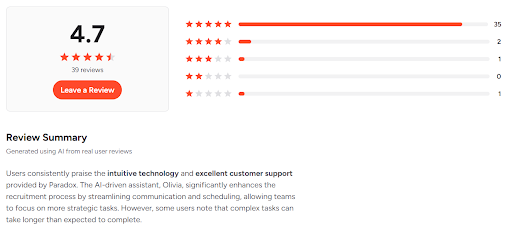
G2 rating : 4.7 / 5 ⭐
Capterra rating: 4.0 / 5 ⭐
Paradox has a solid G2 score, yet has a smaller overall set of G2 reviews than other, more established talent platforms. The two sites show similar feedback trends, with POC highlighting strengths in communication and automation but highlighting some issues involving complexity and flexibility.
What Users Like
- AI-Powered Candidate Engagement: Users appreciate Olivia, the conversational assistant, for making communication easier and speeding up communication between candidates and the organization.
- Automating Interview Scheduler: Recruiters highlight that scheduling interviews via the platform takes up significant time to facilitate scheduling interviews with high-volume interviews, and automating the process.
- Increased Administrative Efficiency: Many teams stated that they have significantly decreased the amount of time spent coordinating administrative functions, which allows recruiters to make higher-level job decisions about hiring.
- Speed-to-Interview: The Paradox platform has proven to be very effective for organizations in a high-volume environment (i.e. retail/ healthcare) where speed-to-interview is critical.
What Users Don’t Like
- Complex Tasks Can Take Longer: Some users stated that tasks with a sophisticated workflow may require intervention from the hiring team and may need to be done manually.
- Learning Curve & Setup Time: The system requires a structured set of setup steps before going live and the time required is significant for enterprise environments to establish the system and obtain workflow approval.
- Limited Structured Interview Depth
While Paradox has done a great job coordinating and communicating with all parties involved, there are limited or adaptive competencies based on interview processes that can provide detailed results for decision-making.
Paradox Alternatives
If you’re evaluating Paradox against other AI recruiting platforms, here’s a quick side-by-side comparison before diving into individual breakdowns.
| Tool | Best For | Core Strength |
| Paradox | High-volume frontline hiring | Conversational AI + scheduling automation |
| Peoplebox.ai (Nova) | Structured AI interviews | Competency-based first-round interviews + performance integration |
| HireVue | Enterprise structured interviews | Video interviews + AI assessments + compliance support |
| Fountain | Operational high-volume hiring | Workflow automation for frontline roles |
| XOR | Conversational automation | SMS/chatbot screening + scheduling |
| Humanly | Mid-market automation | AI conversational screening with a lighter footprint |
| Eightfold AI | Talent intelligence strategy | AI sourcing, matching, skills inference |
Paradox is strong in conversational automation. However, hiring models vary significantly across organizations. Some teams need structured evaluation depth, others need workflow orchestration, and some need talent intelligence at scale.
If you’re evaluating alternatives, the question isn’t “Is Paradox good?” It’s “Is it built for our hiring architecture?”
Below are the most credible alternatives in 2026, organized by hiring priority and operational model.
1. Peoplebox.ai (Nova) – Full-Cycle AI Interviewing, Not Just Chat Automation
Nova is the world’s most human-like AI interviewer built to automate resume screening, pre-screening calls, and full first-round interviews, not just scheduling.
It reduces a 2–6 week screening cycle to a structured output in under 30 minutes. Nova is a truly omnichannel AI interviewer, supporting phone, video, chat, and SMS, all unified into a single structured hiring workflow.
What Nova Does
- Instant Resume Screening: Parses resumes, enriches candidate data, and evaluates against job-specific criteria within seconds, eliminating manual shortlisting.
- AI Phone, Video & Chat Interviews: Conducts real, conversational interviews across voice, video, and text, not static scripts or decision trees.
- Adaptive Follow-Up Questioning: Dynamically probes deeper based on candidate responses, mimicking how a skilled human interviewer evaluates answers.
- Role-Specific Interview Frameworks: Tailored interviews for sales, engineering, healthcare, operations, and more, including behavioral and situational depth.
- Built-in Coding & Case Assessments: Enables candidates to complete technical challenges or case-based evaluations directly within the AI interview.
- AI-Powered Proctoring: Monitors for tab-switching, suspicious behavior, or external assistance to protect assessment integrity.
- Structured Scorecards & Hiring Reports: Generates skill ratings, summaries, red flags, and hiring recommendations delivered directly to recruiters or ATS.
- ATS Integrations: Syncs candidate data and evaluation outputs into existing systems without disrupting workflow.
- Bulk & 24/7 Automation: Conducts hundreds of interviews simultaneously, eliminating recruiter calendar bottlenecks and time-zone delays.
Where Nova Wins Against Paradox
- ATS-Agnostic (Not Workday-Tied)
Paradox is now owned by Workday. For non-Workday customers (SAP SuccessFactors, Oracle, iCIMS, Greenhouse, Lever), roadmap alignment and long-term platform neutrality may become a concern. Nova is fully ATS-agnostic. - Mid-Market Focus
Paradox’s sales motion is increasingly enterprise-oriented. Nova is priced and structured for mid-market and scaling companies doing volume hiring without enterprise ACV commitments. - Real AI Interviews vs. Chatbot Screening
Paradox automates coordination. Nova replaces first-round interviews.Nova conducts structured interviews with dynamic follow-ups, evaluates candidate responses, and produces scoring reports. It behaves like an interviewer, not just a scheduler.
- True Omnichannel Interviewing
Nova was built for phone-first AI interviewing, not just chat. It supports voice, video, chat, and text as core workflows, not add-ons. - Hiring Quality Visibility
Nova connects hiring outcomes back to structured evaluation frameworks, helping teams improve quality-of-hire, not just time-to-schedule.
If your hiring challenge is scheduling friction, Paradox works. If your challenge is interview capacity, quality-of-hire, or structured evaluation at scale, Nova is built differently.
| Scheduling Isn’t the Bottleneck Anymore
If your team is still spending hours on first-round interviews, automation hasn’t gone far enough. Nova by Peoplebox.ai replaces resume screening and first-round interviews with one AI-led conversation. |
Other Notable Paradox Alternatives
2. HireVue
HireVue is a long-standing enterprise video interviewing and assessment platform offering structured digital interviews, AI-powered assessments, and workflow automation. It is particularly strong in compliance-heavy industries and large enterprises that require standardized, scalable interview frameworks.
However, it is often considered heavier in implementation and pricing compared to mid-market-focused AI tools.
3. Fountain
Fountain is a high-volume hiring platform built for frontline and hourly workforce recruiting. It combines automation, workflow orchestration, and screening tools to help companies manage large applicant volumes efficiently.
While it excels in operational hiring at scale, its strength lies more in workflow management than in deeply structured AI-led interview evaluation.
4. XOR
XOR is a conversational AI recruiting platform focused on chatbot automation across SMS, web, and messaging channels. Similar to Paradox, it emphasizes screening conversations, candidate engagement, and interview scheduling.
It is best suited for organizations prioritizing speed and automation at the top of the funnel rather than structured competency-based evaluation.
5. Humanly
Humanly is an AI-powered conversational screening and scheduling platform aimed at mid-market organizations. It automates early-stage candidate engagement and pre-screening while maintaining a lighter implementation footprint than enterprise-grade systems.
It focuses on reducing recruiter workload rather than replacing structured interview frameworks entirely.
6. Eightfold AI
Eightfold AI is a broader talent intelligence platform that combines AI-driven sourcing, matching, workforce planning, and internal mobility. It goes beyond conversational automation by focusing on skills inference and long-term talent strategy.
It is typically chosen by enterprises seeking an end-to-end talent intelligence layer rather than just screening automation.
Final Verdict: Is Paradox the Right Fit?
Paradox performs well in high-volume, frontline hiring environments where speed and scheduling automation are the primary bottlenecks.
If your focus is on reducing coordination time and automating early-stage communication, especially within the Workday ecosystem, Paradox is a strong option.
But if your hiring process gets tricky, maybe you need better ways to rate candidates, keep track of quality, or handle more complex interviews. Just adding chat automation won’t solve everything.
Paradox is all about making scheduling easier. Nova, on the other hand, focuses on screening and evaluating candidates.