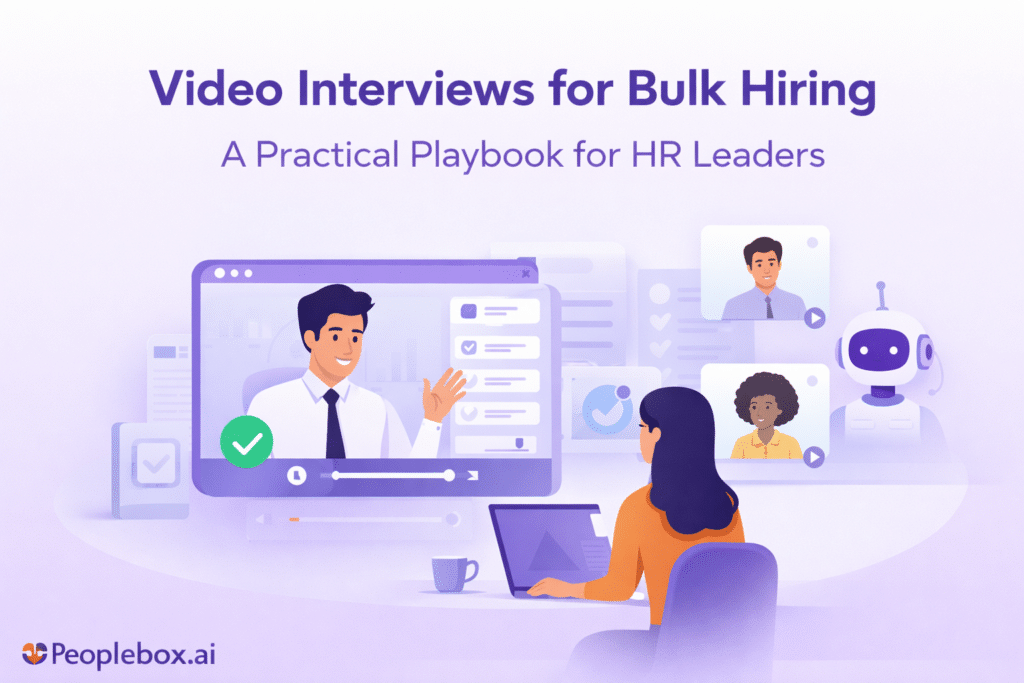

Video interviewing has moved from “Zoom instead of onsite” to a full-blown hiring layer recorded, scored, summarized, and increasingly AI-assisted.
This video interview guide tracks that evolution end-to-end: live video interviews → one-way (asynchronous) interviews → AI-led, human-like interview experiences, and what each shift changed for speed, consistency, and candidate experience. It also covers what’s changing right now: interview fraud is rising (6% of candidates admitted participating), and organizations are responding with more verification and tighter standards sometimes adding an in-person step back into the mix.
Where Video Interviews Fit in the Bulk Hiring Funnel
With video interviews now used by almost 9 in 10 employers at the top of the hiring funnel, the real question isn’t whether to use them, it’s where and how they create the most value in bulk hiring.
Video interviews create the most value in the top-to-mid funnel, after basic eligibility checks and before final human validation.
A simple, practical funnel for bulk roles looks like this:
- Eligibility knockouts (must-have requirements)
- Video interview screening (top-to-mid funnel filter)
- Optional assessment (only if the role needs it)
- Final validation (hiring manager / panel)
- Offer
The mistake many teams make is pushing video interviews too late (“we’ll only do it after screening calls”), or too far (“we’ll make video the final decision”). In bulk hiring, video interviews work best when they do one job: turn a large applicant pool into a shortlist that hiring managers can trust.
When implemented properly, the outcomes are measurable:
- Shortlists move from “end of week” to 24–72 hours
- Recruiter screening load drops sharply
- Candidate evaluation becomes more consistent across locations and recruiters
- Hiring managers spend time only on candidates who clear baseline signal
The Three Video Interview Formats (and Where Each Fits)
Not all “video interviews” are the same. Choosing the wrong format is why teams end up feeling like video interviews “don’t work.”
1) Live Video Interviews
Live video is a real-time Zoom/Teams interview. It’s high-signal because you can probe, clarify, and build rapport but it’s the least scalable format.
Use live video for:
- Shortlist validation (the last 10–20%)
- Hiring manager rounds
- Roles where real-time probing matters (complex customer issues, escalation handling, team leadership)
Avoid live video for first-round bulk screening because it recreates the same bottleneck: calendars + interviewer hours. At volume, “let’s do live video screens for everyone” becomes “we can’t keep up.”
Bulk hiring rule: live video is best used as a final filter, not the entry point.
2) One-Way (Asynchronous) Video Interviews
One-way interviews ask candidates to record answers to structured questions and submit them. This works in bulk hiring because it removes coordination and lets teams review in batches.
Use one-way video for:
- Frontline, sales, support, operations roles
- Multi-location hiring drives
- Campus hiring
- Any funnel where scheduling is the blocker
Why it works when done right:
- Candidates can complete it when convenient
- Every candidate gets the same questions (consistency)
- Reviewers can evaluate in batches (calibration improves)
- Hiring managers can review only top responses
Why it fails when done poorly:
- Drop-offs spike when interviews are long, impersonal, or poorly framed. 33% of candidates abandon applications that include one-way video interviews when the experience feels cold or time-consuming
- Candidate experience feels “cold” if it’s the first touch with no context
- Scoring becomes inconsistent without a rubric, so it’s not faster , it’s just different work
To make one-way video work in bulk hiring:
- Keep it short: 4–6 questions
- Keep it focused: assess only job-relevant competencies
- Make it mobile-first
- Communicate timelines clearly (ex: “you’ll hear back by X”)
If your completion rate is low, the issue is almost always friction + unclear expectations, not “candidates hate video.”
3) AI-Led, Human-Like Video Interviews
AI-led interviews are conversational interviews run by an AI agent that can ask follow-ups, manage flow, and generate structured summaries or scorecards. The value is scale + consistency without turning the interview into “record into a void.”
Use AI-led interviews for:
- Extreme volume hiring where recruiter screening is the constraint
- Repeatable roles with clear success criteria
- Early screening where you need consistent evaluation fast
Where HR should be cautious:
- Senior roles requiring nuanced judgment
- Regions with strict AI regulations / works councils
- Any environment where you can’t provide auditability and bias monitoring
A practical HR checklist before using AI-led interviews:
- Are candidates told clearly that AI is involved?
- Can humans review and override decisions?
- Is scoring explainable (not a black box)?
- Are adverse impact checks and fairness monitoring in place?
- Are accessibility accommodations available?
AI-led interviews should reduce workload but they must increase trust, not reduce it.
Ready to Upgrade Your First-Round Video Interviews?Peoplebox Nova runs structured, human-like AI video interviews with adaptive follow-ups, explainable scoring, and full human oversight. Built for bulk hiring teams that need speed, without compromising trust. |
Designing a Scalable and Defensible Video Interview Process
Bulk hiring doesn’t need “more interviews.” It needs structured screening.
Define the right competencies (not too many)
In bulk roles, the best scorecards focus on 4–6 competencies that actually predict performance. More than that creates noise and reviewer fatigue.
Examples that often matter in volume roles:
- Communication clarity
- Customer orientation
- Reliability and ownership
- Problem-solving basics
- Learning agility
The key is picking competencies that are observable in a short interview, not aspirational traits like “leadership presence” for an entry-level role.
Ask standardized, job-relevant questions
At volume, fairness and consistency depend on standardization:
- Same questions for everyone
- Same time limits
- Same evaluation criteria
Use a mix of:
- Behavioral questions (“Tell me about a time…”) to get evidence
- Situational questions (“What would you do if…”) to test judgment
Avoid vague prompts (“tell me about yourself”) as core screening questions they produce rehearsed answers and weak signal. Also avoid “culture fit” questions that are subjective and hard to defend.
A strong bulk interview question set is specific, short, and mapped to competencies.
Build a scorecard that reviewers can actually use
A bulk hiring scorecard must prevent two issues: inconsistency and gut-feel scoring.
What works:
- Anchored rating scales (what good vs average vs weak looks like)
- Weighted competencies (not all traits matter equally)
- Mandatory evidence notes (one line: what did they say that earned that score?)
If you can’t explain why someone scored “low,” you can’t defend the process and you can’t improve it.
Candidate Experience at Scale (Why It’s a Business Metric)
In bulk hiring, candidate experience isn’t brand polish , it’s conversion.According to a Glassdoor survey, 66% of candidates accept offers based on experience; 26% reject due to poor hiring processes . At scale, experience gaps directly translate into lost hires and delays.
A poor interview step causes:
- Drop-offs (fewer candidates reach shortlist)
- Longer time-to-fill (re-sourcing cycles)
- Higher cost per hire (more spend to replace drop-offs)
- More offer declines (candidates lose trust)
Video interviews fail when they’re designed only for employer convenience. Candidates will tolerate automation they won’t tolerate ambiguity.
Three fixes that improve completion without losing signal:
- Reduce friction: 10–15 minutes total, mobile-friendly
- Set expectations: what this step is, what happens next, by when
- Humanize: a short intro from the employer + clear timeline updates
If candidates don’t know when they’ll hear back, they assume they won’t.
Reduce friction without reducing signal
Most bulk funnels don’t fail because candidates are weak they fail because the process is tiring to complete. The goal is to keep the interview light enough to finish, but structured enough to differentiate.
Do this consistently:
- Shorter interviews: Keep it to 4–6 questions (10–15 minutes total). Anything longer pushes drop-offs up fast.
- Mobile-first completion: Assume candidates are on mobile. If it’s not smooth on a phone, your completion rate will suffer.
- Clear instructions and expectations: Tell candidates upfront:
- how long it takes
- how many questions
- whether they get prep time / re-records
- what happens after they submit
- when they’ll hear back ,these reduces anxiety and increases completion without lowering hiring signals.
Humanize the process
Video interviewing scales, but trust doesn’t scale automatically. Bulk candidates drop when the process feels cold or unclear.
Three simple fixes:
- Intro video from the employer: A 30–60 second clip from the hiring team explaining the role and what the interview step is for.
- Explain why video interviews are used: “We use this to evaluate everyone fairly on the same criteria and move faster.” Candidates accept automation more when they understand the reason.
- Communicate timelines and next steps: Confirm submission instantly and set a clear review window (“you’ll hear back in 48–72 hours”). Silence causes drop-off and brand damage.
If the process feels fair, clear, and human, you’ll get better completion and better answers not just more throughput.
Compliance, Fairness, and Risk Management
In bulk hiring, small inconsistencies quickly become large patterns. That’s why video interviewing must be treated as a governed hiring system, not just a tool.HR leaders remain accountable for outcomes even when using third-party platforms or AI.
Bias and Adverse Impact
At scale, fairness is measured in outcomes, not intent. HR teams should monitor selection rates at each stage (application → interview → shortlist → offer) and watch for disparities across demographic groups.
Structured questions and scorecards reduce bias compared to unstructured interviews but only if results are reviewed regularly. Without monitoring, even well-designed systems drift.
Responsible Use of AI
AI should support decisions, not make them.
Non-negotiables:
- Human-in-the-loop decisions
- Explainable scores and summaries
- Clear audit trails (questions, criteria, reviewer notes)
- No black-box signals like facial or tone analysis
If a system can’t explain why a candidate was advanced or rejected, it’s not fit for hiring.
Data Privacy and Security
Video interviews collect sensitive data at scale.
HR teams should enforce:
- Data minimization (collect only what’s job-relevant)
- Defined retention and deletion policies
- Vendor security and compliance checks
- Regional compliance (GDPR, local labor and AI laws where applicable)
Accountability doesn’t transfer to the vendor.
Accessibility and Accommodations
Bulk hiring systems must support:
- Alternative formats
- Extra time where needed
- Clear accommodation requests without penalty
Accessibility isn’t an edge case at scale, it’s a requirement.
Operating Model: How to Run Video Interviewing Without Bottlenecks
Most bulk hiring programs don’t fail because the tool is bad. They fail because no one owns the workflow.Video interviews create speed at the top of the funnel. Without clear ownership and review discipline, that speed just turns into another backlog.
Roles and Responsibilities (RACI)
Bulk hiring needs single-point ownership, not shared responsibility.
- Recruiters own flow: sending invites, tracking completion, and moving candidates forward.
- Hiring managers own quality: defining what “good” looks like and validating shortlists on time.
- HR / Legal set guardrails: fairness, compliance, and accommodation readiness.
- TA Ops own the system: templates, dashboards, reviewer enablement, and cadence.
If accountability isn’t explicit, review slows and candidates wait.
Calibration and Quality Control
At volume, inconsistency compounds fast.Teams that scale video interviewing well run light but regular calibration:
- Weekly or bi-weekly sample reviews during active drives
- Quick alignment on what strong vs weak responses look like
- Early correction of overly strict or overly lenient reviewers
Calibration isn’t bureaucracy ,it’s how quality holds when volume spikes.
SLAs That Prevent Bottlenecks
Speed only matters if decisions keep up.High-volume teams set three non-negotiable SLAs:
- Review turnaround: interviews reviewed within 24-48 hours
- Escalation rules: missed SLAs trigger reminders, then leadership visibility
- Batch review discipline: short, frequent review blocks not marathon catch-ups
Without SLAs, video interviews become just another queue.
Metrics HR Leaders Should Track
These metrics tell you whether video interviews are actually reducing pressure or just moving it.
Speed & efficiency
- Time to shortlist : Should shrink dramatically. If not, review ownership or SLAs are broken.
- Time to fill : Confirms whether faster screening is translating to faster hiring.
- Recruiter hours saved : If screening calls haven’t dropped, video interviews aren’t replacing work.
Funnel health
- Completion rate : Low completion means friction, poor framing, or interviews that are too long.
- Drop-off point : Shows where candidates disengage (before start, mid-interview, post-submit).
- Review turnaround time : Fast candidate completion is useless if reviews pile up.
Quality proxies
- Training pass rate : Early signal of role readiness.
- 60 / 90-day attrition : Confirms screening quality beyond resumes.
- Hiring manager satisfaction : If managers don’t trust the shortlist, the system won’t stick.
Fairness & consistency
- Selection rates across groups : Detects bias early, before it becomes risk.
- Score consistency across reviewers : Reveals whether calibration is actually working.
If these metrics don’t improve, the failure isn’t video interviews. It’s process design, ownership, or governance.
Implementation Roadmap for HR Teams
Rolling out video interviews for bulk hiring isn’t a big-bang change. Teams that succeed treat it as a controlled rollout, not a tool switch.
Phase 1: Design for Consistency First
Before any candidate records a video, the foundation has to be right.
This phase is about deciding what “good” looks like. HR and hiring managers should align on a small set of role-critical competencies, translate those into structured interview questions, and define clear scorecards with anchored criteria. Legal and compliance teams should review this upfront to ensure job relevance, fairness, and accommodation readiness.
If design is rushed, every downstream problem bias risk, weak shortlists, manager distrust gets amplified at scale.
Phase 2: Pilot Under Real Conditions
The biggest mistake teams make is rolling video interviews across all roles at once.
Instead, run a pilot with one role in one geography. This creates a safe environment to see how the process behaves under real candidate volume. Track completion rates, review speed, shortlist quality, and any early fairness signals. Pay close attention to where candidates drop off and where reviewers slow down.
The goal of the pilot isn’t perfection. It’s to surface friction before it becomes systemic.
Phase 3: Scale Only What Works
Once the process holds up under pressure, expansion becomes straightforward.
Extend the model to additional role families, formalize governance, and introduce automation or AI support only after the core workflow is stable. Scaling too early locks in broken assumptions and forces teams to fix problems mid-hiring drive, the worst possible moment.
Bulk hiring systems should scale only after they’re proven to be stable. Speed without stability just creates chaos faster.
Common Pitfalls (and How to Avoid Them)
- High candidate drop-offOccurs when interviews are long, expectations are unclear, or mobile access is poor.Prevented by short, time-boxed interviews with upfront clarity and mobile-first access.
- Inconsistent scoringHappens when reviewers rely on personal judgment instead of shared standards.Prevented by anchored rubrics and recurring calibration across reviewers.
- Hiring manager disengagementEmerges when managers don’t help define what “good” looks like and distrust outputs.Prevented by manager involvement in competency definition and shortlist criteria.
- Compliance pushbackArises when legal review happens after tools are live and decisions lack traceability.Prevented by pre-approved evaluation criteria, audit trails, and adverse-impact monitoring.
- Over-automationBreaks trust when decisions can’t be explained or overridden.Prevented by human-in-the-loop controls and transparent scoring logic.
Bulk hiring success isn’t about finding the perfect tool. It’s about removing bottlenecks without creating new ones.
FAQs for HR Leaders
- Are one-way or AI video interviews compliant?
Yes, if they’re structured and human-reviewed.They must use job-related criteria, allow overrides, support accommodations, and have audit trails. Auto-rejects and black-box scoring increase risk.
2. How do we reduce bias in video screening?
Use standard questions, anchored rubrics, calibration, and outcome monitoring.Avoid facial/tone analysis and track pass-through rates to catch drift early.
3. Should AI score candidates or just assist?
Assist first, decide later.AI can summarize and recommend; humans should own final decisions and overrides.
4. How long should a video interview be?
10–15 minutes total.4–6 questions max. If you need more depth, add a second stage and don’t extend the first.
5. What roles are best suited for video screening?
High-volume, repeatable roles where communication and judgment matter:support, sales, retail, operations, healthcare intake.Not ideal for exec or highly bespoke roles.
Conclusion: Video Interviews That Scale Without Compromising Trust
Video interviews are not a tactic ,they’re infrastructure for bulk hiring. They work only when HR leaders treat them as a system, not a feature.
That system needs:
- Structured, job-relevant questions and scorecards
- Short, mobile-first candidate experiences
- Human oversight with clear governance
- Defined operating ownership and SLAs
- Metrics that prove speed, quality, and fairness
Bulk hiring will always be a pressure test.Video interviews help you pass it only when they’re designed for scale, accountability, and trust not just automation.