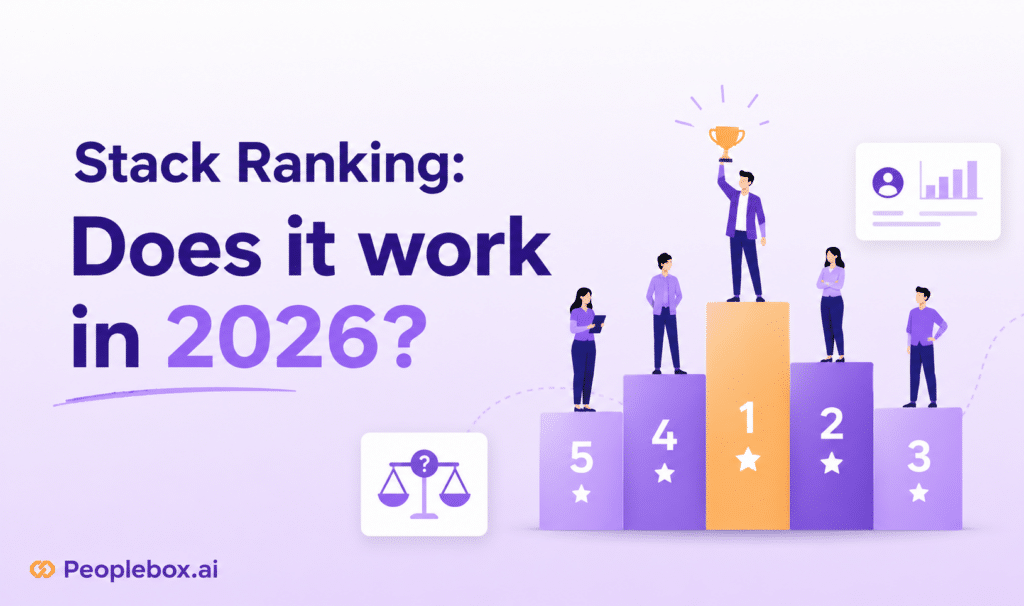

Stack ranking is one of the few management practices that have been implemented, researched, and then almost universally abandoned, all within a single generation of corporate leadership. Its failure wasn’t inevitable. It reveals exactly where performance differentiation goes wrong when the mechanism prioritises competition over accuracy.
What Is Stack Ranking?
Stack ranking, also called forced ranking or rank-and-yank, is a performance evaluation method in which employees are ranked against each other and placed into a fixed distribution, irrespective of their individual performance.
The most common model is the 20/70/10 rule: the top 20% are considered high performers, rewarded with incentives and promotions; the middle 70% are the “vital majority,” maintained and trained; and the bottom 10% are considered underperformers and fired. The key point is that even if every employee on a team is genuinely strong, someone still ends up in the bottom 10%.
Jack Welch introduced this approach at General Electric in the 1980s. He called it a “vitality curve.” The idea was that removing the weakest performers annually would build an increasingly stronger organization. The logic was appealing, but the practice proved far more complicated.
How Stack Ranking Works
The stack ranking system operates on an apparently straightforward procedure; however, the process itself has negative implications that tend to build up over time.
Step 1: Set Performance Criteria
Managers define what will be evaluated – goal achievement, competencies, behavioral metrics, or some combination. In theory, this creates a consistent baseline, but in practice, criteria are often loosely defined, so the ranking reflects managerial interpretation as much as employee performance.
Step 2: Evaluate Employees Independently
During this stage, each manager evaluates their subordinates according to the performance criteria established in step 1. This is where the process appears fair, as evaluations occur before the distribution being applied, creating the impression that rankings are merit-based.
Step 3: Apply the Forced Distribution
Regardless of the results in step 2, employees are distributed into predetermined tiers. The forced distribution process overrides actual results and performance.
What happens when the distribution is applied to a genuinely strong team:
| Employee | Actual Performance | Stack Ranking Label |
|---|---|---|
| Employee A | Exceptional | Top performer ✅ |
| Employee B | Strong | Top performer ✅ |
| Employees C-I | Solid, meeting all expectations | Vital majority |
| Employee J | Also solid, meeting all expectations | Underperformer ❌ |
Employee J performed effectively, but someone has to be in the bottom 10%, irrespective of whether they deserve or earn this tag.
Step 4: Act on the Outcomes
High-performing employees are rewarded through incentives, promotions, and development opportunities, whereas underperforming employees are given a performance improvement plan, demotion, reduced pay, or even termination. But the outcome for employee J was determined by who their colleagues were, not how they performed.
The Rise and Fall of Stack Ranking
1980s: Jack Welch implements the vitality curve at GE. The 20/70/10 model attracts attention as GE’s revenues grow, and performance differentiation becomes a competitive lever that other companies want to replicate.
1990s–2000s: Widespread adoption. By 2009, 42% of surveyed companies were using some form of forced ranking. Enron, Microsoft, Yahoo, Amazon, and Capital One all implemented versions. At Enron, the system contributed to a culture of fraud; employees manipulated results to avoid the bottom cut.
2011: Industry adoption of forced ranking drops sharply, from 42% in 2009 to approximately 12–14%.
2012: Kurt Eichenwald’s Vanity Fair article on Microsoft’s “Lost Decade” identifies stack ranking as the most destructive process at the company. A former Microsoft engineer described it directly: “No matter how good everyone was, two people were going to get a great review, seven were going to get mediocre reviews, and one was going to get a terrible review.” It leads employees to focus on competing with each other rather than with other companies.
2016: Amazon drops its rank-and-yank system, followed by GE, the company that originated the vitality curve. The two organizations most associated with stack ranking had both walked away from it.
Today: Stack ranking in its traditional form has largely been abandoned. Where it persists, it tends to be in high-volume, low-complexity roles where individual output is easily quantified, and collaboration is minimal.
Advantages and Disadvantages of Stack Ranking
Before dismissing it entirely, it’s worth being precise about what the model was actually trying to accomplish. These goals are still valid:
Advantages
Forces performance differentiation
Without a structured process, managers default to rating most employees as “good”, not because everyone is excellent, but because difficult conversations are uncomfortable. Stack ranking forces managers to make distinctions.
Creates clear accountability
Employees in a stack ranking environment understand that performance has consequences. The system removes ambiguity about what it means to underperform.
Identifies top performers systematically
Rather than relying on individual manager advocacy, stack ranking creates a structured process for surfacing high performers across an organization.
Prevents rating inflation
The forced distribution counteracts the tendency for ratings to cluster around “meets expectations” or above when there are no constraints on how many people can receive each rating.
Disadvantages:
Destroys collaboration
Microsoft engineers actively avoided working with talented colleagues to protect their own ranking. Helping a peer who then outperformed them damaged their rating. Stack ranking converts the workplace into a zero-sum competition.
Kills innovation
Risky projects carry the potential for visible failure. Under stack ranking, visible failure means a lower ranking. The rational choice becomes safe, incremental work. Stack ranking is structurally incompatible with an innovation culture.
Creates perverse hiring incentives
Some managers admitted to intentionally hiring underperformers so their existing top talent wouldn’t fall into the bottom tier by comparison. The system incentivized building weaker teams to protect individual ratings.
Amplifies bias
When managers must slot people into predetermined percentages, unconscious bias determines who lands where. The mathematical veneer creates an illusion of objectivity that doesn’t exist.
Punishes high-performing teams
If a manager hires well and the entire team is genuinely strong, someone still gets labeled “bottom 10%.” The system assumes every team contains underperformers, which isn’t true.
Generates unsustainable turnover costs
Replacing an employee costs 50-150% of their annual salary (SHRM). Systematically eliminating 10% of the workforce annually guarantees massive replacement costs, not counting the institutional knowledge that walks out with each departure.
Stack Ranking Examples
Microsoft
Under Steve Ballmer, every Microsoft team, regardless of size or actual performance, distributed employees across five fixed rating buckets. Engineers actively avoided working with talented colleagues to protect their own rankings, since helping a peer who then outperformed them was a career risk.
The outcome was structural: top engineers avoided joining strong teams because being ranked against excellent colleagues was dangerous. This is the collaboration destruction failure in its clearest form. Microsoft scrapped the system in 2013 under CEO Satya Nadella.
Amazon
Amazon’s version was called the Organization Level Review. Managers were required to rank employees, and the bottom performers faced annual culling, the system that became known as “rank and yank.” Notably, Amazon did not share rankings with employees, creating an atmosphere of anxiety and a lack of transparency about where individuals stood.
This is the bias amplification failure made operational. With no visibility into how rankings were determined, employees had no basis to challenge outcomes that may have reflected manager preference over performance. Amazon dropped the system in 2016.
GE
GE originated the 20/70/10 model, and by financial metrics, the company performed strongly during Welch’s tenure. But the attribution is disputed, GE had multiple performance drivers, and the cultural costs became apparent over time.
The GE case most directly illustrates the high-performing team’s failure. When a company hires well, the forced distribution still requires labelling someone as an underperformer every cycle. Eventually, GE moved away from forced ranking, an acknowledgment that the model designed to strengthen teams was structurally guaranteed to damage them.
What Are the Best Alternatives to Stack Ranking?
Stack ranking was abandoned, but the underlying need didn’t disappear. Companies still need a performance management approach that differentiates performance, identifies top contributors, addresses underperformance, and ensures consistency across managers. Modern approaches solve these problems without the forced distribution and its consequences.
Software-Assisted Calibration: Managers evaluate employees independently, then meet in calibration sessions to compare and normalize ratings across teams. The system surfaces where ratings cluster or skew, but doesn’t override manager judgment. If a manager rates their entire team above average and can justify it, that stands. The outcome is consistent ratings across managers without a forced distribution.
Weighted Multi-Source Ratings: Performance scores come from multiple weighted sources – direct manager, matrix manager, peer feedback, rather than a single evaluator. Common configurations include a 60/40 goals-to-competency split or a 40/60 matrix-to-direct manager weighting. Multiple inputs reduce individual bias and make scoring transparent.
Goals and Competency-Based Performance Reviews: Employees are evaluated against defined goals and competency frameworks, not against each other. Performance is measured by what an employee achieved and how they achieved it. This removes the zero-sum dynamic entirely and makes evaluation criteria consistent and visible across the organization.
360-Degree Feedback: Rather than one manager determining an employee’s rating, 360-degree feedback gathers input from peers, direct reports, and managers. Multiple perspectives reduce single-evaluator bias and surface performance dimensions that a direct manager doesn’t have visibility into, such as cross-functional collaboration, peer impact, and upward leadership.
Goal-Based Evaluation: Employees are evaluated against their own goals and company objectives, not against each other. Collaboration becomes safe because helping a colleague achieve their goals doesn’t damage one’s own rating. Ambitious goal-setting is encouraged because failing to meet a stretch goal isn’t the same as being labelled “bottom 10%.”
Development-Focused Performance Plans: Instead of ranking employees against each other, managers create individual development plans focused on skill improvement and growth. Performance is measured by progress against a personal development trajectory. This replaces the threat of termination with a structured path forward and produces the development conversations that stack ranking consistently failed to generate.
| Move beyond stack ranking with Peoplebox.ai Peoplebox.ai handles calibration, weighted multi-source ratings, Goal-based evaluation, 360-degree feedback, and development plans in one platform, giving you the performance differentiation stack ranking promised, without the forced distribution. See how it works |
Does Stack Ranking Work in 2026?
No, not in its traditional form.
The companies that built it and ran it longest eventually walked away. Microsoft scrapped it in 2013. Amazon dropped it in 2016. GE, the company that originated the model, moved away from it, too. That’s not a coincidence – it’s a pattern.
Stack ranking’s core problem is simple: it guarantees a fixed number of losers every cycle, regardless of actual performance. A strong team still produces one underperformer. A manager who hires well still fires someone. The math overrides the reality.
If the leadership wants performance accountability, the real question to ask is: what problem are they actually trying to solve? In most cases, it’s one of three things: rating inflation across managers, no visibility into top performers, or no structured way to address underperformance. The alternatives in this guide solve all three without a forced distribution.
Bottom Line
Stack ranking addressed an actual need of performance differentiation, but it used an extremely faulty way of solving that problem. Forcing employees into a fixed distribution regardless of absolute performance destroyed collaboration, suppressed innovation, and guaranteed unfair outcomes for employees who happened to work on strong teams and good colleagues.
The companies that have stopped using it did not stop differentiating performance. They switched to calibration-based approaches, multi-source ratings, and goal-based evaluation, tools that meet the same requirement without the cultural damage.
The need for stack ranking to address consistent performance differentiation is still valid. The tools to address it properly now exist.