
Most organizations already have some version of goal-setting, reviews, and feedback in place. The problem is not the strategies they chose. It is that those strategies do not connect.
Without a clear standard for what constitutes good performance, goals are set, but ratings remain subjective. Without documented feedback throughout the year, annual reviews compress 12 months of work into whatever a manager recalls during the review. Without calibration, two employees doing equivalent work receive different ratings depending on their managers. Each strategy looks reasonable on its own. Together, they produce results nobody trusts, and only 2% of Fortune 500 CHROs strongly agree their performance management system actually inspires employees to improve.
This guide organizes 12 performance management strategies into 4 pillars: Foundation, Cadence, Evaluation, and Growth, so you can see which strategies you already have, which to add, and in what order. Each strategy includes what it does, how it fails, and what good execution looks like. Insights in this guide are drawn from Peoplebox.ai’s demo and implementation call recordings with HR leaders across 200+ companies.
What Are Performance Management Strategies?
A performance management strategy is a specific method an organization chooses to set goals, evaluate work, and develop people. These are deliberate choices: SMART goals, 360-degree feedback, calibration, competency frameworks, structured 1:1s, each with a specific function in the performance management cycle.
The cycle shows when action should be taken, and strategy indicates how it should be done. Whether you use SMART goals or KPIs in planning, continuous feedback or annual surveys in monitoring, and review through calibration or independent rating, these are all decisions regarding strategy. The cycle itself remains constant, but the strategies vary within it.
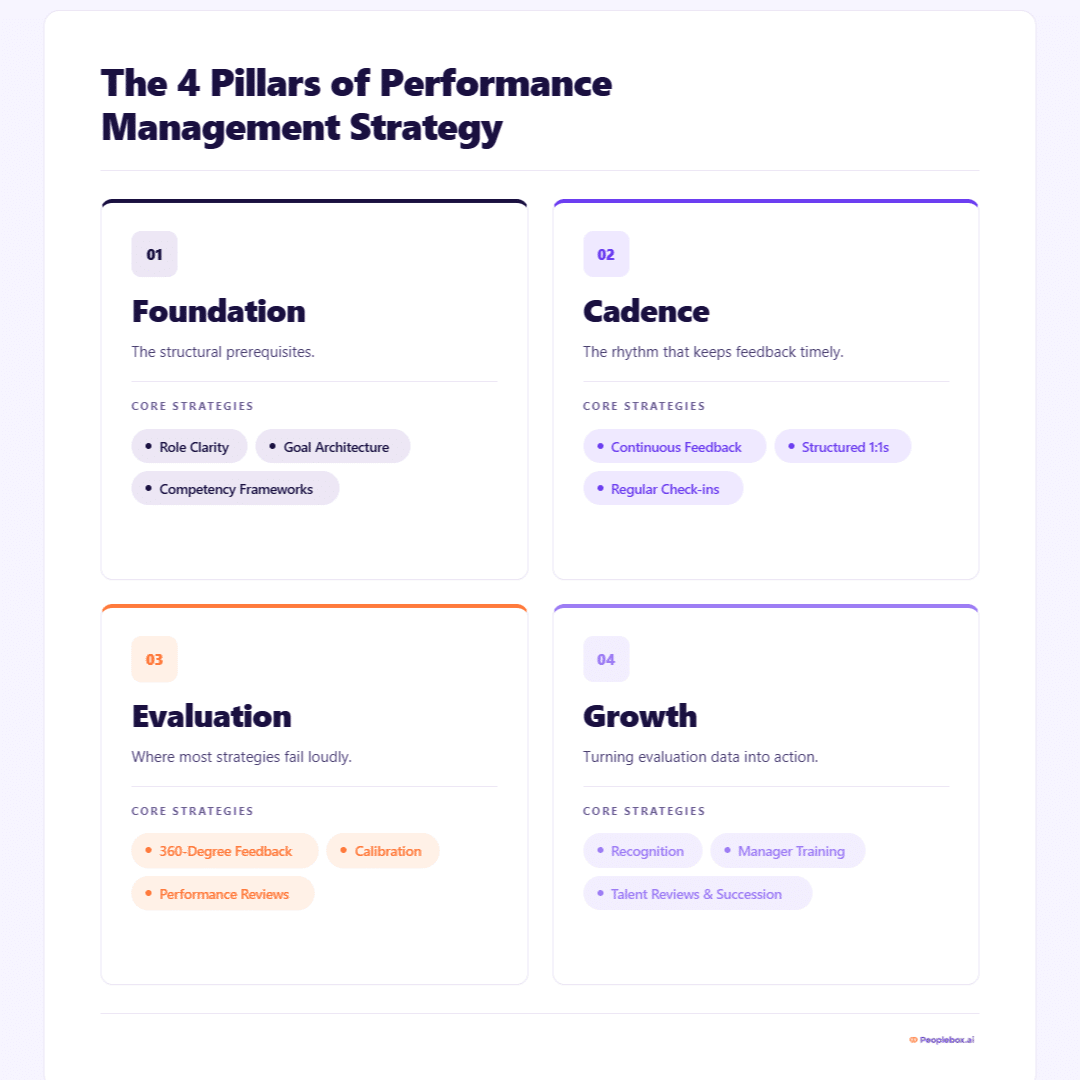
The 4 Pillars of Performance Management Strategy
There are 12 strategies within performance management, but these are organized into four distinct pillars due to the importance of the order. You cannot calibrate your ratings without first defining what constitutes successful performance. You cannot execute meaningful reviews without documentation of feedback collected throughout the year.
Foundation pillar (Strategies 1–3): Goal-setting, goal cascading, competency frameworks. They must be done first because all other strategies assume their existence. Without them, ratings reflect the manager’s preferences more than the employee’s performance.
Cadence pillar (Strategies 4–6): Continuous feedback, structured 1:1s, regular check-ins. The challenge in most performance management systems is not what we measure; it’s how often we discuss our measurements. Annual-only conversations mean feedback always arrives after the moment to act on it has passed.
Evaluation pillar (Strategies 7–9): 360-degree feedback, calibration, performance reviews. This is where most organizations feel the pain first. It’s not necessarily the methodology used for evaluations, but the lack of documentation and feedback that would have provided the information necessary for the process.
Growth pillar (Strategies 10–12): Recognition, manager training, talent reviews, and succession. Evaluation informs us about what happened. Growth strategies determine how we respond.
Foundation Pillar – Strategies 1–3
These three strategies are the structural prerequisites. Skip them, and the rest of the system operates on guesswork.
Strategy 1: Set SMART Goals Tied to Role Expectations
Without documented goals, a manager has nothing concrete to evaluate against. Reviews default to how an employee comes across rather than what they actually delivered.
SMART goals, Specific, Measurable, Achievable, Relevant, Time-bound, are the baseline. The implementation consistently fails in one specific way: goals are established once a year in January and remain unchanged all year long. By Q3, priorities have changed, yet reviews take place based on outdated metrics.
How to do it well: Goals need to be defined at the role level; each employee should have 3-5 goals aligned with their job description. Also, implement quarterly goal updates to align with business priorities. This does not need to be a review meeting, but a 15-minute discussion to confirm that the goals are still valid. If goals are adjusted each quarter, meaningful evaluations can take place.
Failure mode: SMART goals that focus on measuring the number of activities performed rather than results delivered. “Send 50 outreach emails per week” is a SMART goal. “Increase the qualified lead conversion rate from 12% to 18% by Q3” is a performance goal. One measures effort. The other measures impact.
Strategy 2: Cascade Goals From Company Objectives to Individual Targets
Goal cascading connects individual work to company outcomes. A company-level objective breaks into function-level targets, which break into individual key results. Each layer makes the company’s direction visible to the person doing the work.
Goal cascading and SMART goals serve different purposes. SMART goals define what an individual should accomplish in their role. Cascading goals connect the individual work to what the company is trying to achieve. Both belong in the same system. SMART goals give employees clarity on their targets; cascading ensures those targets point in the same direction.
At a large CPG company we work with, leadership defined 25-30 critical business priorities and cascaded them to functional heads. Each function translated high-level objectives, like “strengthen distributor relationships,” into specific, measurable key results. That translation step is where most cascading efforts stop. The objective is easy to write. The measurable proof that it was achieved is not.
Failure mode: Leadership defines company goals but never breaks them down to the team or individual level. Employees set their own targets independently, and the cascade exists on paper but not in practice.
Strategy 3: Build a Role-Specific Competency Framework
Competency frameworks set standards for what constitutes great performance within each particular role in terms of behaviors, not results. Without one, ratings become a reflection of the manager’s preference rather than actual performance.
Without competency frameworks, calibration becomes a discussion of personalities. In the case of 360-degree feedback, it produces vague responses since there is nothing concrete that raters are supposed to measure against. Performance reviews depend solely on the manager’s memories and preferences.
A fully developed framework contains 5-8 competencies per role family, along with corresponding behaviors and levels for entry, mid, and senior-level performers. The set of competencies must be unique for each role. “Collaboration” for ICs involves the exchange of information and support for peers. Collaboration for a manager implies the elimination of obstacles for the team’s successful operation.
A European tech services company we worked with replaced their previous platform specifically because it treated competencies as a flat company-wide list, the same five behaviors applied to engineers, account managers, and team leads equally. Feedback generated by this system was not very valuable due to excessive genericity.
Failure mode: One-size-fits-all competencies. Generic enough to apply to everyone means specific enough to help no one.
Cadence Pillar – Strategies 4-6
Foundation strategies define what to measure. Cadence strategies define how often you discuss it. Annual only cadences break every other strategy on this list; they turn feedback into history by the time it is delivered.
Strategy 4: Continuous Feedback – Informal and Structured
Continuous feedback has two components that are often conflated: informal feedback, either praise or correction (the congratulatory message sent on Slack after an effective presentation, or the flag raised after a missed handoff), and formal monthly or quarterly meetings focused on competencies and goals.
Both have their roles. Informal feedback is essential to building trust and preventing problems from becoming bigger. Formally, these meetings are essential because they generate the record that makes subsequent performance review and calibration meetings possible. Without continuous feedback, performance reviews end up being based on everything a manager remembers over a year.
Gallup research shows that employees who receive regular feedback are 2.8 times more likely to be engaged. The mechanism is not a mystery; people perform better when they know where they stand, not just once a year.
Failure mode: Feedback is available in the company’s policies, but is provided only during formal reviews. The manager’s intend to provide feedback consistently during the year, but rely on their memory at the end of each year.
Strategy 5: Structured 1:1s With Documented Action Items
The 1:1 is the smallest, highest-leverage unit of performance management. Most teams have them, but only a few use them well.
Most 1:1s are unstructured; they become status update meetings with no documented output. A structured 1:1 has a shared agenda, documented action items that carry forward automatically, notes that build a track record over time, and enough consistency in format that both manager and employee know what to expect.
The documentation is what converts 1:1s from a management habit into a performance management strategy. When a review cycle opens, the manager who documented 12 months of 1:1s has concrete evidence to work from. The manager who does not have memory.
Across the demos we run, “can we document 1:1s in the system” is one of the most consistent questions from buyers. They know unrecorded 1:1s are wasted institutional memory; every decision, every piece of feedback, every agreed-upon action disappears when someone changes managers or leaves the team.
Failure mode: The 1:1 happens, but nothing gets documented – in six months, neither manager nor employee can recall what was discussed, what was agreed, or what should have happened next.
Strategy 6: Regular Check-ins on Goal Progress
Goal check-ins differ from 1:1 meetings. A 1:1 meeting discusses the entire agenda, including priorities, obstacles, development, and interpersonal dynamics in the team. Goal check-ins are all about a single issue: are we on track? And if we are not, what needs to be changed?
A quarterly check-in on goal progress usually takes 15-20 minutes. The purpose is to update goal status, identify risk, and obtain from the manager the necessary information that would allow us to address any problems before they become obvious at year-end. Integrated into the systems where the actual work takes place, Jira for engineering, Salesforce for sales, goal check-ins may be partly automated: the system produces data, and the conversation adds analysis.
Failure mode: The goal check-in turns into a reporting overhead, rather than a problem-solving tool. A goal check-in that requires an employee to prepare a deck and deliver a status report is essentially a presentation, not a discussion. A good check-in process is supposed to help stay aligned with goals, not complicate them. If employees spend more time preparing for the check-in than conducting it, the process is working against itself.
Evaluation Pillar – Strategies 7-9
Evaluation is where most performance management strategies fail loudly. The cause is rarely the evaluation method itself; it is the missing foundation and cadence inputs that should be feeding it.
Strategy 7: 360-Degree Feedback With Controlled Peer Selection
360-degree feedback gathers input from the manager, peers, direct reports, and even skip-level evaluators. By eliminating bias from a single source, 360-degree feedback addresses the structural issue that any evaluation based on a single point of view will contain as much bias from the point of view of the evaluator as the employee’s true performance.
How to do it well: Peer selection must be managed by the manager, not the employee. Self-selected peers lead to echo chambers. Weighting among reviewers should be explicit, such as 70% manager, 20% peer, 10% direct report, and should accurately reflect the significance of their respective points of view. Questions should align with the competency model of Strategy 3. Without alignment, 360-degree feedback becomes impossible to aggregate.
A B2B SaaS company we worked with was transitioning from individual manager reviews to 360-degree feedback for the first time. Their specific requirement: controlled peer selection and explicit weighting by reviewer group, because their previous setup let employees choose their own reviewers, and the feedback consistently reflected relationships rather than performance.
Failure mode: Employees selecting their own peers. Self-selection of reviewers leads to employees choosing five of their most supportive colleagues, resulting in a total of five equally good evaluations per peer review.
Strategy 8: Calibration to Reduce Manager Bias
Calibration is the strategy most performance management guides skip entirely and the one that does the most damage when missing.
It is a structured discussion among managers, facilitated by HR, which takes place before the results are distributed to employees. Managers compare scores for different teams, expose any biases present at the manager level, and correct them before the process continues. Without it, a generous manager will inflate his team’s ratings while a strict manager will deflate his own ratings. Employees from equally high-performing teams will receive unequal results purely on the basis of which manager oversees them.
An HR Director for a mid-market services company explained the process in detail: hierarchical calibration of managers’ ratings, including skip-level review ending with the committee’s evaluation, distribution of scores along the bell curve only as a recommendation, manual adjustments of automatic score calculations whenever necessary, and question-level calibration, which involves discussion of each review question, not just the overall score. Distribution parameters were adjusted for leadership and individual contributor positions since the curves looked different for each category.
Failure mode: Calibration sessions with nothing to anchor them. Managers arrive and debate ratings from memory. Without documented 1:1s, check-ins, and continuous feedback in place first, calibration becomes a negotiation rather than a normalization.
Strategy 9: Performance Reviews Drawing on Documented Evidence
The formal performance review, annual, biannual, or quarterly, is not going away. The question is whether it synthesizes a year of documented performance data or asks managers to reconstruct the year from memory.
How to do it well: Review forms should pull in goal completion rates, peer feedback summaries, documented 1:1 notes, and continuous feedback records. The sequence matters: Begin with a self-evaluation; then follow up with a review by the manager based on documentable information, and finally calibration (Strategy 8). Then, have a conversation with the employee about what is coming next in terms of development, compensation, and position.
Documentation is the only mechanism that makes a review genuinely annual rather than effectively monthly with annual paperwork. If managers are basing their judgment on their memory, the past six weeks will carry more weight than the preceding ten months.
Failure mode: Managers writing reviews from scratch at year-end, based on memory. The recency-bias trap is not a manager’s failure; it is a system design failure. Without Strategies 4-6 in place, no review system can produce evidence-based assessments.
Growth Pillar – Strategies 10-12
Evaluation is a process that shows what has happened. Growth strategies determine what you do with the data. Skip this pillar, and you are measuring performance without acting on the results.
Strategy 10: Recognition and Reward Programs
Recognition is the retention multiplier on top of performance evaluation. A high-rated employee who receives no acknowledgment between reviews and a modest compensation adjustment at year-end is not retained; they are a leaving employee on a delay.
Effective recognition has two channels. Public recognition, in Slack channels, all-hands meetings, and team communications, signals that good performance is visible and valued. Private recognition, a specific written note, a direct conversation, signals that the manager sees what the individual is doing. Both matter, and neither substitutes for the other.
The link between retention is clear: Recognition based on particular actions encourages such actions. Generalized recognition like “great job this quarter” evokes pleasant feelings but sends no behavioral message. “The way you conducted the calibration meeting last week, grounding everything in facts, not impressions, is precisely how we gain credibility in the process,” is a form of recognition that explains to the employee what action to replicate.
Failure mode: Recognition programs that run once a year at review time, tied entirely to compensation outcomes. By then, the moment for recognition has passed. Behavior changes when feedback arrives close to the behavior. Annual recognition schedules serve the HR calendar, not performance development.
Strategy 11: Manager Training
Most performance management strategies fail at the manager level. The investment goes into frameworks, software, and 360 surveys while assuming managers know how to give feedback, run structured 1:1s, calibrate ratings, and have difficult performance conversations. They often do not, not by default.
Specific manager skills that directly affect performance management outcomes: writing concrete feedback rather than vague impressions (“your stakeholder communication needs work” versus “in the Q3 roadmap presentation, you presented three options without a recommendation, leadership wants a point of view, not a menu”), running 1:1s as coaching conversations rather than status updates, calibrating ratings against documented evidence rather than gut feel, and documenting decisions in real time rather than reconstructing them months later.
Across multiple conversations with HR leaders we’ve spoken with, “manager adoption” and “providing reasoning for ratings” appear consistently as top concerns. The platform matters less than whether managers engage with it honestly. Untrained managers default to vague ratings and avoid difficult conversations, two behaviors that undermine every other strategy on this page.
Google’s approach makes this explicit: training managers specifically on performance conversations is treated as a continuous program, not a one-time onboarding module.
Failure mode: Investing in performance management infrastructure while assuming managers will figure out the human skills on their own. They will not. This is the silent failure mode; the system looks like it is running, but the quality of every input is degraded.
Strategy 12: Talent Reviews and Succession Planning
Talent reviews translate performance data into organizational intelligence. Rather than treating each employee’s review as an isolated document, talent reviews use the aggregate data, ratings, potential assessments, and development plans to map the organization’s capability landscape.
The 9-box matrix is the most common starting point: a grid plotting performance (x-axis) against potential (y-axis) that positions each employee in one of nine categories. High-performance, high- potential employees are succession candidates. High-performance, lower-potential employees are strong contributors to retention and reward. Lower performance, high-potential employees need development investment. The matrix is a starting point for a leadership conversation, not a final verdict.
A financial services firm we work with wanted the 9-box matrix specifically to “identify top performers and employees needing improvement”, and, critically, to document the reasoning behind each placement. The documentation requirement is what makes the 9-box a development tool rather than a labeling exercise.
Failure mode: The 9-box becomes a static annual label. Employees placed in the bottom-left quadrant receive no development plan and no clear path to move. Used correctly, every placement generates an action, development investment, succession nomination, or a structured support conversation.
Where Does Performance Management Software Fit?
Software amplifies whatever performance management strategy you have, for better or worse. A weak goal-setting process at scale produces bad goals faster. A strong calibration process supported by software produces consistent, defensible ratings across a hundred managers instead of five.
The honest answer to “do we need software?” depends on three factors: team size, cycle complexity, and calibration needs.
When software pays for itself: more than 50 employees, multiple review cycles per year, calibration across multiple managers, and goal cascading from the company level to individuals. At this scale, manual processes create coordination overhead that exceeds the cost of a purpose-built platform.
When software is overkill: fewer than 30 employees, a single annual review cycle, one or two managers doing calibration informally. A well-structured set of templates in Google Sheets handles this without introducing platform adoption as an additional variable.
The critical point: software does not fix a broken strategy. If goal-setting is ambiguous, a goal-tracking tool makes ambiguous goals more visible. If managers do not know how to give feedback, a feedback module produces feedback that is vague and unhelpful at scale. The strategies come first. The software executes them.
| See all 12 strategies running in one platform
Peoplebox connects goal cascading, structured 1:1s, 360 feedback, calibration, and talent reviews in one system, with native Slack and Teams integration so managers work where they already are. |
How to Choose Which Strategies to Start With
Most teams searching for how to manage employee performance start with a list of strategies and no guidance on where to begin. Sequencing matters, and the right sequence depends on what is actually broken, not what looks most comprehensive on paper.
If you have nothing structured, start with Strategy 1 (SMART goals) and Strategy 3 (competency framework). Without a clear definition of what good performance looks like and what employees are being measured against, every other strategy operates in a vacuum.
If you have goals and annual reviews but no rhythm between them: Add Strategies 4 and 5, continuous feedback, and structured 1:1s. The Gallup engagement data is unambiguous here: regular feedback is the single biggest lever on employee engagement. Annual-only cadences guarantee that feedback arrives too late to change anything.
If reviews feel arbitrary or inconsistent across managers, add Strategy 8 (calibration). Rating inconsistency is a structural problem that no amount of better review forms will fix. Calibration is the only mechanism that normalizes ratings across evaluators before employees see them.
If you are losing high performers despite strong review scores, add Strategies 10 and 12, recognition, and talent reviews. High-rated employees who see no visible acknowledgment and no clear development path leave for organizations where performance is visibly connected to growth.
The honest framing: most teams need to add 3-4 strategies deliberately, not 12 simultaneously. The value of this framework is that it tells you 3-4, based on what is actually breaking, rather than presenting 12 options without a priority order.
Getting the System Right
The 12 strategies above work as a system, not a checklist. Goal cascading only works if role expectations are clear. Calibration only works if 1:1s and check-ins have built a documented record throughout the year. Talent reviews only work if evaluation data is trustworthy, which requires calibration to have happened first.
The teams that get performance management right are not the ones who adopt the most strategies. They are the ones who build the foundation first, establish a feedback cadence second, and let evaluation and growth operate on solid inputs.
Most teams need 3-4 strategies added deliberately, in sequence. Start with what is actually broken, not what looks most comprehensive on paper.