

















Biswashree Roy

BLOG / Performance Management
What Is Performance Management? Definition, Process & Complete Guide
April 24, 2026
Expert Reviewed


Performance management is the system that connects what a company aims to achieve with what each person is actually working on, through goal-setting, ongoing feedback, and structured reviews throughout the year.
This guide covers what performance management is, how the five-stage cycle works in practice, the frameworks organizations use to run it, and how the approach should evolve as a company grows.
What Is Performance Management?
Performance management is a continuous process of setting goals, monitoring progress, providing feedback, and evaluating employees to align individual performance with organizational objectives.
It is not a single event or an annual review form. It is the system that connects what a company is trying to achieve with what each person is actually working on and creates a documented record of how that’s going throughout the year.
The annual performance review is one component of that system. It is not the system itself.
Common Performance Management Misconceptions
Performance management is not task management
Tracking daily to-dos, project deliverables, or hours worked is task or project management. Performance management is about goal attainment, skill development, and behavioral effectiveness over a cycle, not what someone did today.
Performance management is not time tracking
Tracking employee location, on-site hours, or field activity is operations management. Performance management is about what someone achieved, not where they were.
Performance management is not just for HR
Performance management is most often framed as an HR initiative. In practice, it involves managers (who conduct reviews and 1:1s), employees (who set goals and complete self-assessments), and leadership (who use performance management data to inform compensation, promotion, and succession decisions). HR designs and administers the system. Everyone else runs it.
Performance management is not the same as a performance appraisal – the table below covers the distinction directly.
Performance Management vs Performance Appraisal
| Criteria | Performance Management | Performance Appraisal |
|---|---|---|
| What it is | Ongoing system | Single evaluation event |
| Frequency | Continuous throughout the year | Annual or bi-annual |
| Purpose | Align goals, develop employees, drive accountability | Assess past performance, inform compensation |
| Who is involved | Manager, employee, HR, leadership | Manager and employee |
| Output | Documented goals, feedback records, and development plans | Rating score, review form |
| Relationship to performance management | The complete system | One component of the system |
The appraisal is the formal evaluation at the end of a cycle. Performance management is everything that happens before, during, and after it.
Why Performance Management Matters
Employees involved in goal-setting are 3.6x more likely to be engaged (Gallup). Organizations with effective performance management are 4.2x more likely to outperform peers (McKinsey). The numbers reflect three key changes that occur when performance management is done well.
Goal alignment: Without a structured goal-setting process, employees work hard on things that may not move the needle. A well-run performance management cycle creates a visible line from company objectives to team goals to individual key results, so everyone knows what they are accountable for and why it matters.
Defensible decisions: When pay and promotion decisions are based on a year of documented performance data, check-in notes, feedback records, and goal completion rates, they are fairer and easier to justify. When they are based on a manager’s memory, they create pay inequity and erode trust.
Early warning: Turnover, disengagement, and underperformance are rarely sudden; they develop over months. Performance management gives HR and leadership early warning through regular check-ins and engagement tracking, before the resignation letter rather than after it.
The decision to invest in structured performance management is rarely proactive. It usually follows a compensation cycle in which no one can justify the outcomes, or a resignation by someone whose leadership was assumed to be fine.
The Performance Management Cycle
The performance management cycle has five stages. Most companies operate a version of all five, though the maturity of each stage varies significantly by company size and history.
Stage 1: Planning (Goal Setting)
At the start of a cycle, company objectives cascade to team goals and then to individual goals or KRAs. The output is a documented, shared record – goals that both the manager and employee can see, track, and reference in every subsequent check-in and review.
Without that documentation, everything that follows loses its reference point, feedback has nothing specific to address, reviews measure nothing that was formally agreed upon, and calibration compares ratings that were never grounded in shared criteria.
In practice, this is the stage where most companies do poorly. Goals are set informally, not documented, or agreed verbally and never tracked, which means by the time the review cycle opens, neither side has a clear record of what was actually being measured.
Stage 2: Monitoring (Ongoing Tracking)
Between the start and end of a cycle, managers and employees track goal progress. This includes weekly or biweekly 1:1s, check-ins on key results, and real-time visibility into whether goals are on track.
In practice, this stage is where most monitoring efforts break down. When goal updates depend on someone manually entering numbers into a spreadsheet, sales KPIs in one file, engineering progress in another, operations metrics in a third, the data becomes stale within weeks, and nobody has a single view of where things stand.
The organizations that sustain this stage do two things: they automate progress tracking from the tools teams already use (Jira for engineering, Salesforce for sales, Google Sheets for ops), and they run different review cadences for different functions within the same system rather than forcing a single rhythm across the entire organization.
Stage 3: Developing (Coaching and Feedback)
Throughout the cycle, managers provide feedback, identify skill gaps, and support development. This includes continuous feedback (praise, constructive input, project-specific), coaching conversations, and individual development plans (IDPs) for employees on structured growth paths.
Development conversations are most effective when they’re decoupled from evaluation conversations. The moment a development discussion is linked to a compensation decision, the employee stops being honest about their gaps.
Stage 4: Reviewing (Formal Evaluation)
At the end of a cycle, a structured review takes place. Most companies use a combination of self-assessment, manager review, and optional peer or 360-degree feedback. Ratings are applied using a consistent rating scale, typically 3-point (below/meets/exceeds), 5-point, or categorical. Performance calibration sessions bring managers together to normalise ratings across teams and identify outliers before results are shared.
When calibration sessions surface rating distributions skewed heavily toward the top tier, with 70–80% of employees rated “exceeds expectations”, it signals that managers are applying the scale inconsistently, not that the organization has assembled an exceptionally strong workforce. Without calibration, those inflated ratings reach employees unchecked. With it, HR can identify and correct the inconsistency before results are published.
Stage 5: Rewarding (Outcomes)
Review data feeds into compensation decisions, promotion discussions, and succession planning. This is the stage that gives the entire cycle credibility. If performance management data is collected but never referenced in compensation or promotion decisions, employees notice and stop taking the process seriously.
The five-stage cycle is the structure. The framework you choose determines how goals are set and measured within it. The right choice depends on company size, the nature of the work, and how mature the process already is.
Performance Management Frameworks
Different frameworks suit different organizations. The right choice depends on company size, the nature of the work, and how mature the performance management process already is. The frameworks below follow a natural progression, from the simplest starting point to the most sophisticated.
SMART Goals
Specific, Measurable, Achievable, Relevant, and Time-bound. A goal-setting methodology used at the individual level, most commonly in an organizational setting, formally sets goals for the first time. SMART Goals work well as a foundation and are often combined with OKR or KPI frameworks as the organization matures.
MBO (Management by Objectives)
A top-down framework where managers and employees agree on specific objectives at the start of a cycle. Widely used since the 1950s and still common in traditional organizations. The primary limitation is that objectives are set annually and rarely revisited mid-cycle, which means they can drift out of relevance as priorities shift. Many organizations using MBO are actively evolving toward OKRs for this reason.
KRAs and KPIs (Key Result Areas and Key Performance Indicators)
KRAs define the areas of responsibility for a role. KPIs measure performance within those areas. This framework is common in sales-heavy teams and target-driven functions where specific numeric outcomes drive evaluation. A common configuration: a 70% KPI weighting for numeric targets and 30% competency weighting for behavioural effectiveness, applied in semi-annual review cycles.
OKRs (Objectives and Key Results)
OKRs connect ambitious objectives to measurable key results. They’re most effective for organizations that need strong cross-functional goal alignment, where knowing how each team’s work connects to company priorities is the primary challenge. Unlike MBO, OKRs reset quarterly, which keeps them aligned with how priorities actually move.
Balanced Scorecard
A multi-dimensional framework measuring performance across four perspectives: financial, customer, internal processes, and learning and growth. Used in enterprise organizations that need to evaluate performance beyond financial metrics alone.
Performance Management by Company Size
Performance management looks different depending on where a company is in its growth.
Small teams (10–50 employees): At this stage, performance management is often informal, with verbal check-ins, no documentation, goals in someone’s head, or a shared spreadsheet. The priority is establishing any structure at all: agree on what you’re evaluating, set goals at the start of the cycle, and close the cycle with a documented review. Software is secondary to process at this stage.
Growth stage (50–200 employees): Companies in this range need formalised review cycles, goal tracking that doesn’t depend on spreadsheets, and Slack or Teams integration so review reminders actually reach managers. This is typically the point of a company’s first performance management software purchase. The most common trigger: a review cycle that took four months to close because every step required manual chasing.
Mid-market (200–500 employees): At this scale, inconsistency across managers becomes visible. Some managers conduct rigorous reviews; others file forms to meet a deadline. Calibration, competency frameworks, and analytics dashboards become necessary, not nice-to-haves. This is where 360-degree feedback is typically introduced.
Enterprise (500+ employees) Large organizations need differentiated workflows; a blue-collar employee in a manufacturing plant has different review requirements than a software engineer or a senior leader. Multi-entity support, hierarchical calibration with bell-curve controls, and integration with HRIS and payroll systems are essential. Performance management data at this scale informs talent planning and succession decisions at the board level.
The Modern Evolution of Performance Management
1950s-1990s: Performance was evaluated once a year through a top-down process, managers rated employees against objectives set at the start of the cycle, and the annual review was the primary mechanism for feedback, assessment, and development.
2000s: As organizations grew more complex, a single annual rating against financial objectives stopped capturing the full picture of performance. The Balanced Scorecard introduced a multi-dimensional framework measuring performance across four perspectives: financial, customer, internal processes, and learning and growth. Competency frameworks became widespread alongside it.
2010s: The Balanced Scorecard solved the measurement problem but not the timing problem; ratings still arrived once a year, too late to change anything. Tech companies, led by Google’s adoption of OKRs, began moving away from annual reviews toward quarterly goal cycles, continuous feedback, and 1:1 meetings as the primary feedback mechanism.
2020s: Remote and hybrid work accelerated the shift. When managers and employees aren’t in the same office, informal feedback disappears entirely, which makes formal continuous performance management processes necessary rather than aspirational. AI is now entering the cycle: review summarisation, calibration suggestions, feedback writing assistance, and goal tracking automation. The direction is clear, from periodic evaluation toward continuous feedback, with AI reducing the administrative burden on managers.
What a Modern Performance Management System Does
A performance management system is the software that makes the performance management cycle operational, replacing spreadsheets, email chains, and manual tracking with a structured platform.
- Sets and cascades goals from the company level to individual key results
- Tracks goal progress automatically from Jira, Salesforce, Google Sheets, and other work tools
- Runs review cycles with configurable forms, self-assessments, manager reviews, and 360-degree feedback
- Documents 1:1 meetings with shared agendas and persistent action items
- Calibrates ratings across managers before they’re published to employees
- Produces analytics on review completion, rating distributions, and goal health
The distinction worth drawing: a performance management system should serve managers and employees, not just HR. If only HR uses it, the cycle produces data that sits in a database and informs no decisions. The performance management tools that generate adoption are the ones that meet managers where they already work, inside Slack or Teams, connected to the tools the team uses daily.
| See how Peoplebox.ai handles the full Performance Management cycle
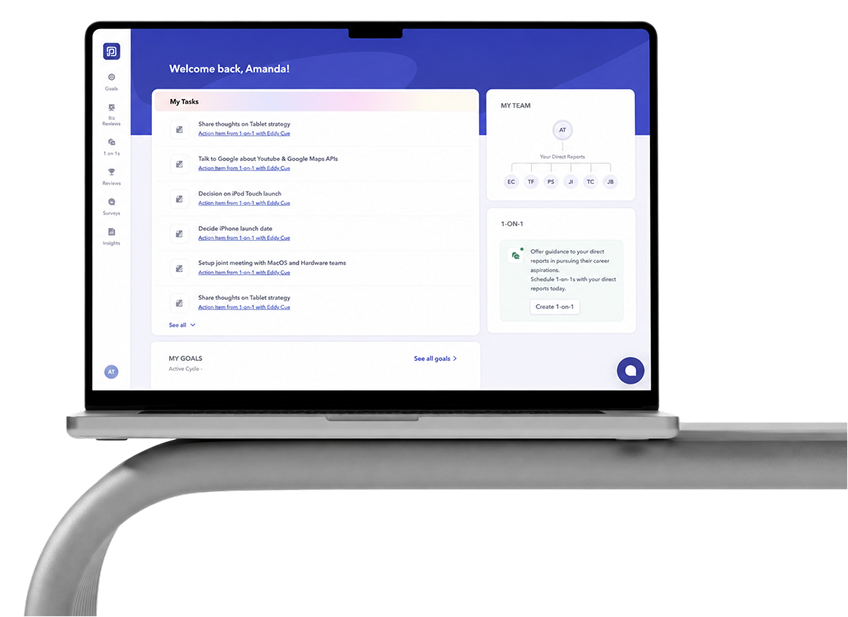
Peoplebox.ai, a performance management platform, handles Goal cascading, 1:1 management, continuous feedback, quarterly reviews with calibration, and HRIS integration, all in one platform. Reviews and check-ins run inside Slack or Teams, so adoption doesn’t depend on managers remembering to log in. Book a demo → Tailored to your team size and current setup. |
The ROI of Performance Management: A Framework for Your Business Case
Use the framework below to calculate what manual performance management is costing your organization and what structured performance management would cost to replace it. The numbers use a 200-person company as the baseline; adjust the inputs to match your headcount, average salary, and turnover rate.
The cost of manual performance management
- Manager time on manual review cycles if each manager spends 20 hours per review cycle across 8-10 direct reports, and the company runs two review cycles per year: 25 managers × 40 hours × $50/hour = $50,000/year in manager time, before accounting for HR admin overhead.
- HR admin overhead collecting forms, chasing completions, organizing feedback, and building reports for leadership. A lean two-person HR team spends 600 hours annually on performance management administration at $40/hour = $24,000/year.
- Turnover cost 15% annual turnover at 200 employees = 30 departures. At 50-150% of a $60K average salary:
Conservative (50%): $900,000/year
Moderate (100%): $1,800,000/year
A 2% improvement in retention from better performance management = 4 fewer departures = $120,000-$240,000 saved annually.
- Opportunity cost of strategic misalignment: When goals aren’t documented or tracked, teams work on initiatives that don’t connect to company priorities. This is the hardest cost to quantify, but HR leaders who have moved from verbal goals to tracked, cascaded goals consistently describe it as the most significant change.
The cost of performance management software
For a 200-person company at market rates:
- Subscription: $4-$10/employee/month = $9,600-$24,000/year
- Implementation: One-time $1,500-$3,000
- Training: Typically included in implementation
Total Year 1: $11,000–$27,000
At the most conservative estimate, a 2% improvement in retention at a 200-person company, the annual saving from reduced turnover alone is $120,000-$240,000 against a software cost of $11,000-$27,000. Manager time savings and HR admin reduction add further return on top of that.
Bottom Line
Performance management works when it’s treated as a system, not an event. The goal-setting at the start of a cycle, the check-ins in the middle, the feedback between reviews, and the calibration before ratings are published; each component depends on the others. Remove any one of them, and what remains is either incomplete data or a review cycle that produces ratings nobody trusts.
The starting point for most organizations isn’t building the perfect system. It’s following performance management best practices, agreeing on what they’re measuring, setting goals before work begins, and closing one complete cycle before adding complexity. The process doesn’t need to be sophisticated to be credible; it needs to be consistent.
FAQs
What is performance management?
Performance management is a continuous process of setting goals, monitoring progress, providing feedback, and evaluating employees to align individual performance with organizational objectives. It is the entire system, not just the annual review.
What is the difference between performance management and performance appraisal?
A performance appraisal is a single formal evaluation event, typically annual or bi-annual. Performance management is the ongoing system that includes goal setting, monitoring, feedback, and development throughout the year. The appraisal is one component of performance management.
What are the 5 stages of the performance management cycle?
Planning (goal setting), Monitoring (ongoing tracking and 1:1s), Developing (coaching and feedback), Reviewing (formal evaluation and calibration), and Rewarding (compensation and promotion outcomes).
What are common performance management frameworks?
OKRs (Objectives and Key Results), KRAs and KPIs (Key Result Areas and Key Performance Indicators), Balanced Scorecard, MBO (Management by Objectives), and SMART Goals. The right framework depends on company size, industry, and how mature the performance management process already is.
Why is performance management important?
Effective performance management aligns individual work with company strategy, creates a documented record of performance that informs fair compensation decisions, and gives employees the feedback they need to grow. Without it, reviews are based on recency bias and gut feel, which drives disengagement and attrition.
What is a performance management system?
A performance management system is software that makes the performance management cycle operational, replacing spreadsheets and email with a platform for goal tracking, review cycles, 1:1 management, calibration, and analytics. It should serve managers and employees, not just HR.
How do small businesses implement performance management?
Start with the process before the software. Agree on what you’re evaluating (goals, competencies, or both), set goals at the start of the cycle rather than retroactively, choose a rating scale and define what each level means, and run one complete cycle manually before introducing a tool. Start with one complete cycle. Adjust from there.
Author

Content Writer & SEO Specialist
I’m Rohitha Polavarapu, a Content Writer Associate at Peoplebox.ai, where I research and write about the evolving world of HR, AI, and employee experience. I joined the Peoplebox.ai editorial team in March 2025 after completing my MBA in Digital Marketing and Business Analytics from CMR University.
At Peoplebox.ai, I focus on creating content that simplifies complex HR and technology concepts from AI interviewers to performance management software and turns them into actionable insights for HR leaders and recruiters. My writing helps organizations make smarter, data-backed talent decisions while keeping the human element at the core of hiring and performance.
I explore topics such as recruitment automation, employee engagement, and the future of work, examining how AI empowers people leaders to make better decisions. When I’m not writing, I’m usually reading about new HR tech innovations or brainstorming ways to make HR content more engaging and relatable.
View profile 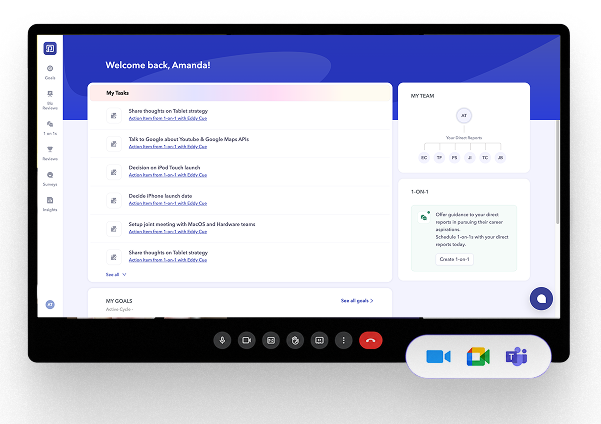
Top Picks




YOU'VE READ THE PLAYBOOK
Now see it running - live, on your org chart
A 30-minute walkthrough of reviews, goals and 1:1s inside Slack & MS Teams. No slides, just the product.
Request a Demo