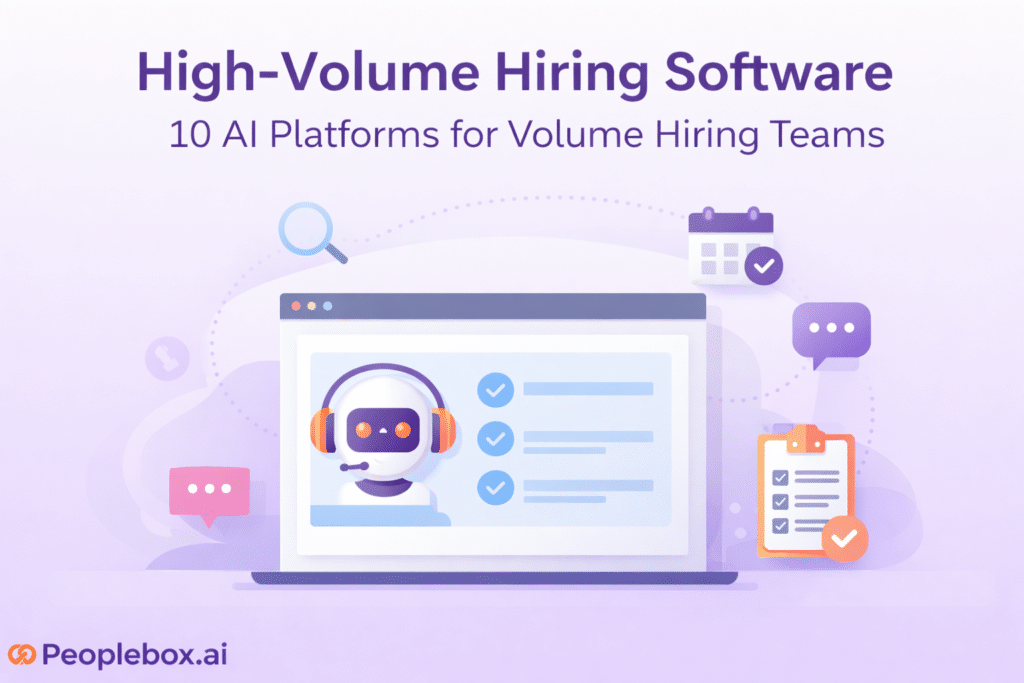

Hiring at scale requires a different approach than regular recruiting. When teams need to fill roles quickly and in large numbers, the right high-volume hiring software can make a real difference. This blog explores how high-volume hiring tools work and reviews 10 AI platforms designed to help hiring teams manage volume efficiently while maintaining consistent, controlled decision-making.
What is high-volume hiring software?
High-volume hiring software helps companies quickly recruit and hire a large number of candidates. It’s helpful for industries such as retail, hospitality, customer service, and logistics, which have many positions to fill quickly. According to HR.com, nearly three-quarters (73%) of companies engaged in this type of hiring in 2022.
These tools usually include automated screening, AI-based matching, mass communication, interview scheduling, and hiring dashboards. Some handle the entire hiring process, while others connect to an existing applicant tracking system to speed up certain steps.
The aim is straightforward: to process a large number of candidates faster, consistently, and without overburdening recruiters.
| According to a survey from Aptitude Research, nearly half (46%) of candidates who drop off early in the high-volume hiring process did so because of a poor application experience. |
Comparison of the best 10 high-volume hiring software
To make comparison easier, the table below breaks down each platform by what it’s best for, where it shines, and where it may fall short in real high-volume hiring scenarios.
| Platform | What type of software | Best For | Core Strength | Key Limitation |
| Peoplebox.ai | AI screening & interview platform (ATS overlay) | AI-led interviews + decision support | Human-like AI interviews, early signal insights | Focused on early screening, not a full ATS |
| Sapia.ai | Chat-based screening platform (ATS overlay) | Bias-aware chat screening | High completion rates, explainable scoring | More features than small teams may need |
| Paradox | Conversational AI (screening & scheduling overlay) | Conversational screening & scheduling | 24/7 engagement, scheduling automation | Limited depth in candidate assessment |
| Fountain | End-to-end ATS (hourly hiring) | Hourly & frontline hiring | Mobile-first ATS, automated workflows | Replaces existing ATS; not ideal for professional roles |
| HireVue | Video interview & assessment platform | Enterprise video interviewing | Structured video interviews, assessments | Video can impact candidate comfort; bias concerns |
| Harver | Assessment-led hiring platform | Assessment-centric hiring | Strong assessments, automated progression | Heavy assessments can reduce completion rates |
| SmartRecruiters | End-to-end enterprise ATS | Enterprise ATS with integrations | Full hiring lifecycle, large marketplace | Paid integrations needed for full- scale support |
| iCIMS | Enterprise ATS | Volume hiring with complex workflows | Configurable workflows, branding | Long setup and complex configuration |
| Phenom | CRM + talent experience platform | Talent pipelines & engagement | Career site, CRM, engagement tools | Feature-heavy; longer implementation |
| Greenhouse | ATS with partner ecosystem | Structured, fair hiring | Strong interview structure, scorecards | Needs partner tools for true high-volume hiring |
Best 10 high-volume hiring softwares
Here are some AI platforms that many large hiring teams use. Each tool tackles a different part of hiring, so choose the one that best fits the problem you’re trying to fix.
1. Peoplebox.ai – AI-led interviews and decision support for volume hiring
Best for: Teams that need to hire many candidates, want to use AI for interviews, keep reviews consistent, and speed up shortlisting but still want human judgment.
Peoplebox.ai swaps out old-fashioned first-round screening with human-like, voice-based AI interviews that run 24/7. Candidates are judged through real conversations rather than just their resumes. This system helps teams see how well people communicate and solve problems, and it lets them quickly evaluate many candidates.
Pros:
- AI-led, voice-based interviews available anytime
- Structured and consistent evaluation across candidates
- Reduces recruiter workload in early screening
- Helps teams move faster without rushing decisions
Cons:
- Best suited for teams hiring at scale rather than very small hiring volumes
Peoplebox.ai G2 rating: 4.5/5
2. Sapia.ai – Interview-first screening with a focus on fairness
Best for: Retail, quick service restaurants, healthcare, logistics, and call center groups that are hiring in many places or need seasonal staff.
Sapia.ai uses structured, chat-based interviews as the first step for every applicant. Candidates complete the interview process over the phone, and then the platform generates competency-based insights for hiring teams. The system is designed to minimise bias through anonymous scoring and clear results.
Sapia.ai cares deeply about candidate experience and fairness, making it popular in industries with compliance and fairness requirements.
Pros:
- High interview completion rates
- Blind and explainable scoring
- Strong analytics and transparency features
- Good ATS integrations
Cons:
- The Feature set may be more than smaller teams require
Saptia G2 rating: 4.6/5
3. SmartRecruiters – Enterprise ATS with a large marketplace
Best for: Large organisations that need a complete ATS with add-ons.
SmartRecruiters has everything from tracking applicants to scheduling interviews, handling offers, and creating reports. The Marketplace lets you add features like assessments, screening, and automation from other companies.
This approach works well for organisations with complex hiring needs but often requires combining multiple tools.
Pros:
- Covers the full recruiting lifecycle
- Large ecosystem of integrations
- Suitable for global enterprise hiring
Cons:
- Advanced use cases rely on paid integrations
- The Total cost can increase quickly
SmartRecruiter G2 rating: 4.3/5
4. Paradox – Conversational screening and scheduling
Best for: Teams that want to automate candidate communication and interview scheduling.
Paradox uses conversational AI to engage candidates, answer their questions, meet basic requirements, and automatically schedule interviews. It reduces recruiter coordination work and keeps candidates moving through the process.
This platform works best for communication and getting things set up, not for in-depth review.
Pros:
- 24/7 candidate engagement
- Strong scheduling automation
- Reduces time spent on coordination
Cons:
- Limited assessment depth
- Can allow many low-fit candidates to progress
Paradox G2 rating: 4.7
5. Fountain – High-volume ATS for hourly hiring
Best for: Companies that need to quickly hire lots of hourly and frontline staff.
Fountain is an ATS that works well on mobile devices, making it perfect for hiring a lot of hourly workers. It handles applications, background checks, offers, and onboarding. It uses automated steps made for frontline roles.
The platform is built specifically for volume but works best when used as the primary ATS.
Pros:
- Designed for hourly hiring patterns
- Strong mobile experience
- End-to-end automation
Cons:
- Requires replacing your existing ATS
- Not ideal for professional or mixed role hiring
Fountain G2 rating: 4.3
6. HireVue – Video interviews and assessments for enterprises
Best for: Big companies that conduct many video interviews.
HireVue started the trend of recorded video interviews. Now, it also offers tests and AI to help judge candidates. Candidates record their responses, and then either people or AI score them. The platform is widely adopted but can raise concerns around candidate comfort and bias.
Pros:
- Proven enterprise scalability
- Multiple assessment formats
- Detailed reporting and analytics
Cons:
- HireVue’s video-centric approach can affect candidate experience.
- Bias concerns with video-based AI scoring
Hire Vue G2 rating: 4.1
7. Harver – Pre-hire assessments with workflow automation
Best for: Teams that rely on pre-employment assessments to predict job performance.
Harver uses science-backed tests with automated steps. Candidates move forward based on their scores, and the system takes care of follow- ups, background checks, and even offers letters. This approach works well when assessments are strong predictors of success.
Pros:
- Validated assessments
- Strong workflow automation
- Clear insights into funnel performance
Cons:
- Assessment-heavy flows can reduce completion rates
- Shift from resume-first hiring requires change management
Harver G2 rating: 4.6
8. Phenom – CRM and talent experience platform
Best for: Enterprises focused on long-term talent pipelines and candidate engagement.
Phenom combines career site personalisation, CRM, automation, and internal mobility into a single platform. It’s designed to help organisations attract, engage, and re-engage talent over time. The platform is broad and powerful, but it can take time to implement.
Pros:
- Strong candidate engagement features
- Talent community building
- Enterprise-grade integrations
Cons:
- A large feature set can feel complex
- Longer implementation timelines
Phenom G2 rating: 4.3
9. iCIMS – Enterprise ATS with volume workflows
Best for: Organisations hiring both hourly and professional roles at scale.
iCIMS offers configurable workflows, automated screening rules, and sourcing tools within a single ATS. It supports high-volume hiring but requires significant configuration and setup.
Pros:
- Enterprise-ready ATS
- Handles complex hiring workflows
- Strong employer branding tools
Cons:
- Long implementation cycles
- Configuration can be time-consuming
iCIMS G2 rating: 4.1
10. Greenhouse – Structured hiring with partner tools
Best for: Growing and enterprise teams that prioritise structured, fair hiring.
Greenhouse is known for consistent interview frameworks and scorecards. While not built specifically for high-volume hiring, it scales well when combined with specialised screening and automation partners.
Pros:
- Strong, structured hiring approach
- Good hiring team experience
- Reliable partner ecosystem
Cons:
- Needs additional tools for true high-volume hiring
- Not optimised for frontline scale on its own
Greenhouse G2 rating: 4.4
Why Peoplebox.ai is different for high-volume hiring
Watch Nova, our AI interviewer, in action
Peoplebox.ai Nova is an AI-powered screening platform built specifically for early-stage hiring. It replaces manual resume screening and first- round interviews with human-like, structured AI interviews, helping teams evaluate a large number of candidates faster and in a more organized way.
A lot of hiring tools help with planning or sending messages, but Nova is designed to help you make better choices early in the hiring process.
Human-like AI interviews (voice and video)
Nova does interviews that feel like real talk, not like talking to a robot. Candidates can talk to an AI interviewer that seems like a person, using either voice or video. They can do the interviews when they have time, so they don’t have to wait for a recruiter to be free.
This helps more people finish the interview and reduces scheduling problems, which often occur when you are hiring many candidates.
Three-layer screening model
Nova evaluates candidates using multiple signals instead of relying on resumes alone:
- Resume assessment
Automatically analyzes experience, skills, and role relevance. - Interview assessment
Structured AI-led interviews with dynamic, context-aware follow-up questions. - Integrity and proctoring checks
We have features to help lower cheating, getting help from outside, and lying.
This approach to checking helps teams handle a lot of work while keeping reviews reliable.
Strong follow-up questioning (key differentiator)
Nova doesn’t just take the first answer it gets. In interviews, it asks smart follow-up questions to really dig in.
- depth of knowledge
- Decision making
- Trade-offs and real-world thinking
This mirrors how experienced human interviewers assess candidates and surface stronger signals early in the process.
Technical screening beyond auto-graded tests
For engineering and technical roles, Nova goes beyond traditional coding tests. Instead of acting like a test engine, Nova behaves like a senior interviewer:
- interacts with candidates while they solve problems
- asks clarifying and follow-up questions
- evaluates reasoning, approach, and problem solving, not just final answers
Consistent and bias-safe evaluation at scale
Nova applies structured rubrics and consistent scoring logic across all candidates. Because the AI doesn’t get tired, rushed, or influenced, evaluations remain consistent even when hiring volume spikes across roles, locations, or time zones.
Designed for asynchronous, high-volume hiring
Candidates complete interviews on their own schedule, which:
- reduces drop-offs
- removes scheduling friction
- creates a modern, candidate-friendly experience
Recruiters get clear summaries and data, so they can spend their time reviewing candidates and making final choices instead of sifting through applications by hand.
See how Peoplebox.ai handles high-volume hiringScreen hundreds of candidates faster with human-like AI interviews without adding recruiters or losing control. |
Where AI hiring tools make the biggest impact in high-volume hiring
When hiring volumes increase, different steps in the process slow down at different times. AI hiring tools are most helpful in areas where manual work creates the biggest bottlenecks.
1. Candidate sourcing
In high-volume hiring, sourcing is often the first place things break. Posting jobs one by one across multiple job boards and tracking candidates manually takes time and results in missed applicants.
AI hiring tools help teams post jobs to multiple job boards rather than uploading roles to each platform separately. Many tools also connect to large candidate databases and your existing ATS, helping recruiters surface past applicants and internal candidates who may already be a good fit.
Some platforms use simple, natural search rather than complex filters, so recruiters don’t need to use Boolean logic to find talent. According to LinkedIn, recruiters using AI-assisted sourcing are twice as likely to find qualified candidates faster than those using manual sourcing. The result is a fuller pipeline, less manual effort, and all candidate data tracked in one system.
2. Resume screening
Manually reviewing resumes is time-consuming and inconsistent, and recruiters often spend more time sorting than evaluating.
AI screening tools review resumes at scale and apply the same criteria to every candidate. Strong tools go beyond keyword matching by looking at related skills, work history, and role fit. They can flag keyword stuffing, copied resumes, and surface strong candidates who may be buried deep in the applicant list.
Some systems also bring back candidates already in your ATS who applied earlier for other roles, turning old data into an active talent pool. Research shows recruiters spend up to 52% of their time screening resumes, and AI-based screening can cut that effort by more than half.
3. Interview screening
In high-volume hiring, phone screens and first-round interviews often become the biggest bottleneck. AI-driven interviews fix this by taking care of initial screening automatically. Candidates can do interviews whenever it works for them, and the system checks everyone’s answers in the same way.
Better tools can even do two-way interviews, asking follow-up questions based on what candidates say. This helps check their communication skills, problem-solving abilities, and how well they fit the job early on, so recruiters don’t have to be part of every first interview. Studies show that structured and automated interviews can reduce time-to-hire by up to 40% in high-volume roles.
Real-World Examples: How Teams Use High-Volume Hiring Software at Scale
Here are some real-world cases of how teams put high-volume hiring software to work. These examples are from public case studies done by vendors of hiring software. They show how teams handle a lot of hiring while keeping it quick, fair, and positive for job seekers.
1. EDF Energy: Managing 17,000+ Applications Without Losing Fairness
EDF Energy gets over 17,000 applications each hiring season for its graduate and entry-level jobs. Phone screenings done by hand used to take 30-40 minutes for each person, which meant recruiters got stuck doing paperwork.
By switching to asynchronous interviews, EDF:
- Allowed candidates to interview when it suited them.
- Provided audio or video choices to make it easier for everyone.
- Used the same scoring for each applicant.
Result:
EDF reduced recruiter paperwork by 50% and gave every applicant a fair shot.
2. Packaly: Scaling Hiring from 7 Days to 8 Hours
Packaly faced the challenge of quickly bringing on over 3,500 delivery drivers. Their old hiring process took 7 days per person and would have required hiring 4 more recruiters to handle the load.
They changed their hiring to use automation and basic screening, focusing on the skills that mattered most for delivery work.
Result:
- Time from application to onboarding went down to 8 hours.
- The team hired many more candidates without needing additional recruiters.
- They saved a lot of hiring costs.
3. Lunio: Replacing Recruitment Agencies for Volume SDR Hiring
After their Series A funding, Lunio had to quickly grow its sales development rep team. Instead of relying on agencies, they decided to handle the initial screening themselves using video interviews that candidates could complete on their own time.
Result:
- They built their SDR team without paying any agency fees.
- They saved over £50,000.
- They kept complete control over their company brand and candidate experience.
4. Madison Reed: Cutting Time-to-Hire in Half Nationwide
Madison Reed needed to hire stylists for over 95 locations, and many had unusual schedules. Live interviews were causing major delays.
So, they switched to on-demand video interviews with automatic reminders, letting candidates answer at their convenience.
Result:
- Hiring time reduced from over 30 days to less than 15.
- Screening time dropped by 66%.
- Candidate response rates doubled.
Together, these examples show a clear pattern: when teams remove manual screening and scheduling from high-volume hiring, speed improves without sacrificing fairness or candidate experience.
Whether it’s early career roles, gig workers, sales teams, or frontline staff, the right hiring software helps teams scale without adding recruiters or burning out the ones they already have.
Conclusion
When you’re hiring a lot of candidates, things fall apart if you are doing everything manually. The correct hiring software can assist teams in working more quickly, keeping candidates interested, and maintaining consistency without taking recruiters’ decision-making power.
If you choose tools that match how you work and can handle more as you expand, high-volume hiring becomes simpler to handle and easier to do well.