



















Dhanya
Home / HR Toolkit / Performance Improvement Plan Template
● Free HR template · Word, PDF, Google Docs, Excel
Free Performance Improvement Plan Template
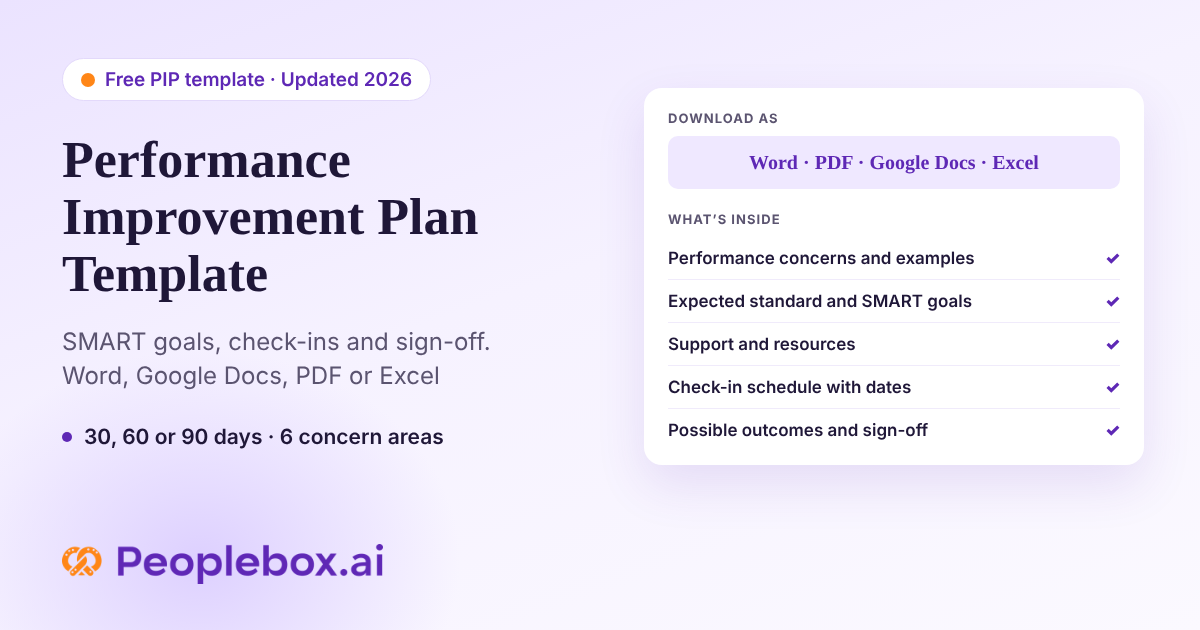
A free performance improvement plan (PIP) template with performance concerns, SMART goals, support, a check-in schedule and sign-off. Fill it in on this page, then download it in Word, PDF or Google Docs.
- 30, 60 or 90-day plan with check-in dates
- 6 ready concern areas with SMART goals
- Word, PDF, Google Docs and an Excel tracker
Fill in your PIP
Add the details and pick the concern areas. The plan below updates as you type.
Concern areas (1 selected)
Add dates and facts. They appear under Performance concerns.
More options (optional)
Want AI to write the plan for you? Use the free AI PIP generator →
What is a performance improvement plan template? A performance improvement plan (PIP) template is a ready document that sets out an employee’s performance concerns, the standard expected, measurable goals, the support offered and the check-in dates over 30, 60 or 90 days. It keeps every PIP fair, specific and consistent.
Performance improvement plan template: preview and edit
This is your 60-day performance improvement plan. Fill in the details above, then edit any text after you download it.
[Company name]
PERFORMANCE IMPROVEMENT PLAN (PIP)
| Employee name | [Employee name] |
|---|---|
| Job title | [Job title] |
| Department | [Department] |
| Manager | [Manager name] |
| HR contact | [HR contact] |
| Plan length | 60 days |
| Start date | [Start date] |
| End date | [End date] |
1. Purpose of this plan
This performance improvement plan sets out the areas where the employee’s performance needs to improve, the standard expected and the support the company will provide over the next 60 days. The aim of this plan is to help the employee succeed in the role.
2. Performance concerns
Work quality
The quality of the employee’s work has been below the standard expected for the role. Recent work has needed repeated corrections or rework before it could be used.
Examples
- [Date and specific example 1]
- [Date and specific example 2]
3. Expected standard
- Work quality: Work is accurate, complete and meets the agreed quality checklist the first time it is submitted.
4. Improvement goals
| # | Goal | How success is measured | Deadline |
|---|---|---|---|
| 1 | Submit work that passes the quality checklist on the first review | At least 90% of tasks pass review with no major corrections | Day 30 |
| 2 | Self-check every task against the checklist before submitting | Checklist attached to each submitted task | Day 30 |
| 3 | Reduce rework requests from the team | No more than one rework request per week by the end of the plan | Day 60 |
5. Support and resources
- Team quality checklist and a short walkthrough with the manager
- Example of a high-quality piece of work to use as a reference
- Weekly feedback from the manager on recent work
- Every-two-weeks check-in meetings with [Manager name]
6. Check-in schedule
| Check-in | Date | Progress notes |
|---|---|---|
| Check-in 1 | Day 14 | |
| Check-in 2 | Day 28 | |
| Check-in 3 | Day 42 | |
| Final review | Day 60 |
7. Possible outcomes
- Goals met: the plan closes and the employee continues in the role with regular feedback.
- Good progress, goals not fully met: the plan may be extended once, for up to 30 days.
- Goals not met: further action may be taken in line with the company’s policies, which can include a change of role or termination of employment.
8. Employee comments
9. Sign-off
Signing confirms that this plan was shared and discussed. It does not mean the employee agrees with every point.
| Role | Name | Signature | Date |
|---|---|---|---|
| Employee | [Employee name] | ||
| Manager | [Manager name] | ||
| HR | [HR contact] |
This template is a general guide, not legal advice. Check it against your company policy and local employment law before use.
Your template is unlocked. Use Download Word, PDF, Google Docs or the Excel tracker above any time. Want to track PIP goals, check-ins and review notes in one place instead of a document?
What is a performance improvement plan?
A performance improvement plan (PIP) is a formal, written plan that gives an employee a set time, usually 30, 60 or 90 days, to close a specific performance gap. It explains what is not working, what good looks like, how progress will be measured and what help the company will give.
A good PIP is a support tool, not a formality before letting someone go. When the goals are clear and the manager checks in often, many employees use the plan to get back on track.
When to use a PIP: after regular feedback and coaching have not fixed a clear, ongoing issue with work quality, deadlines, attendance, conduct or targets. If you have not yet given feedback, start with a one-on-one conversation first.
PIP or 30-60-90 day plan? A PIP is for an existing employee whose performance has fallen below the expected standard. Setting goals for a new hire or a new role instead? Use the free 30-60-90 day plan template.
What to include in a performance improvement plan
The template above already has every section.
| Section | What to write |
|---|---|
| Employee and plan details | Name, job title, department, manager, HR contact, plan length, start and end dates. |
| Purpose | One short paragraph on why the plan exists and that the goal is to help the employee succeed. |
| Performance concerns | The specific issues, with dates and examples. Facts, not opinions. |
| Expected standard | What good performance looks like for this role, in measurable terms. |
| SMART goals | Two to four goals, each with how success is measured and a deadline. |
| Support and resources | Training, coaching, tools and regular time with the manager. |
| Check-in schedule | Dates for each review meeting and space for progress notes. |
| Possible outcomes | What happens if goals are met, if more time is needed and if they are not met. |
| Comments and sign-off | Space for the employee’s comments and signatures from the employee, manager and HR. |
How to write a performance improvement plan
- Gather facts first: Collect specific, recent examples of the issue with dates, and check that the employee already knew what was expected.
- Describe the gap clearly: Write what is happening now and the standard you expect, in plain words and without labels about personality.
- Set SMART goals: Agree two to four goals that are specific, measurable and possible to reach within the plan length.
- List the support: Name the training, tools, coaching and time the company will give, so the plan is fair and realistic.
- Book the check-ins: Put weekly or every-two-weeks check-ins in the calendar and note progress after each one.
- Explain the outcomes: Say what happens if the goals are met, if more time is needed and if they are not met, in line with company policy.
- Meet, discuss and sign: Go through the plan in a private meeting, let the employee add comments, then ask everyone to sign and date it.
Performance improvement plan example
Here is a short example of a 60-day PIP for work quality, written with this template.
| Section | Example |
|---|---|
| Employee | Jordan Lee, Customer Support Specialist, 60-day plan from December 1 to January 30 |
| Concern | In October and November, 9 of 30 reviewed tickets had wrong answers or missing steps, and 4 customers reopened tickets. |
| Expected standard | At least 90% of reviewed tickets pass the quality checklist, with fewer than 2 reopened tickets a month. |
| Goal 1 | Pass the quality checklist on 90% of reviewed tickets by day 60. Measured in the weekly QA review. |
| Goal 2 | Use the knowledge base checklist on every ticket from day 1. Measured by spot checks. |
| Support | Two shadowing sessions with a senior agent, a product refresher course and weekly 30-minute coaching with the manager. |
| Check-ins | Every two weeks: days 14, 28, 42 and 60. |
30, 60 or 90-day PIP: which to choose
| Plan length | Best for | Check-ins |
|---|---|---|
| 30 days | Clear, quick-to-fix issues such as attendance, punctuality or following a process. | Weekly |
| 60 days | Most work quality, productivity and communication issues. | Every two weeks |
| 90 days | Complex skills, senior roles or targets that take longer to show, such as sales. | Every two weeks |
Tips for a fair performance improvement plan
- Be specific. “Missed 4 of 10 deadlines in October” is clearer than “often late”.
- Keep the goals few and reachable. Two to four goals are enough for one plan.
- Give real support and write it down, so the employee has what they need to improve.
- Hold every check-in on time and write short notes the employee can see.
- Focus on the work, not the person. Avoid words about personality or attitude.
- Check the plan with HR and your company policy before you share it.
Need help with the feedback conversation itself? Read our constructive criticism examples.
Track PIP goals and check-ins in one place
Peoplebox keeps goals, one-on-one notes, feedback and reviews together, so managers can follow a performance improvement plan week by week and HR can see progress without chasing documents.
Related HR guides
- Constructive criticism examples
How to give clear, fair feedback before and during a PIP.
- SMART goals examples for employees
Ideas for measurable PIP goals.
- Areas of improvement examples
Words to describe performance gaps.
- Performance review templates and forms
Review the employee at the end of the plan.
Performance improvement plan FAQs
What is a performance improvement plan template?
A performance improvement plan template is a ready document HR and managers use to write a PIP. It has sections for the performance concerns, the expected standard, SMART goals, the support the company will give, check-in dates, possible outcomes and sign-off, so every plan is clear and consistent.
What should a performance improvement plan include?
Employee and manager details, the plan length and dates, specific performance concerns with examples, the standard expected, measurable goals with deadlines, the training or support offered, a check-in schedule, what happens at the end of the plan, space for employee comments, and signatures.
How long should a PIP last?
Most PIPs last 30, 60 or 90 days. Use 30 days for clear, quick-to-fix issues such as attendance, 60 days for most performance issues, and 90 days for complex skills or roles where results take longer to show, such as sales.
How often should you check in during a PIP?
Weekly for a 30-day plan and every two weeks for 60 and 90-day plans. Write down progress after each check-in and share it with the employee, so there are no surprises at the end of the plan.
Should the employee sign the PIP?
Yes. Ask the employee, the manager and HR to sign and date the plan. The signature confirms the employee received and discussed the plan. It does not mean they agree with every point, and they can add their own comments.
Is this PIP template free?
Yes. You can fill in and preview the performance improvement plan on this page for free. To download it in Word or PDF, copy it for Google Docs or get the Excel tracker, you share your name, work email and phone number once. After that, every toolkit download stays unlocked in your browser.
Can I use this PIP template in Word, Google Docs or Excel?
Yes. Download Word to edit the plan in Microsoft Word, use Copy for Google Docs to paste it into a Google Doc, or download the CSV tracker to follow goals and check-ins in Excel or Google Sheets.
Is this template legal advice?
No. This template is a general starting point. Employment rules differ by country and state, so check the plan against your company policy and local law, and speak to your HR or legal team before you use it.
Get your PIP template
Share a few details with your work email to download the template. We will also send you useful HR resources.
Work emails only. By continuing you agree to Peoplebox’s Privacy Policy. The details in your plan never leave your browser.
✓ Your performance improvement plan is downloading
See Peoplebox.ai in action
Loading the form…
Trusted by 600+ organizations across 60+ countries
Since we started using Peoplebox.ai, we have been able to bring all of our leadership across the organization together and show them how all of our goals align

Jaclyn HooverSenior Director HR, Propel School