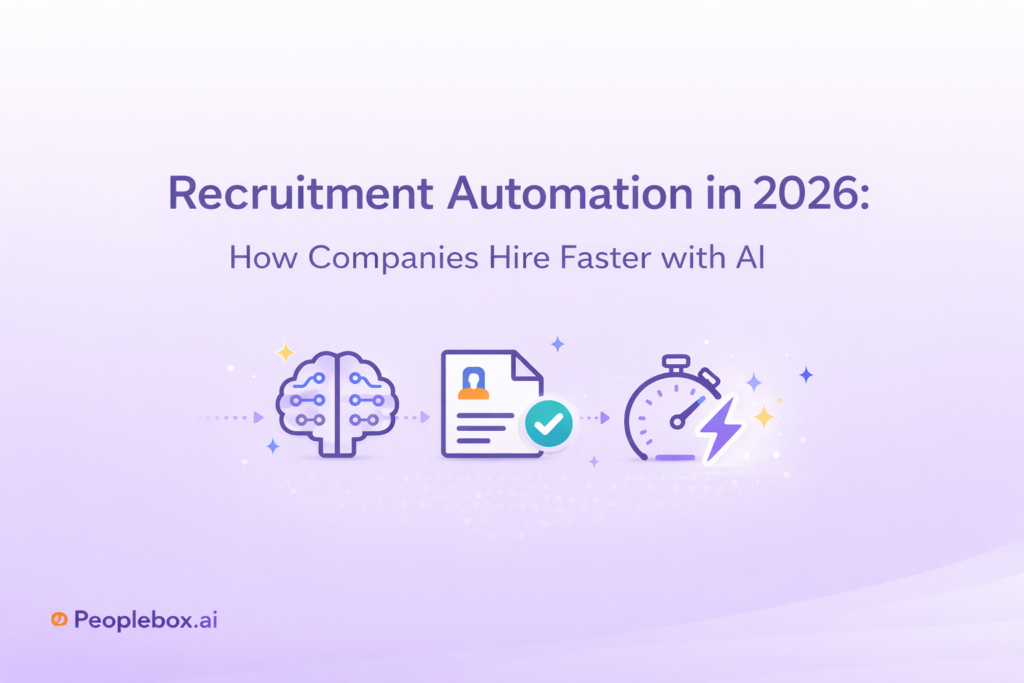

Recruitment automation in 2026 is redefining hiring speed.Companies are moving from weeks to days not by adding headcount, but by applying AI where it matters most.
Roles now attract hundreds of AI-assisted applications within 24-48 hours. When inbound moves that fast, the advantage doesn’t go to the team with the best scheduling system.
It goes to the team that evaluates first.The companies hiring faster in 2026 have automated first-round judgment and that’s the shift changing everything.
The Real Shift: AI on Both Sides of Hiring
AI is expanding what hiring teams can do on both sides of the process. Candidates use AI to write resumes, tailor applications, and rehearse answers. Recruiters use AI to source, filter, and assess applicants.
When both sides use AI, traditional screening signals weaken. Keyword filters become less reliable, and resume polish becomes less predictive.
The constraint isn’t coordination, it’s evaluation:
- How do you distinguish genuine experience from AI-polished answers
- How do you assess 300 candidates consistently?
- How do you shortlist before strong candidates move on?
Why 2026 Is Different
AI adoption in hiring didn’t start this year. What changed is scale.Candidates now use AI by default. Application velocity increased without recruiter headcount increasing. Hiring managers expect faster shortlists.
The gap between inbound volume and human evaluation capacity widened. That gap made decision automation necessary, not optional.
To understand how hiring reached this point, it helps to look at how automation evolved.
From Workflow Automation to Recruitment Automation: The Shift to Decision Automation
Most TA teams have been through two phases of automation. In 2026, a third is underway. Understanding the difference matters before you choose where to invest.
Phase 1: Workflow Automation
Automated emails, scheduling links, application confirmations, rejection triggers,status notifications removed a large share of administrative tasks from recruiters’ plates and it worked. But workflow automation doesn’t evaluate candidates. It just moves them through a process faster.
Phase 2: Screening Automation
ATS knockout filters, skills-matching algorithms, resume ranking, and keyword-based shortlisting were designed to reduce recruiter workload. They trimmed the volume but they didn’t solve the real bottleneck: human screening.
The problem: keyword matching rewards candidates who know how to game the system. Ranking algorithms sort resumes but don’t assess candidates. A list of 50 “top-ranked” profiles still requires a human to determine which ones are actually worth talking to.
The workload shrinks from 400 profiles to 50 but it’s still manual, still subjective, and still a bottleneck.
Phase 3 (2026): Decision Automation
This is the layer most TA teams haven’t fully adopted yet and it’s where the time-to-fill gap is being closed.
Decision automation doesn’t sort resumes or send emails. It evaluates candidates. Specifically:
- AI conducts the first-round interview conversationally, not via static form
- AI probes when answers are vague or inconsistent (“You mentioned 2 years in that role can you walk me through a specific challenge you solved there?”)
- AI detects patterns that signal strong or weak fit based on structured competency frameworks
- AI generates a hiring-ready scorecard with reasoning so the recruiter steps in with context, not confusion
The output isn’t a ranked list. It’s a structured evaluation. A recruiter who previously spent 3 hours on 12 phone screens can now review 12 AI-generated scorecards in 25 minutes and make better decisions because the evaluation criteria are consistent across all 12.
If automation now targets evaluation, the next question is simple:What exactly can AI handle in first-round screening and where does human judgment still matter?
What AI Can and Cannot Replace in First-Round Screening
The real question isn’t whether AI can replace first-round interviews.It’s what first-round interviews are actually designed to accomplish.
1. Can AI Ask Smart Follow-Ups?
If built for conversation – yes.
A strong AI interviewer doesn’t just ask scripted questions, it listens. If a candidate claims four years of sales experience but cannot explain a key metric, the system probes deeper. That kind of adaptive follow-up is what separates conversational AI from static forms or one-way video platforms.
2. Can It Judge Communication Quality?
At the first-round level – yes.
AI can assess clarity, structure, coherence, and professional tone. For high-volume roles in sales, support, operations, and healthcare-facing teams, that level of signal is usually enough to determine whether a candidate moves forward.
3. Can It Assess Real Role Fit Not Just Keywords?
Only when built on competency frameworks.
Instead of scanning for “CRM” or “Salesforce,” AI can evaluate how a candidate handled an angry customer or solved a real operational issue and score that response against predefined criteria.That’s fundamentally different from resume ranking.
4. Can It Evaluate at Scale Consistently?
This is where AI has a structural advantage.A recruiter’s 30th phone screen is never evaluated the same way as their first. Fatigue and comparison bias creep in.
AI applies the same framework to candidate 1 and candidate 300. That consistency is what enables scale without drift.
The Real Boundary
AI does not replace human judgment. It replaces repetitive, structured screening work so human judgment is applied later, on a smaller and higher-quality shortlist. In high-volume hiring, that shift is what compresses weeks into days.
How AI Actually Speeds Up Hiring
Hiring slows down at the first evaluation layer. In high-volume environments, three delays compound:
1. Screening Lag
Applications arrive in hours, screening happens days later. AI removes this gap by evaluating candidates immediately after they apply, not when a recruiter finds calendar space.
2. Calendar Dependency
Traditional first-round calls depend on recruiter availability.When screening runs through AI, interviews happen 24/7 across time zones. Evaluation is no longer constrained by working hours.
3. Shortlist Delay
Recruiters spend hours reviewing resumes and conducting repetitive calls before presenting a shortlist.With AI-generated structured scorecards, recruiters review evaluated candidates instead of raw profiles. The time to create a qualified shortlist drops dramatically.
When these three delays disappear, early-stage hiring compresses from weeks into days.The speed gain doesn’t come from doing the same work faster, it comes from removing human bottlenecks at the evaluation layer.
That’s how companies hiring 100+ roles per quarter maintain consistency even during volume spikes.
Will Candidates Accept AI Interviews?
The common concern is simple: Will candidates drop off if they’re asked to interview with AI?
In reality, candidates don’t resent AI, they resent the delay. In high-volume hiring, frustration rarely comes from technology. It comes from silence:
- Apply on Monday, hear nothing until the following week
- Screening call scheduled 5-8 days out
- After the call, two more weeks of uncertainty
- No clarity on next steps
Against that experience, a structured AI interview available immediately completed in 15 minutes, with confirmation within hours is not a downgrade, it’s faster and more transparent.
Speed signals seriousness and companies that respond quickly appear organized and decisive. That perception alone often improves engagement and offers acceptance rates.
Where AI interviews fail is not in the technology, but in the design:
- One-way video platforms with no context feel transactional.
- Static question forms feel like surveys.
- Black-box evaluations create distrust.
Conversational AI that explains the process, adapts follow-ups, and clearly communicates next steps feels structured not impersonal.
That said, candidate trust is not automatic. Transparency, human oversight, and explainability are essential,when candidates understand what is being evaluated and how decisions are made, acceptance increases significantly.
The issue isn’t whether candidates will accept AI, it’s whether the experience is designed well.
What Changes for Recruiters?
Every AI hiring discussion eventually lands on the same question:If AI handles screening and first-round interviews, what happens to recruiters?
The answer isn’t replacement. It’s a reallocation.When first-round screening is automated, here’s what disappears:
What goes away:
- 30 repetitive phone screens per week for a single requisition
- Resume triage across hundreds of applications
- Back-and-forth scheduling for initial calls
- Manually compiling briefing notes for hiring managers
What remains and becomes more important:
- Hiring manager alignment: ensuring the role is scoped correctly, the criteria are right, and the AI’s evaluation framework reflects what actually predicts success
- Offer conversion: closing candidates who have competing offers requires relationship skills, negotiation, and judgment that AI doesn’t have
- Candidate experience at decision stages: the moments that define employer brand senior interviews, offer conversations, onboarding are human moments
- Talent marketing and pipeline building: identifying and warming future candidates before roles open
- Analytics and continuous improvement: reading shortlist quality data, identifying where the funnel is leaking, calibrating evaluation criteria
The recruiter role doesn’t shrink, it shifts from volume handling to decision influence.Teams that automate repetitive screening don’t eliminate recruiters but they increase recruiter capacity per requisition and elevate the impact of the role.
When AI Screening Becomes a Speed Advantage (And When It Doesn’t)
AI screening is powerful but it’s not universal. The decision should be driven by hiring velocity and evaluation complexity, not trend pressure.
Here’s how to think about it.
Adopt Now If:
- You hire 50+ roles per quarter.
At this scale, manual first-round screening becomes structurally unsustainable. If a single role requires 8 recruiter-hours of screening and you manage 50 requisitions, that’s 400 hours per quarter spent just on early evaluation. That’s not inefficiency, it’s capacity overload.
- You operate in high-volume environments (BPO, frontline, healthcare, tech scale-ups).
These roles share repeatable competencies, heavy inbound, and aggressive time-to-fill targets. AI screening thrives where structured evaluation matters more than nuanced relationship-building.
- You receive high inbound volume with uneven quality.
If a large percentage of applicants are unqualified, the problem isn’t sourcing, it’s filtering. AI screening is designed to evaluate at scale consistently and without fatigue.
- You hire across multiple time zones.
Human screening is bound by recruiter availability but AI screening runs continuously, eliminating lag created by geography.
You Can Wait If:
- You hire fewer than 10 roles per month.
At lower volumes, structured phone screens and disciplined scorecards often deliver sufficient ROI without additional infrastructure.
- Your focus is primarily senior executive hiring.
Executive evaluation is contextual, relational, and heavily judgment-driven. AI adds limited value in early filtering at this level.
- You recruit for highly specialized or research-intensive roles.
When publications, patents, or deep domain expertise drive evaluation, human-led assessment remains more effective.
The decision isn’t about being “early” or “late” to AI. It’s about whether screening is currently your bottleneck.If volume creates evaluation strain, AI screening is a leverage tool. If it doesn’t, discipline and structure may be enough for now.
What an AI-Ready Hiring Stack Looks Like
This isn’t a tool comparison. It’s a conceptual architecture that shows where each capability belongs.
Layer 1: ATS – System of Record Your existing ATS isn’t going anywhere. It’s where candidate data lives, compliance is tracked, and reporting is generated. The specific choice matters less than ensuring it’s actually configured and used correctly.
Layer 2: AI Screening Layer – Decision Engine This is where first-round evaluation lives. It’s not built into most ATS platforms at the depth required for volume hiring. This layer conducts structured interviews, applies competency frameworks, generates scorecards, and surfaces the candidates worth human time.
Layer 3: Scheduling Layer – Coordination Automation Once candidates are shortlisted, interview scheduling should be fully automated. Self-scheduling links, interviewer availability sync, automated reminders, no-show re-engagement. This layer should require zero recruiter involvement.
Layer 4: Interview Intelligence Layer For human interviews that happen after AI screening, this layer captures notes, generates summaries, and ensures evaluation consistency. Not all teams need this immediately, but at scale it reduces decision latency significantly.
Layer 5: Analytics Layer Real-time visibility into where the funnel is breaking by role, source, stage, and recruiter. Most ATS platforms report on historical data. This layer provides live operational data so course-corrections happen during a hiring drive, not after.
The important point: you don’t need all five layers simultaneously. Most TA teams at 50–200 hires per quarter need Layers 1, 2, and 3 to see meaningful improvement. Start there.
What Hiring Looks Like After Evaluation Is Automated
When first-round evaluation is automated, the hiring flow changes in a practical way:
When application submitted:
→ AI conducts a structured first-round screening within hours
→ A scorecard is generated with clear evaluation criteria and reasoning
→ Recruiter reviews a qualified shortlist not raw resumes
→ Hiring manager interviews high-signal candidates
→ Job offering
The difference isn’t that humans disappear from the process.It’s that humans enter later when the signal is stronger, the noise is filtered out, and their time is focused on decision-making, alignment, and closing.
Automation doesn’t remove judgment. It removes early-stage bottlenecks so judgment is applied where it matters most.
| Automate First-Round Screening
Stop spending recruiter hours on repetitive phone screens. Peoplebox.ai’s Nova helps you run structured AI interviews, generate scorecards instantly, and shortlist qualified candidates within hours. |
The Single Most Important Decision in Your 2026 TA Strategy
Every TA leader is facing the same question right now: where does AI actually belong in my process, and what does my team do when it’s there?
The companies getting this right have a consistent pattern: they identified screening as the bottleneck, removed humans from that specific stage, and redirected recruiter time toward closing, alignment, and experience. They didn’t automate everything. They automated the right thing.
The question is no longer whether to adopt. It’s whether you adopt at the right layer or spend another year automating around the bottleneck that’s actually slowing you down.
First-round screening is where volume hiring breaks and where AI delivers its clearest ROI when implemented correctly.