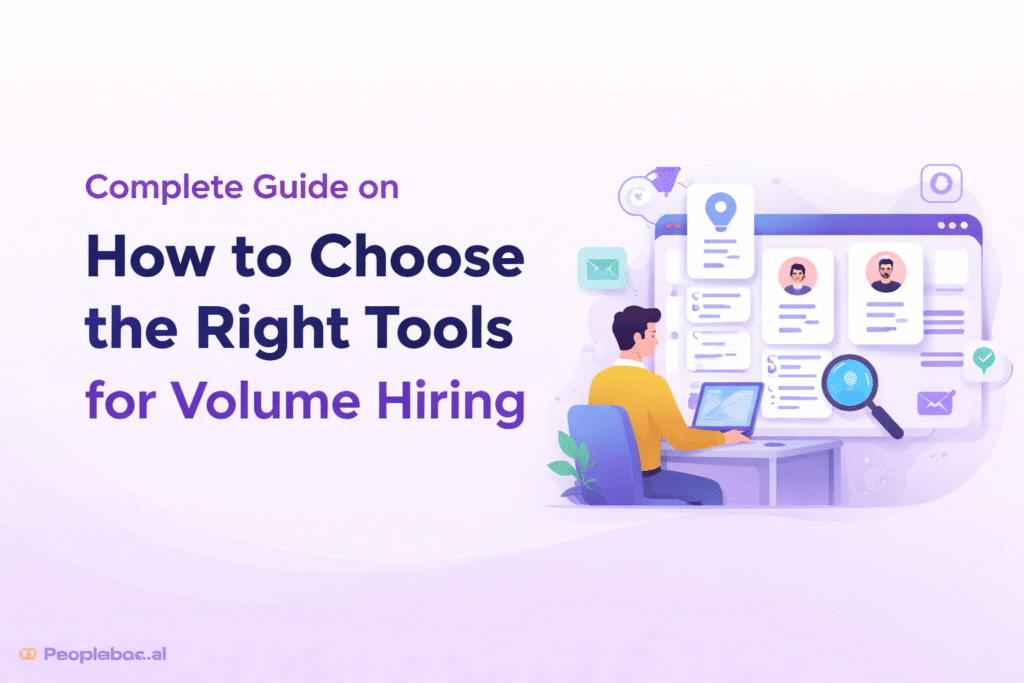

Bulk hiring doesn’t break because you chose a bad tool. It breaks because you chose a tool for the wrong bottleneck.
When applications spike, pressure exposes exactly where your hiring system fails, resume overload, screening capacity, scheduling delays, hiring manager latency, or offer-stage drop-offs. If you solve the wrong stage, the backlog simply shifts downstream.
This guide is built to help you diagnose first, then decide. Before evaluating vendors, identify what’s actually slowing your volume hiring and match the solution to that constraint.
If you want a simple comparison of the top bulk hiring tools and when to use them, read “Bulk Hiring Tools: 10 Best Platforms to Hire at Scale Faster.”
Why Most Bulk Hiring Tool Decisions Go Wrong
Most bulk hiring tools don’t fail at implementation. They fail at purchase.Here’s how it happens:
Buying automation without diagnosing bottlenecks
A team hitting 10,000 applications buys an AI screening tool. But their actual problem is that hiring managers take 12 days to review shortlists. The AI generates faster shortlists and they sit in inboxes just as long. Nothing changes.
Confusing sourcing overload with screening overload
These are not the same problem. Sourcing overload means you don’t have enough qualified applicants. Screening overload means you have too many to process. Buying a screening tool when you have a sourcing problem gives you an empty, efficient funnel. Buying sourcing tools when your problem is screening creates more chaos.
Solving speed while ignoring decision latency
GoodTime’s 2025 Hiring Insights Report found that 35% of recruiter time is spent on interview scheduling alone. But scheduling delays are rarely the root cause. Often, the real issue is that candidates aren’t being advanced to scheduling quickly enough. Fix the wrong stage, extend your timeline.
Mistaking “AI” for “capacity”
AI screening doesn’t add headcount. It changes where your team’s effort goes. If your recruiters are spending 8 hours a day on screening calls, AI screening can free those 8 hours. But if they’re spending those 8 hours on hiring manager negotiations, compliance reviews, or offer management, AI screening won’t help.
Here are the five bottlenecks that break most volume hiring drives: diagnose yours before you shortlist tools.
The 5 Bulk Hiring Bottlenecks (Diagnose Yours First)
Before evaluating vendors, identify which bottleneck is actually breaking your volume hiring. Most teams have one primary constraint. Solve that first.
Bottleneck 1: Applicant Volume Overload
What it looks like:
- Hundreds+ of applications per role
- Recruiters buried in manual resume review
- Good candidates lost in keyword filtering
Diagnosis test: Are recruiters spending most of their time just trying to find who to talk to?
You need: Structured screening that creates signals before a recruiter touches the profile.
Bottleneck 2: Screening Capacity Collapse
What it looks like:
- First-round phone screens dominating recruiter calendars
- Inconsistent pass/reject decisions across recruiters
- Strong candidates accepting other offers before being screened
Diagnosis test: Is your team the throughput constraint in the first interview stage?
You need: A scalable first-round evaluation method that replaces repetitive calls without removing decision control.
Bottleneck 3: Scheduling Coordination Failure
What it looks like:
- Qualified candidates waiting days for interview slots
- High no-shows and constant rescheduling
- Multi-location coordination slowing everything down
Diagnosis test: Is your shortlist ready, but interviews can’t happen fast enough?
You need: Automation that handles scheduling, reminders, and reschedules without recruiter intervention.
Bottleneck 4: Hiring Manager Review Delays
What it looks like:
- Shortlists sitting unreviewed
- Candidates waiting weeks for feedback
- Candidates disengaging mid-process
Diagnosis test: Do candidates wait more than two weeks for internal decisions?
You need: Structured scorecards and clear outputs that reduce decision effort for hiring managers.
Bottleneck 5: Offer-Stage Attrition
What it looks like:
- Low offer acceptance
- Slow approvals and paperwork delays
- Candidates going cold at the final stage
Diagnosis test: Are you losing candidates after final interviews?
You need: Faster offers workflows, approvals, and pre-boarding communication, not more screening tools.
The Bulk Hiring Tool Decision Matrix
Once you’ve diagnosed your primary bottleneck, the category decision becomes straightforward.
| Your Bottleneck | Tool Category You Need | What It Does |
| Resume overload / volume screening | AI interview or structured screening tool | Replaces manual resume review and first-round calls with structured, scalable evaluation |
| Scheduling coordination failure | Conversational automation | Handles interview scheduling, reminders, and rescheduling without recruiter involvement |
| Candidate drop-off mid-funnel | Communication-first tools | Automated engagement, status updates, and re-engagement sequences |
| Multi-location or compliance complexity | ATS backbone / structured HRIS | Workflow standardization, compliance tracking, audit trails across locations |
| Event / campus / walk-in hiring | Intake-first platform | Rapid applicant capture, queue management, on-site screening |
| Hiring manager review delays | Structured output + internal process | Better scorecards and summaries plus process accountability |
| Offer-stage attrition | Offer workflow + onboarding automation | Faster approvals, digital offer delivery, pre-boarding engagement |
Pick the row that explains most of your pain.Solving one bottleneck first platform replacement is a different project.
| Cut Time-to-Shortlist Without Adding Recruiters
When applications spike, the goal isn’t “more automation.” It’s faster, consistent first-round decisions. Peoplebox.ai Nova runs adaptive AI interviews (phone/video/chat), evaluates candidates using structured rubrics, and delivers clear scorecards your hiring managers can act on immediately. If you want to reduce screening backlog and hiring manager decision latency in bulk hiring drives, Nova is built for that constraint. |
When Not to Buy a Bulk Hiring Tool
- Don’t buy if your issue is sourcing, not screening.
Do this instead: Fix applicant inflow first job distribution, employer brand, sourcing strategy. Screening tools don’t help empty funnels. - Don’t buy if your volume is inconsistent.
Do this instead: Use temporary RPO or contract recruiters for seasonal spikes instead of committing to annual platform costs. - Don’t buy if hiring managers won’t adopt structure.
Do this instead: Align on scorecards, SLAs, and decision rules before adding technology. Tools won’t fix behavioral gaps. - Don’t buy if your ATS already solves the bottleneck.
Do this instead: Audit configuration and workflows. Many “tool gaps” are actually setup problems. - Don’t buy if your process is broken.
Do this instead: Fix screening criteria, approval flows, and ownership first. Automating a weak process just makes it fail faster.
How to Evaluate Tools Without Falling for Demos
Vendor demos are designed to impress, not to simulate pressure. Here are the five questions that expose whether a tool will survive your actual conditions.
- Ask for a spike simulation.
“Show me what happens when 300 candidates complete interviews in 48 hours. What does the dashboard look like? What’s the lag to shortlist? How do you manage queue load?”
If they can’t simulate spike conditions, the tool hasn’t proven it can handle them. - Ask for a recruiter override walkthrough.
“What happens when a recruiter disagrees with the AI recommendation? How is it overridden? Is it logged? Does feedback improve future scoring?”
No clear override = low recruiter adoption. - Ask for drop-off analytics.
“Where do candidates abandon the process? What’s your average completion rate? How do you diagnose drop-offs?”
If they can’t show abandonment data, they can’t manage candidate experience. - Ask to see a 300-applicant flow in real time.
“Walk me through how recruiters triage a large batch completed applications bulk actions, filtering, shortlist generation.”
Handling 10 profiles is not handling volume. - Ask for SLA modeling.
“In a 500-hire drive, what time-to-shortlist benchmarks do your customers achieve? What breaks at 2× volume?”
Look for customer benchmarks, not projections.
The Real Cost of Choosing Wrong
The cost of a bad bulk hiring tool isn’t the contract value. It’s what happens during a live hiring drive when the tool fails.
- Mid-drive collapse
When the tool buckles under volume, your team falls back to manual processes exports, spreadsheets, inbox approvals. Now they’re running the old system and managing a broken one at the same time. - Recruiter burnout
Instead of removing load, the tool adds oversight and troubleshooting. The team that was already stretched now carries operational and technical debt mid-drive. - Re-sourcing spend
If friction increases drop-offs, you must refill the top of the funnel. That means more job board spend, more agency fees, and more recruiter hours just to recover lost conversion. - Brand damage and internal credibility loss
Candidates experiencing delays or broken workflows don’t forget it. Internally, failed tool decisions erode trust with finance and hiring leaders making the next investment harder to justify.
Replace, Layer, or Extend? The Stack Decision Framework
Next: decide whether you’re replacing, layering, or extending your stack.
Replace your ATS – only if
Your core workflows, compliance tracking, reporting, and integrations are fundamentally broken across all hiring, not just during spikes.
Layer a screening tool – when
Resume overload or first-round interview capacity is your primary bottleneck, and your ATS works fine as the system of record.
Add scheduling / communication automation – when
Shortlists are ready but interviews are delayed due to coordination, no-shows, or recruiter admin load.
Build event workflows – when
You run repeatable campus, franchise, retail, seasonal, or walk-in hiring drives that require fast intake → same-day screening → rapid decisions.
Where AI Screening Fits in 2026
- When volume justifies it.
AI screening makes sense when roles receive 200+ applications and evaluation criteria are repeatable. Below that, the overhead may outweigh the gain. - When screening is the real bottleneck.
If recruiters spend most of their time on resume review and first-round calls, AI-led interviews can remove that constraint. If your delay is elsewhere, AI won’t fix it. - When consistency matters at scale.
For roles hired in batches (50–500+), structured, standardized evaluation improves fairness and reduces interviewer fatigue.
If screening is your bottleneck, evaluate AI-led interview tools (e.g., Peoplebox.ai Nova) that generate structured scorecards and allow recruiter override.
The 2026 Bulk Hiring Tool Checklist
Before signing any contract, run through this. More than two “no” answers means keep evaluating.
☐ Does it remove human effort, not just reorganize it?
☐ Can it handle a 5× applicant spike without slowing down?
☐ Can recruiters override decisions easily?
☐ Does it measurably reduce time-to-shortlist?
☐ Does it integrate with your ATS without heavy IT involvement?
☐ Is it fully mobile-friendly with no forced app downloads?
☐ Does it provide real-time funnel visibility during live drives?
Final Takeaway
You can outsource the vendor evaluation. You can’t outsource the bottleneck diagnosis.
The framework is simple:
- Identify your bottleneck – not your symptoms
- Match the category – not the feature list
- Evaluate for spike conditions – not steady-state demos
- Layer intelligently – don’t replace what’s working
- Measure time-to-shortlist – it’s the only metric that predicts the rest
When you get the diagnosis right, most tool evaluations become straightforward. When you get it wrong, no tool saves the drive.
Diagnose first. Then buy.