
Hiring teams aren’t struggling because they can’t attract candidates. They’re struggling because too many candidates apply at once.
A single role can receive hundreds or thousands of resumes in a day. Hiring slows down, not because teams are careless, but because manual screening can’t keep up.
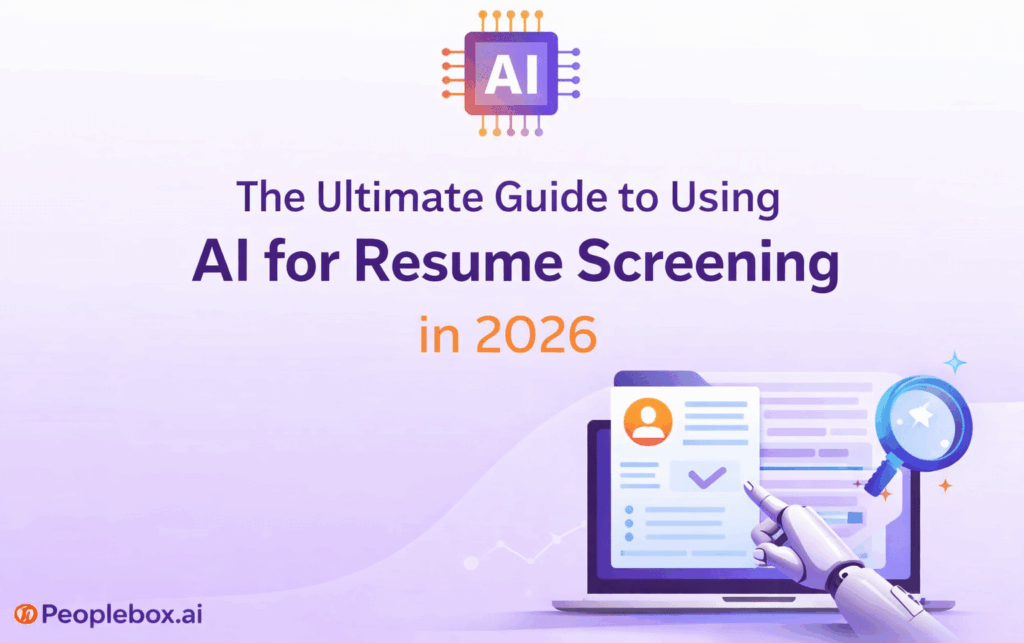
AI resume screening helps. It quickly sorts through many applications to find those with the right skills, so recruiters can focus on key decisions and speed up hiring.
What Is AI for Resume Screening?
AI resume screening uses software to review job applications faster and more consistently at scale.
The key difference between AI resume screening and traditional ATS filtering is the intelligence they bring. A basic ATS looks for exact keywords. If your job description says “customer relationship management,” it may ignore resumes that describe the same skill in different terms.
AI goes beyond exact matches. It understands context and related terms, so phrases like “managed client accounts” or “built long-term customer relationships” are recognized as relevant experiences. This helps you surface qualified candidates more fairly and efficiently, even at high volume.
Types of AI Used in Resume Screening
Keyword-based screening
This is the simplest type. The AI scans resumes for specific words from the job description and highlights those that match.
Context-based screening
This type tries to understand meaning. It reads sentences to see what a candidate has actually done, even if they use different wording.
Pattern-based screening
This AI analyses career patterns, including job history, growth, and timelines. It helps spot relevant experience even when resumes don’t look traditional.
Manual Resume Screening vs AI-Based Resume Screening
In 2026, the strongest hiring teams use AI to handle resume overload and rely on humans where judgment matters most.
| Area | Manual Resume Screening | AI-Based Resume Screening |
| Screening speed | Slow and limited by recruiter time | Screens thousands of resumes in minutes |
| Consistency | Varies by recruiter, mood, and workload | Same criteria applied to every candidate |
| Bias risk | High risk of unconscious bias | Reduced bias with skills-based evaluation |
| Depth of review | Often surface-level due to time pressure | Analyzes skills, patterns, and context |
| Scalability | Requires more recruiters as volume grows | Scales instantly without adding headcount |
| Handling non-traditional resumes | Often filtered out early | Identifies transferable and related skills |
| Cost efficiency | High cost per screened resume | Very low cost per screened resume |
| Best use | Final interviews, judgment, culture fit | Early-stage, high-volume screening |
Where AI Resume Screening Works Best
AI resume screening works best when the goal is to create a strong shortlist without sacrificing quality or fairness.
1. When resume volume overwhelms your team
If your team is swamped with resumes, AI can help you take back control. It checks every single one using the same standards and finds the best people for you, so you don’t have to rush through them. Use your time to talk to good candidates rather than just sorting through all the paperwork.
2. When early screening slows down hiring
If you’re struggling to get past the initial resume pile, AI can quickly sort things out. It ranks applicants by their skills, background, and how well they match the job. This means you’re not starting from scratch with each new opening. You move faster without rushing decisions.
3. When you need consistency across roles and recruiters
AI can help if your recruiters are shortlisting different people for the same job. It makes sure every application gets the same review. This way, your shortlists are consistent and make sense to hiring managers.
4. When you’re hiring at scale
If you need to fill many of the same jobs, looking at each application by hand takes too long. AI can go through thousands of resumes fast, without missing important details. This means you don’t have to hire a ton of recruiters just to stay on top of things.
5. When non-traditional resumes get overlooked
AI can help find strong candidates whose resumes don’t follow the usual path by spotting useful skills and experience. Instead of just looking at job titles or company names, AI checks out what people have really done.
6. When fairness matters in early decisions
If you’re worried about bias in hiring, AI can step in to help fix it early on. Instead of going with people you know or just a hunch, AI looks at skills and if they’re right for the job.
Common Mistakes Teams Make When Using AI for Resume Screening
AI is effective for sifting through tons of resumes quickly. Still, if you’re not careful, it can mess things up more than it helps.
Many teams think AI will just do its thing. But if you don’t set it up right or you trust it too much, you could miss out on good people, introduce bias, or make the whole candidate experience a pain. Here’s what to watch out for.
Mistake 1: Relying on AI Without Human Oversight
AI can review resumes much faster than any human. What it can’t really get is what someone wants to do with their career, how much they could grow, or culture fit.
If you let AI have the final say on who moves forward, you might end up turning down people who actually could do great if they were given a fair shot.
So, use AI to help you sort through the initial pile, but don’t let it be the only thing that decides. You should look at those tricky cases, folks applying for bigger jobs, and people who’ve taken a different path to get where they are, before you make any calls.
Mistake 2: Using Poorly Trained or Black-Box Models
AI learns from data. If that data is old or biased, the results will be too. When tools don’t explain why someone was ranked higher or lower, problems stay hidden.
Choose tools that explain why candidates are ranked a certain way. Review results regularly and work with vendors who allow audits and improvements.
Mistake 3: Ignoring Candidate Experience
If your AI screening process is slow, confusing, or just feels impersonal, applicants will definitely notice. If they don’t get what’s happening, they drop out.
Just keep things simple and easy to understand. Let candidates know when you’re using AI, what it’s checking for, and what the next steps are. And always give them a way to talk to a real person.
Mistake 4: Over-Filtering Too Early
Strict filters on keywords, years of experience, or titles can exclude candidates with transferable skills or high potential.
This often leads to “safe” resumes moving forward, not the best ones.
Use AI to surface potential, not just reject profiles. Focus on skills and experience patterns, not hard cutoffs.
Mistake 5: Overlooking Compliance and Privacy
AI tools handle sensitive candidate data. If you don’t think about consent, storage, and legal requirements early, you expose yourself to risk.
Ensure your tools comply with GDPR, CCPA, and local AI hiring laws. Clearly explain to candidates how their data is used and protected.
How to Choose the Right AI Resume Screening Tool in 2026
Choosing the best AI resume screener means first thinking about what’s causing headaches in your hiring, not just grabbing the latest tech. The platform you choose should fix the actual problems you’re having and be easy for your team to use with what they already do.
Start with Your Hiring Goals
First, be clear on what’s slowing you down today. Is it too many resumes? Slow shortlisting? Inconsistent decisions?
If a tool doesn’t fix your biggest hiring problem, it’s probably not the right one, no matter how advanced it looks.
Evaluate Screening Logic and Transparency
Not all AI works the same. Good tools don’t just look for keywords. They use machine learning to determine a person’s skills, experience, and background. The best platforms should also explain why they ranked someone a certain way, rather than just giving you a score that makes no sense.
Consider Integration and Workflow Fit
The tool should just fit right into your ATS and how you hire now. If your team has to jump between different systems or update manually, it just makes more work instead of saving time. Good AI platforms should feel like they’re already part of how you hire, not some extra thing you have to do.
Look for Bias Mitigation and Fairness Features
AI can make things fairer, but only if it’s made the right way. See whether the platform is checked over, how often it’s reviewed, and how they monitor for bias. It doesn’t have to be perfect, but it should really care about being fair and tell you how it makes decisions.
Don’t Forget Candidate Experience
If the process feels confusing or cold, candidates will drop off. The best tools are simple, fast, and clear about how AI is used. A good candidate experience isn’t just nice to have; it directly affects completion rates and employer brand.
Trial, Test, and Get Feedback
Don’t decide based only on a demo. Try the tool with real roles and real resumes. See if it actually saves time and improves the quality of the shortlist. Also, ask your recruiters and hiring managers how it feels to use it. If they don’t trust it, they won’t adopt it.
Focus on Long-Term Support and Updates
AI hiring tech evolves quickly. Choose vendors who commit to ongoing model updates, bias mitigation practices, and explainability features, not just flashy launches.
How Peoplebox.ai Nova Fits Into Modern Resume Screening
Watch Nova, our AI interviewer, in action
Resume screening today isn’t about finding the best looking resume. It’s about quickly figuring out who is actually worth moving forward. Peoplebox.ai Nova is built for that exact problem.
Designed for Early-Stage Screening
Nova focuses only on early screening, the stage where hiring usually slows down first. It replaces:
- Manual resume screening
- Repetitive first-round screening calls
This helps recruiters stop spending hours sorting resumes or repeating the same questions.
Resumes Are Just the Starting Point
Nova doesn’t treat resumes as the final signal. It uses them to decide who should be evaluated further. After screening resumes, Nova runs human-like AI interviews to check:
- Whether skills on the resume hold up in conversation
- How candidates think and explain their answers
- How well they fit the role beyond keywords
Human-Like AI Interviews, Not One-Way Videos
Instead of static video responses, candidates speak to a conversational AI avatar (voice or video). Nova asks role-specific questions and follows up based on what the candidate says, similar to a strong interviewer.
Strong Follow-Ups Create Real Signal
Nova doesn’t stop at first answers. It asks smart follow-up questions to understand:
- Depth of knowledge
- Decision making
- Real world problem solving
This is where many resumes and basic video tools fall short.
Consistent Screening, Even at High Volume
Every candidate is evaluated using the same structure and criteria. Nova doesn’t rush, get tired, or take shortcuts. This makes early screening more fair, consistent, and easier to trust, especially when hiring at volume.
| Ready to move beyond resume guessing? Peoplebox.ai Nova helps you screen candidates faster and more fairly by combining AI resume screening with human-like interviews and structured evaluation.You get better shortlists, fewer missed candidates, and zero manual first-round chaos. 👉 Book a demo with Peoplebox.ai |
How AI Resume Screening Fits Into a Modern Hiring Workflow
AI resume screening is most effective when it’s used early in the hiring journey, before human review begins. In modern hiring, AI reduces the upfront manual effort, enabling recruiters to evaluate the right candidates faster.
1. Applications Come In at Scale
Candidates apply through job boards, career pages, or referrals. For many roles, especially remote or high-volume ones, hundreds of resumes arrive within days. Manually reviewing all of them is slow and inconsistent. This is where AI steps in first.
2. AI Screens and Ranks Resumes
AI resume screening tools automatically read and analyze resumes as they come in. They look at skills, experience, role relevance, and patterns across a work history rather than just exact keywords.
The goal is not to reject people blindly, but to:
- Rank candidates based on job fit
- Highlight strong and borderline profiles
- Reduce obvious mismatches early
Recruiters get a prioritized shortlist instead of a long, unmanageable pile of resumes.
3. Recruiters Review Shortlisted Candidates
After AI screening, recruiters review the top candidates. Because the list is smaller and more relevant, they can spend more time understanding each profile instead of rushing through dozens of resumes.
Human judgment still matters here:
- Validating context AI may miss
- Considering non-traditional backgrounds
- Making final decisions on who moves forward
4. Candidates Move to Interviews Faster
Once resumes are screened, candidates move quickly into interviews or assessments. This reduces delays, improves the candidate experience, and lowers drop-offs due to long wait times.
In many modern workflows, AI resume screening is paired with:
- Video or AI-led interviews
- Skills-based assessments
- Structured interview scorecards
This creates a smooth flow from application to evaluation.
5. Hiring Teams Use Better Data to Decide
Because AI applies the same logic to every resume, hiring teams get more consistent data. This makes it easier to:
- Compare candidates fairly
- Explain hiring decisions
- Reduce bias caused by fatigue or gut feeling
Conclusion
Resume screening isn’t broken because resumes are bad. It’s broken because hiring has outgrown manual judgment at scale.
AI resume screening doesn’t fix hiring by itself. But when used correctly, it removes noise, restores consistency, and gives hiring teams something they’ve lost: confidence in early decisions.
In 2026, the advantage isn’t using AI, it’s using AI to make better human decisions at scale.