
| Key Takeaways The best candidate screening tools in 2026 help teams shortlist high-fit applicants faster using AI assessments, simulations, and video interviews. Peoplebox.ai: Most complete AI screening tool,skills tests, automated video interviews and scoring reports. Vervoe: Best for job-simulation-based skill assessment. TestGorilla: Great for cognitive, personality, and role-based pre-employment tests. HackerRank: Top choice for technical hiring with deep coding challenges. Codility: Ideal for real-world engineering problem-solving assessments. |
Hassled in job applications, yet still struggling to find qualified candidates? And to make it harder, every AI-powered candidate screening tool claims to be the fastest and most accurate. If comparing features, pricing, and screening methods has left you confused, you’re in the right place.
We’ve curated a list of “ The Best Candidate screening tools, so you can instantly understand what each tool does well, where it falls short, and which one actually fits your hiring needs and budget.
This list isn’t based on marketing promises, it’s built on criteria that matter in the real world. Accuracy of skill assessments, fairness and bias reduction, flexibility to screen candidates for both technical and non-technical roles, automation of resume and video screening, quality of scoring and reports, ATS/HR integrations, scalability, candidate experience, and customer support. Our goal is simple: help you pick a tool that screens smarter, hires faster, and delivers the talent quality your business needs.
What is Candidate Screening and Why It Matters
Candidate screening is the first stage of the hiring workflow where recruiters of the hiring workflow where recruiters evaluate job applicants to identify the most qualified fit before interviews It plays a vital role in ensuring that unqualified candidates are filtered out early because A bad hire can cost up to 30% of the employee’s first-year earnings, only high-fit applicants progress to later stages, and the entire hiring cycle becomes faster, more objective, and consistent.
Effective screening goes beyond just resume screening, it uses multiple methods -fit like skills tests and job simulations, personality and cultural fit assessments, automated video interviews, and background/reference checks to validate job-fit. However, without the right technology, candidate screening can become tedious, repetitive, and vulnerable to bias. This is where modern AI-powered candidate screening tools make a difference, automating evaluations, standardizing scoring, and helping recruiters identify the right talent faster and more accurately.
Comparison of 15+ Best Candidate Screening Tools to Use in 2026
A side-by-side breakdown of the most powerful screening solutions, this year:
| Tool | Best For | Screening Techniques Used |
| Peoplebox.ai | AI-powered automated screening | Skills tests, AI video interviews, automated scoring reports, resume parsing, AI shortlisting |
| Vervoe | Skill-focused screening | Job simulations, task-based assessments, auto-grading |
| TestGorilla | Pre-employment assessments | Cognitive, personality, situational judgment, role-specific tests |
| iMocha | Tech + non-tech skill evaluations | Coding tests, domain & functional skills, cognitive tests, benchmarking |
| HackerRank | Tech hiring at scale | Coding tests, algorithm challenges, live coding interviews |
| Codility | Engineering assessments | Coding tasks, debugging simulations, technical evaluations |
| Harver | High-volume hiring | Gamified assessments, situational judgement tests, personality tests |
| Spark Hire | Video interview screening | One-way asynchronous interviews + live structured interviews |
| Pymetrics | Behavioral & soft-skill screening | Neuroscience-based behavioral & cognitive assessments |
| Workable | Small & mid-size hiring teams | Resume filtering, automated candidate scoring, interview kits |
| JazzHR | SMB recruiting | Resume screening, screening questions, automated workflows |
| Toggl Hire | Fast skill-based filtering | Quick skill tests, instant pass/fail scoring |
| Zoho Recruit | End-to-end recruiting | Resume parsing, AI match scoring, screening questionnaires |
| Outmatch | Culture & personality fit testing | Predictive behavioral assessments, soft-skill profiling |
| Greenhouse | ATS + structured screening | Scorecards, structured evaluations, reference checking |
5 Best Candidate Screening Tools to Use in 2026
Smart hiring in 2026 isn’t just about faster screening, it’s about using AI to identify the right talent with accuracy, speed, and fairness.
1. Peoplebox.ai
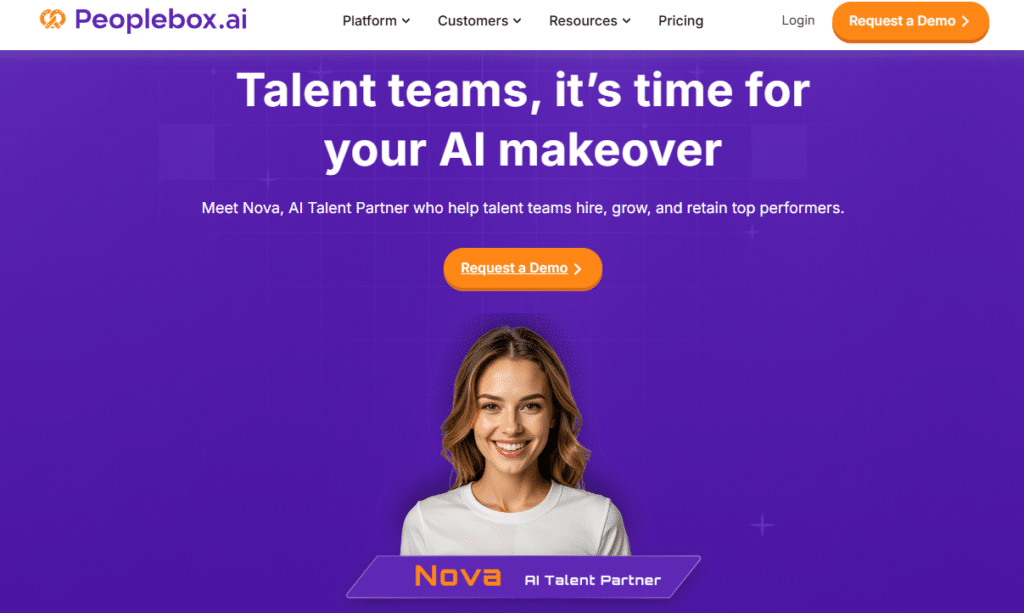
Peoplebox is an all-in-one AI-powered talent platform that combines resume screening, AI-led interviews (voice/video), automated scoring & ranking, and even shortlisting.
- AI video & voice interviews: structured, conversational, and role-specific via nova, with follow-up questions, real-time scoring & analytics.
- Unified hiring & performance stack: after hiring, the same platform supports goal-setting, performance reviews, OKRs, 360 feedback, and employee engagement.
- ATS/HR integrations & tool sync: integrates with many popular tools (communication, HRIS, project tracking) to sync data and workflows.
- Time savings: According to Peoplebox, AI-screening reduces time-to-hire significantly by automating early screening and shortlisting tasks.
Pros
- Great one-stop solution: Covers the entire hiring pipeline from screening to selection to performance, reduces the need for multiple tools.
- Speed & efficiency: Automates repetitive tasks like resume screening, pre-screening calls, and first-round interviews, saving recruiter time.
- Consistency & objectivity: Structured scoring and analytics reduce bias and ensure consistent evaluation across candidates.
- Easy adoption: Clean UI and smooth integration with popular tools reviewers report minimal training overhead.
- Scalable: Works for small teams to mid-size firms to enterprises, particularly those growing quickly or hiring frequently.
Cons / Considerations
As with many AI-powered solutions, some reviewers mention a learning curve, especially when configuring workflows or custom settings.
Best For
- Organizations experiencing high application volume.
- Teams want an end-to-end, integrated hiring + performance solution rather than stitching together multiple tools.
- Hiring managers who value speed, consistency and data-backed screening.
⭐ Peoplebox.ai’s G2 Rating: 4.5/5
Watch Nova, our AI interviewer, in action
| Hire Faster, Fairer & Smarter With AITry Peoplebox.ai, stop spending hours screening candidates manually. Let Nova, the AI interviewer from Peoplebox.ai, screen candidates for you with structured interviews, skill assessments, and automatic scoring, 100% unbiased, 100% scalable, 100% hands-off. 👉 What you get with Peoplebox.ai ✅ Fully automated AI video interviews ✅ Instant scoring, reports & shortlisted candidates ✅ AI-powered skills and competency screening ✅ Real-time integrations with your ATS ✅ Lightning-fast hiring without sacrificing quality See Peoplebox.ai in action — Book a free demo now |
2. Vervoe
Vervoe is built around the philosophy of “hire based on skills, not resumes.” The platform evaluates candidates through realistic, job-specific simulations, allowing employers to see how applicants perform in scenarios they’ll actually face in the role. The tool’s AI grading system automatically reviews responses and ranks candidates based on performance, eliminating subjective resume screening.
Key Features
- Job-specific simulations and skills challenges
- AI auto-grading and candidate ranking
Pros
- Evaluates actual job performance vs theoretical knowledge
- Helps predict real on-the-job effectiveness and ramp-up time
Cons
- Time-intensive: candidates must complete tasks before screening progresses
- For extremely high-volume hiring, reviewing submissions can be a bottleneck
- Requires upfront setup to match simulations to job needs
Vervoe’s G2 Rating : 4.6/5
3. TestGorilla
TestGorilla is known for its large and diverse pre-employment test library, covering technical, cognitive, behavioral, cultural, and role-specific competencies. Recruiters can mix and match tests to create a tailored assessment pipeline.
Key Features
- 300+ ready-made assessments (cognitive, technical, behavioral, personality, etc.)
- Custom test creation support
- Anti-cheating measures including screen monitoring and time tracking
- Candidate scoring dashboard and ranking reports
Pros
- Standardized scoring improves fairness and enables objective shortlisting
- Suitable for both technical and non-technical roles across multiple industries
- Fast rollout due to pre-built test templates
Cons
- Assessment-only approach may miss soft-skills nuances and cultural alignment
- Not ideal for storytelling-style roles (e.g., marketing leaders, creatives) where real-world projects matter more than tests
- High-performing test takers don’t always translate into high job performance
TestGorilla’s G2 Rating : 4.5/5
4. iMocha
iMocha is a skills intelligence and testing platform widely used for hiring across technical and non-technical domains. Its library spans coding skills, communication, finance, sales, cybersecurity, cloud, and more making it popular among companies with varied job categories.
Key Features
- 2,500+ assessment modules
- Coding simulator with scorecards
Pros
- Very broad test coverage, ideal for organizations hiring across multiple departments
- Allows quick elimination of unqualified candidates early in the process
- Provides quantifiable metrics for candidate comparison
Cons
- Soft-skills and culture fit may still require live interviews or behavioral assessments
- Test-timed interface may disadvantage strong performers who don’t thrive under pressure
- Internal test customization may require technical support
iMocha’s G2 Rating : 4.4/5
5. HackerRank
HackerRank remains a globally trusted platform for technical hiring and coding assessments for developers, data science professionals, ML/AI engineers, and other software roles. The tool enables employers to conduct technical screening at scale through automated challenges, paired-programming style interviews, and standardized benchmarking.
Key Features
- Coding challenges across 70+ programming languages
- Role-specific assessments (backend, DevOps, data engineering, ML, frontend, etc.)
Pros
- Highly reliable for validating coding ability with quantifiable results
- Strong brand trust, candidates are familiar and comfortable with the platform
- Reduces time spent on unqualified developer interviews
Cons
- Limited to technical hiring, not suitable for non-engineering roles
- Doesn’t evaluate soft-skills, collaboration style, learning agility, or cultural alignment
- Coding test performance may not cover system-design-level problem solving without additional rounds
HackerRank’s G2 Rating : 4.6/5
Other Candidate Screening Tools
- Codility
- Harver
- Spark Hire
- Pymetrics
- Workable
- JazzHR
- Toggl Hire
- Zoho Recruit
- Outmatch
- Greenhouse
6. Codility
Technical screening platform focused on coding tasks and assessments (for developers/engineers). Common alternative in technical hiring stacks.
Pros: Good for filtering and evaluating developer talent efficiently without scheduling full interviews.
Cons: Like other tech-only tools,not helpful for non-technical roles; doesn’t assess soft skills or broader job attributes.
Codility’s G2 Rating : 4.6/5
7. Harver
Used often for high-volume hiring; includes situation judgment tests, gamified assessments, and role-based screening.
Pros: Designed for volume, helps screen many candidates quickly. Gamified and situational assessments may be more engaging for candidates.
Cons: May produce lower fidelity insights compared to deep assessments or interviews. Soft skills / culture fit still require human checks.
Harver’s G2 Rating : 4.6/5
8. Spark Hire
Video interview tool, supports live and one way video interviews for screening candidates. (Often used in early interview stages.)
Pros: Efficient for screening communication skills, candidate presence, and initial fit without scheduling hassles.
Cons: Limited to interview-based screening, doesn’t test technical or deep skills; requires manually reviewing video responses.
Sparkhire’s G2 Rating : 4.7/5
9. Pymetrics
Behavioral and personality assessment tool, often used to evaluate cognitive traits, soft skills, and culture fit.
Pros: Useful for evaluating non-technical aspects, potential, and fit beyond resume data. Helps flag traits not evident in CVs.
Cons: Less reliable for hard-skills verification. Results may be more subjective; need to pair with skills assessment or interviews.
Pymetrics G2 Rating : 3.5/5
10. Workable
An ATS + recruiting platform with built-in screening/shortlisting, candidate tracking, resume parsing/filtering, and interview workflows.
Pros: Easy to adopt for SMBs or mid-size teams; simplifies recruitment management end-to-end without needing separate tools.
Cons: Its screening may be more basic compared to specialized assessment or AI-interview platforms. May not be ideal for roles requiring deep skill evaluation.
Workable’s G2 Rating : 4.5/5
11. JazzHR
Another ATS / recruitment platform tailored for small-to-medium businesses, helps with resume screening, resume parsing, and automated workflows.
Pros: Cost-effective for SMBs; simplifies resume intake and initial filtering; reduces manual admin work.
Cons: Doesn’t inherently test skills or interview candidates, manual interviews or assessments needed.
Jazz HR’s G2 Rating : 4.4/5
12. Toggl Hire
Skills-test based screening, helps create quick skill-tests to filter candidates before interviews.
Pros: Quick way to filter out unqualified applicants early; good for roles needing clearly defined skill sets.
Cons: Like assessment tools, limited view on soft skills, culture fit; need additional interview rounds.
Toggl Hire’s G2 Rating : 4.7/5
13. Zoho Recruit
End-to-end recruiting/ATS platform that helps parse resumes, filter applicants, match profiles to job criteria, and manage pipelines.
Pros: A practical choice for small/medium businesses; offers good foundational screening + candidate management.
Cons: Screening features are often basic; deeper evaluation requires supplementary tools or interviews.
Zoho Recruit’s G2 Rating : 4.4/5
14. Outmatch
Focuses on personality, behavioral assessments, and culture-fit evaluation to complement resume/skill screening.
Pros: Helps organizations evaluate cultural fit, values alignment, and soft-skill suitability aspects often missed by technical tests.
Cons: Does not test hard technical or domain skills, best used alongside other tools.
Outmatch’s G2 Rating : NA
15. Greenhouse
Greenhouse helps organizations streamline resume screening, automate candidate filtering through scorecards and interview kits, and maintain consistent evaluations across hiring teams. It is known for encouraging structured interviews and bias-free decision frameworks, making the screening experience more predictable and data-driven.
Pros: Ideal for scaling and enterprise companies; offers advanced interview scorecards, structured hiring workflows, and strong API-based integrations with HR tech stack.
Cons: Comes at a higher price point and may be too complex for smaller teams or companies with low hiring volume.
Greenhouse’s G2 Rating : 4.4/5
How Candidate Screening Tools Improve the Hiring Process
The best screening platforms streamline and automate the most time-consuming recruitment steps. They help recruiters:
| Benefits of Screening Tools | Impact |
| Automatic filtering of poor-fit applicants | Saves time and reduces manual screening |
| Skill-based evaluation | More accurate candidate quality |
| Standardized scoring & reporting | Fair and objective hiring |
| Faster candidate selection | Shorter time-to-hire |
| Improved candidate experience | Higher acceptance rates |
From resume parsing to job simulations and screening and evaluating candidates automatically, these tools make it easy for recruiters to screen candidates reliably and at scale.
Conclusion
The competition for talent in 2026 requires speed, precision, and data-backed decisions. Manual resume screening or intuition-based selection is no longer enough. With the right candidate screening tools, organizations can:
- Streamline the screening process
- Evaluate skills and fit objectively
- Improve the quality of hiring decisions
- Reduce time-to-hire dramatically
Whether you’re hiring at scale, evaluating tech talent, or looking to automate screening end-to-end, the tools listed above will help you build a smarter recruitment workflow.
If you’re ready to supercharge your screening in recruitment, Peoplebox.ai offers one of the fastest ways to automate shortlisting, video interviews, and candidate evaluation.performance/people-management workflows, all in a single hub.
It integrates with major ATS/HR systems and common work tools (Slack, MS Teams, Jira, CRMs, HRIS, etc.), making it smoother to embed into existing workflows.
Its AI interviewer (called “nova”) can conduct pre-screen calls, first-round interviews (even coding rounds), and generate decision-ready reports instantly.
Frequently Asked Questions ( FAQs)
What is candidate screening in recruitment?
Candidate screening in recruitment is the process of evaluating applicants to determine whether they meet the requirements for a role. It helps recruiters filter out unqualified candidates early and identify those with the right skills, experience, and cultural fit before interviews or final selection.
What is the candidate screening process?
The candidate screening process typically includes:
- Reviewing resumes and applications
- Shortlisting based on skills, experience, and qualifications
- Conducting assessments or tests (skills, cognitive, behavioral)
- Screening via automated or live interviews
- Checking background, references, and culture fit
This process ensures only high-potential candidates move forward in the hiring pipeline.
How to screen candidates effectively?
To screen candidates effectively:
- Define clear job requirements and must-have criteria
- Use AI tools or ATS filters to automate resume screening
- Apply structured skills assessments or job simulations
- Use standardized scoring for fairness
- Combine behavioral and technical evaluation
- Leverage automated video interview tools to scale screening
Effective screening combines technology + structured evaluation to ensure accuracy and reduce bias.
What screening techniques should recruiters use?
Top screening techniques include:
- Resume screening and keyword matching
- Skills assessments and job simulations
- Cognitive and personality tests
- Behavioral and situational judgment tests
- Automated one-way video interviews
- Culture-fit assessments
- Background and reference checks
Using multiple techniques provides a 360° view of the candidate.
Why is recruitment screening important?
Recruitment screening is important because it:
- Ensures only qualified candidates move forward
- Speeds up hiring and reduces recruiter workload
- Improves quality of hire and long-term employee success
- Reduces hiring risks and turnover
- Minimizes unconscious bias through standardized evaluation
Effective screening builds a stronger workforce and ensures the right talent joins the organization.