


















Tanvi Upadhyay



OKR Examples for Chief of Staff
Improve strategy execution and align with company goals by setting agile OKRs for your Chief of Staff
- Build an agile workforce with focused OKRs
- Drive results that align with the company goals



Trusted by 600+ companies building high-performance cultures


















How Peoplebox Keeps OKRs Alive
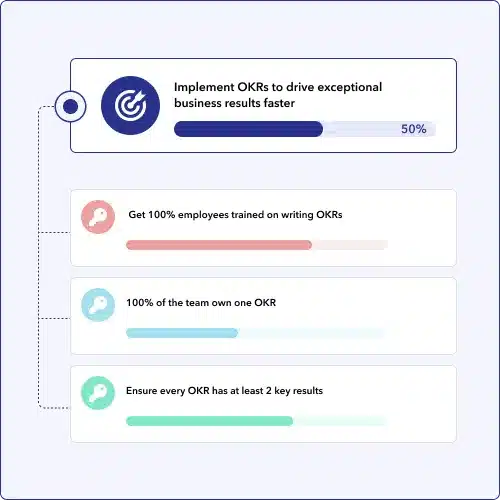
Example: 1
Objective: Implement OKRs to drive exceptional business results faster
Accelerate company growth and performance by integrating an OKR framework that aligns goals, focuses efforts, and drives measurable results.
- Get 100% employees trained on writing OKRs
- 100% of the team own one OKR
- Ensure every OKR has at least 2 key results
- Establish a company-wide OKR tracking system with real-time progress updates
- Increase overall company productivity by 20% within the first two quarters of OKR adoption

Example: 2
Objective: Increase goal alignment across the organization
Strengthen the connection between individual, team, and organizational goals to drive cohesive strategy execution and company-wide success.
- Increase OKR adoption to 100% by ensuring everyone owns OKR in the organization
- Reduce the number of misaligned objectives to zero
- Increase the weekly check-ins per KR from 0.7 to 1
- Achieve a 20% improvement in goal alignment satisfaction scores in employee surveys.
- Conduct bi-monthly check-ins with department heads to monitor progress and alignment.
Example: 3
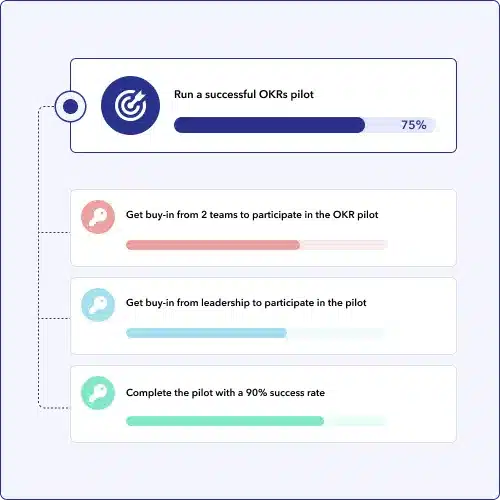
Objective: Run a successful OKRs pilot
Test and refine the OKR framework through a pilot program to ensure successful implementation across the organization.
- Get buy-in from 2 teams to participate in the OKR pilot
- Achieve an 80% completion rate of OKRs set by participants
- Achieve an 80% completion rate of OKRs set by participants
- Achieve an 80% completion rate of OKRs set by participants
- Analyze the results of the pilot program and make necessary adjustments to the OKR framework for successful implementation company-wide

Example: 4
Objective: Implement OKR software that increases adoption
Integrate an OKR software solution that simplifies goal-setting, facilitates tracking, and enhances user engagement to increase adoption and drive successful implementation of the OKR framework.
- 80% of KRs should be updated automatically through integrations
- Reduce the number of misaligned objectives to zero with better visualization
- Reduce the time in preparing for business review to 10 mins
- Achieve a 90% adoption rate of the OKR software within the first two months of implementation
- Measure the impact of the OKR software on goal-setting, tracking, and achievement, and report on key insights to drive continuous improvement
Example: 5
Objective: Streamline Internal Communication
Ensure effective communication across departments to drive productivity and collaboration.
- Implement a weekly cross-departmental newsletter with updates from each team
- Reduce email response time to under 24 hours
- Create a company-wide Slack channel for announcements and updates
- Host monthly town hall meetings for all employees
- Launch a mentorship program to connect employees across departments

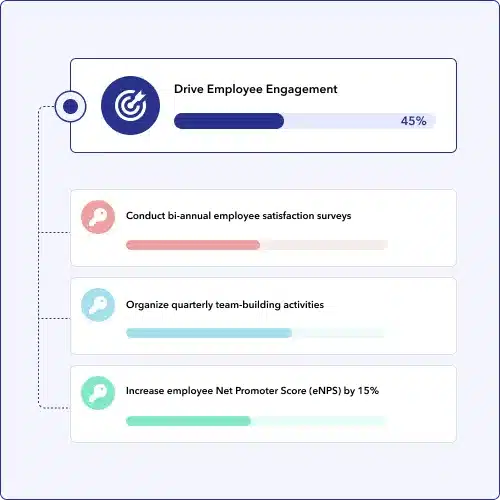
Example: 6
Objective: Drive Employee Engagement
Foster a positive work environment and improve overall employee satisfaction.
- Conduct bi-annual employee satisfaction surveys
- Organize quarterly team-building activities
- Increase employee Net Promoter Score (eNPS) by 15%
- Implement an employee recognition program
- Conduct monthly performance reviews and coaching sessions for continuous improvement.
Example: 7
Objective: Optimize Company Processes
Identify areas of improvement and implement more efficient systems.
- Conduct a comprehensive process audit across departments
- Implement automation tools to reduce manual tasks by 20%
- Standardize and document company-wide procedures
- Train employees on new processes and tools
- Measure and report on process efficiency improvements

Example: 8
Objective: Enhance Financial Performance
Improve the company’s financial health by optimizing resource allocation and monitoring expenses.
- Establish a monthly financial review process
- Implement a zero-based budgeting approach
- Reduce operational expenses by 10%
- Increase gross margin by 5%
- Develop a rolling 12-month financial forecast model
Example: 9
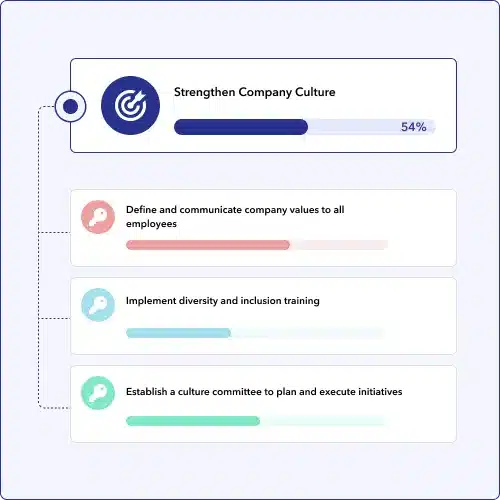
Objective: Strengthen Company Culture
Develop and promote a positive, inclusive, and high-performance company culture.
- Develop and promote a positive, inclusive, and high-performance company culture.
- Implement diversity and inclusion training
- Establish a culture committee to plan and execute initiatives
- Measure and report on cultural health indicators
- Create a feedback loop to continuously improve culture
Example: 10
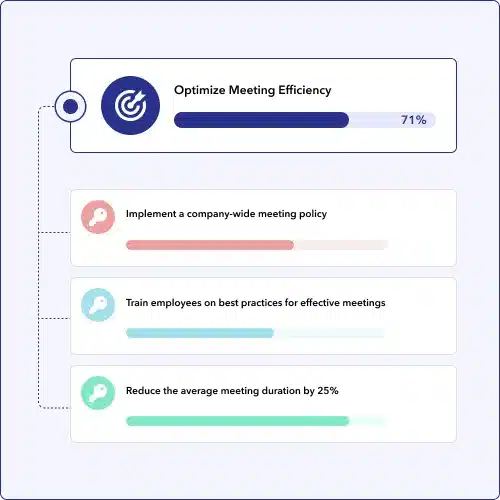
Objective: Optimize Meeting Efficiency
Streamline meetings to maximize productivity and minimize wasted time.
- Implement a company-wide meeting policy
- Train employees on best practices for effective meetings
- Reduce the average meeting duration by 25%
- Establish clear meeting agendas and objectives
- Increase meeting satisfaction scores by 15%
Peoplebox integrates with your HRIS (Workday, BambooHR, Darwin Box, SAP) and replaces only the performance module.
Request a DemoFrequently Asked Questions
How do we ensure that our departmental OKRs align with the organization's overall strategy?
To ensure alignment, it is important to clearly understand the organization’s overall strategy and mission. This can be accomplished by working closely with the leadership team to identify key priorities and ensuring that departmental objectives support those priorities.
How do we choose the right key results to measure progress toward our objectives?
Key results should be specific, measurable, and tied to the objective they are supporting. It is important to choose key results that are actionable and within the control of the team or individual responsible for achieving them.
How can we ensure that our OKRs are challenging but achievable?
Objectives should be ambitious but realistic. It is important to balance the need for progress with the reality of resource constraints and competing priorities. It can be helpful to review past performance and benchmark against industry peers to set realistic yet challenging goals.
How do we communicate our OKRs to our team and ensure their buy-in?
Communication is key when setting OKRs. It is important to involve the team in the goal-setting process and ensure that objectives are clearly communicated and understood. Teams should have the opportunity to provide feedback and ask questions to ensure buy-in and commitment to achieving the goals.
How do we ensure that our OKRs remain relevant and responsive to changing circumstances?
OKRs should be reviewed regularly to ensure that they remain relevant and responsive to changing circumstances. This can be accomplished by tracking progress against key results, monitoring industry trends and shifts in the market, and being open to adjusting objectives and key results as necessary to stay on track.