


















Biswashree Roy


BLOG / Performance Management
Performance Appraisal System: A Complete 2026 Guide
May 28, 2026
Expert Reviewed



What Is a Performance Appraisal System?
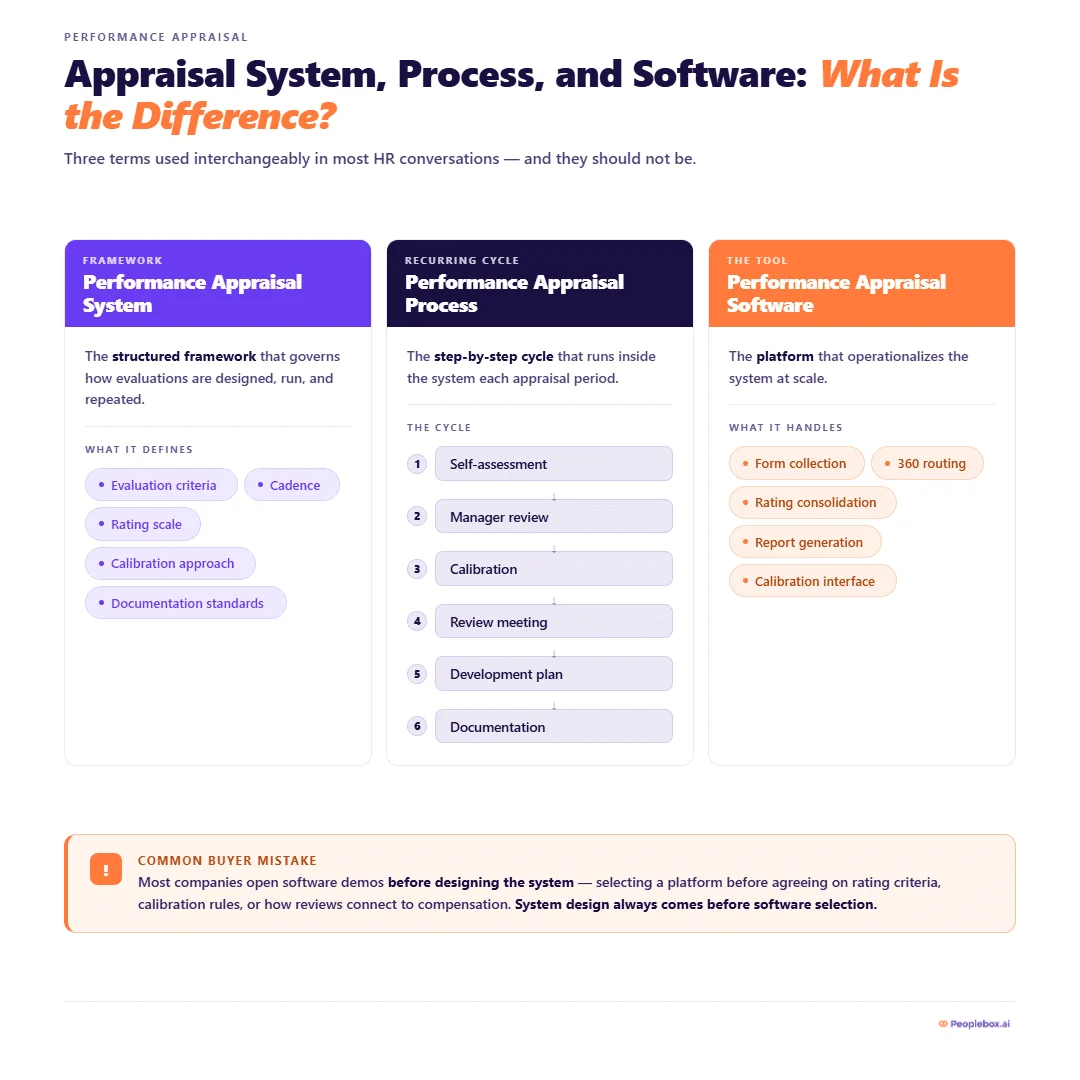
A performance appraisal system is a structured framework that organizations use to evaluate employee performance against defined criteria, combining the processes, participants, and tools that make consistent evaluation possible at scale.
A performance appraisal is the event: the review conversation between a manager and an employee. The system is the architecture around that appraisal, the evaluation criteria, the cadence, the rating scale, the calibration process, and the tooling that makes it repeatable.
Most companies have some version of a performance appraisal. Far fewer have an actual system. The difference shows up at compensation time, when a manager tries to justify a rating with no documentation, or when HR realizes that two departments applied the same 5-point scale for completely different purposes.
A well-designed system achieves three things: it evaluates employee performance based on specific criteria, it generates definsible data to support compensation and promotion decisions, and it surfaces skill gaps early enough to act on.
Why a Performance Appraisal System Matters
The benefits of a well-designed system are specific. So are the costs when the system fails or is missing entirely.
Compensation and promotion decisions become defensible: Without a structured process, discussions regarding compensation and promotions depend solely on the manager’s memory. Recall is influenced by recency, proximity, and interpersonal factors. When a promotion decision gets challenged by the employee, by HR, or in a legal context, documented evidence from a structured system is what holds up, not the manager’s word.Once a rating is tied to a pay outcome, an increment calculator shows the exact new salary for the agreed percentage, so the number in the letter matches the decision.
Skill gaps surface in aggregate, not just individually: One-on-one sessions will uncover an idividual’s skill gap. But for example, a lack of communication skills in stakeholder management will be apparent when review results are analyzed across 10 engineers in the same department. L&D investment follows aggregate patterns, not individual exceptions, and those patterns only appear when a structured system is collecting consistent data.
Performance conversations become a habit, not a surprise: According to Gallup research, employees who receive regular feedback are 2.8 times more likely to be engaged compared to those who only receive such feedback once a year. People perform better when they know where they stand.
What a bad system costs: Rating distributions cluster in the safe middle because managers lack documentation to justify outliers. High performers receive the same rating as average contributors and leave when compensation reflects the same manner. Managers no longer feel compelled to engage in the review process because they understand how mechanical it is. This is not a personal problem; it’s a failure of the system.
Components of a Performance Appraisal System
A functional performance appraisal system has five interdependent components. Weaknesses in any one compromise the others.
1. Evaluation Criteria and Competency Framework
Mature systems evaluate two dimensions separately: outcomes (what was accomplished – Goals, MBOs, KPIs) and competencies (how it was accomplished behaviors, collaboration, decision-making). Separating these two prevents the common failure where a salesperson who reaches the goal by burning their client relationships will be evaluated equally to another reaching the same target by creating customer relationships.
A working competency framework is role-specific, not generic. Behaviors expected of an individual contributor differ from those expected of a people manager. Generic evaluation criteria are applicable to all positions and produce ratings that are silently acknowledged as worthless.
2. Rating Scale and Distribution Policy
Common formats: 3-point scales (Exceeds/Meets/Below), 5-point numerical scales, and BARS (behaviorally anchored rating scales, where each level is anchored to a specific behavioral description). Scale design matters less than consistent application, which is why calibration exists.
The distribution policy is not the same as the scaling policy. Forced ranking, requiring percentages for every level to be assigned, has largely been discredited due to documented failures at GE, Microsoft, and Adobe. Instead, distribution guardrails refer to calibration policies that highlight managers whose ratings are skewed relative to those of other managers in comparison.
3. Cadence and Review Frequency
Annual-only cycles are declining. The dominant pattern in 2026 is hybrid: continuous feedback and check-ins throughout the year, layered on one or two formal appraisal cycles annually. The formal cycle exists for compensation and promotion documentation. The continuous layer exists for performance development. Designing for annual-only in 2026 is designing a system that will need to be rebuilt in two cycles.
4. Multi-Source Feedback
Manager-only performance reviews are quick but miss cross-functional contributions and peer collaboration. Adding self-assessments, peer reviews, and 360-degree feedback increases complexity but provides a more complete picture. It all depends on how complex the job is, how big the company is, and what decisions the review is making.
5. Calibration Overview
Calibration is the cross-manager session that normalizes ratings before results are shared. It exists because even if both managers apply identical criteria, they won’t necessarily apply them equally, resulting in a situation where employees of identical positions end up receiving different results purely based on whose manager is who.
The Performance Appraisal Process: How the Appraisal Cycle Works
The performance appraisal cycle runs inside the system, a recurring sequence of six stages that repeats with every formal review period.
- Set criteria and objectives at cycle start: Before the cycle opens, evaluation criteria, competency definitions, and goal-setting guidance are shared with managers and employees. Setting goals before criteria are documented is the most common upstream failure; employees set targets without knowing how they will be rated.
- Communicate criteria to employees: Self-assessments are only meaningful when employees know what they are assessing themselves against. This step is regularly skipped on the assumption that employees “already know”; they often do not.
- Capture continuous performance data through the cycle: Check-in notes, 1:1 records, project feedback, and recognition moments are documented throughout the cycle. This is what prevents managers from writing reviews from memory in the final week before the deadline.
- Self-assessment and manager assessment at cycle end: The employee submits a self-assessment based on defined criteria. The manager completes their independent assessment using data generated from the cycle and reviews the employee’s self-assessment.
- Calibration across managers: The cross-manager normalization session. Rating distributions are compared, outliers are reviewed, and adjustments are made before results are communicated to employees.
- Review meeting, development planning, and documentation: Development meeting and documentation. A formal discussion between the manager and employee reviewing past cycle performance and setting direction for the upcoming cycle. Outcomes include documenting rating, development plan, and if the cycle connects to compensation, a clean input for the comp decision.
Build vs Buy: Choosing Your Appraisal System
Most companies evaluate this decision in the wrong order. They consider performance appraisal software before having a solid system design plan. The right question is: what does the system need to do? The answer determines which path makes sense.
These three performance appraisal system examples:spreadsheet-based, HRMS module, and dedicated platform, cover the decision most mid-market HR teams face.
Path 1: Spreadsheets and Forms
Works for companies with under 50 employees running a first formal cycle. Fast to set up, quick deployment overhead. Breaks predictably around 100-150 employees: version-control failures, no audit trail, manual data export for any real analysis, and one person on the HR team who becomes a full-time spreadsheet admin during review weeks. Most companies run two or three cycles in a spreadsheet before the overhead becomes untenable.
Path 2: HRMS Performance Module
The most common starting point for companies already on Workday, BambooHR, Darwinbox, Zoho People, or Keka: use the performance module that came with the HRIS. The logic is reasonable, the employee data is there, SSO works, no incremental cost.
Until reaching the ceiling after about two or three cycles. Most HRMS performance modules are built with a form-building framework and a layer of workflow capabilities. They handle self-assessments, manager approvals, and completed reviews. What they fail to do in depth: calibration with distribution reports, 360-degree feedback with selected peers, cascading OKRs from company objectives to employee level, and rating analytics.
The pattern that appears consistently in mid-market implementations: managers complete reviews in the HRIS, HR exports the data to a spreadsheet to do anything useful with it. The system captured the data. It couldn’t turn it into insight.
Path 3: Dedicated Performance Management Platform
Platforms built specifically for performance management, such as Lattice, 15Five, Culture Amp, Leapsome, Peoplebox, Engagedly, exist because HRMS modules hit ceilings that vendors have not consistently resolved. What this category delivers that HRMS modules typically do not: configurable review templates without engineering involvement, calibration interfaces with distribution views and override audit trails, 360-degree feedback with manager-controlled peer selection, continuous feedback and 1:1 notes in the same system as the formal review, and bidirectional HRIS sync.
Integration is a gate criterion, not a feature. A performance appraisal platform that cannot sync cleanly with the existing HRIS creates manual maintenance overhead that will eventually cause the system to be abandoned. For enterprise buyers with 2,000+ employees, HRIS sync and SSO are typically the first questions in any vendor evaluation, not the last.
At what size does each path make sense:
| Path | Best For | Common Failure Point |
|---|---|---|
| Spreadsheets / Forms | Under 50 employees, first cycle | 100-150 employees |
| HRMS Module | 50-300 employees, simple cycles | Calibration and 360-degree complexity |
| Dedicated Platform | 150+ employees, multi-source, calibration | No HRIS integration |
Calibration in Practice: What Actually Happens
Who is in the room: The managers being calibrated, their manager acting as the facilitator, and a senior HR executive. For a business unit of 50 employees, this is typically four to six managers plus one facilitator.
What they review: Rating distributions. A manager whose entire team rates between 3.5 and 4.2 on a 5-point scale is exhibiting central-tendency bias, clustering in the safe middle to avoid difficult conversations. A manager whose full team rates 4.8+ is exhibiting leniency bias.
What gets adjusted: Ratings, not the underlying assessment. Calibration is not a conversation about whether an employee was strong or weak. It is a conversation about whether a 4.2 in one manager’s context means the same thing as a 4.2 in another’s and whether those ratings will hold up side by side in a compensation model.
How long it takes: Four to six hours per business unit in a mature calibration process. Without dedicated tooling, this is typically run in PowerPoint and spreadsheets. At 100+ employees, the data volume exceeds what a spreadsheet can manage without breaking, and the conversation time exceeds what an ad-hoc meeting can contain.
What happens when managers won’t move: A senior HR leader documents the disagreement and escalates. The manager’s manager typically has authority to override a rating when the evidence trail supports it. This is why audit trails in calibration tooling matter; the conversation is about the reasoning that produced the rating, not just the rating itself.
Five Failure Modes That Kill Appraisal Systems
Most appraisal systems do not fail because the design was wrong. They fail because the implementation skipped the parts that are hard.
1. The review-eve scramble: All performance reviews are completed in the last week before the deadline. The output reflects the last two months, not twelve. Solution: continuous documentation, check-ins, and 1:1 meetings stored within the same system as the formal performance appraisal.
2. HRMS-module data death: Performance appraisal is completed through the HRIS. HR exports the data to a spreadsheet for analysis. The cycle is degraded each time until people have stopped believing the data. Solution: A singular system holding both continuous data and formal performance appraisal data with automatic reporting.
3. Calibration-meeting chaos: The calibration process is carried out through a shared spreadsheet that gets overloaded with many users, where three managers justify their outliers without any documentation. Fix: calibration tooling with the ability to view the distribution of the scores, compare side-by-side scores, and track overrides.
4. Rating compression to safe-middle: Managers choose 3 out of 5 for almost all employees, to avoid the conversation that a score of 2 or 5 demands. Differentiation breaks down; high-performers leave. Fix: Distribution guardrails within the calibration process and training about what each score means.
5. The annual-only feedback gap: No layer of feedback operates continuously. Feedback to employees regarding their performance comes up only once a year when discussing last year’s work, with no way to make changes until the next cycle. Solution: build in the feedback layer from the beginning, rather than attempting it after two cycles have failed.
A 90-Day Implementation Framework
The difference between a system that lasts and one that gets abandoned is implementation sequencing. Most appraisal systems fail because someone started configuring the software before the design questions were answered.
Days 1–30: Design
Define the core system components before opening any software: evaluation criteria, rating scale, distribution policy, feedback sources, and frequency. Decide whether you are going to build or buy. If selecting a dedicated platform, map HRIS integration requirements before signing; integration is a gate criterion that becomes expensive to discover post-contract.
Decision gates at Day 30: Have evaluation criteria been designed and approved? Is there agreement among the leadership on the rating scale? Is the relationship between review results and compensation clear?
Days 31–60: Configure and Train
Set up the cycle in your selected software, review templates, routing, ratings scale, and calibration views. Train managers before the cycle begins about the rating process, the rationale behind the ratings, and expectations for calibration. Perform a pilot test cycle with 1 or 2 teams. Pilots highlight issues not discovered during the demonstration.
Decision gates at Day 60: Are the managers trained? Were there any workflow problems in the pilot cycle? Is HRIS synchronization smooth?
Days 61–90: First Formal Cycle
Run the cycle: self-evaluation, manager’s evaluation, calibration session, review meetings, and documentation. Treat the first calibration session as a learning exercise; this is where the organization discovers what consistent evaluation actually means in practice.
Once the cycle ends, record three items: completion rate of the self and manager evaluation, ratings before and after calibration, and manager feedback regarding process difficulty. This is the baseline information for cycle 2.
| See what a configured appraisal system looks like in practice
Peoplebox.ai connects evaluation criteria, continuous check-ins, 360-degree feedback, calibration, and HRIS sync in one workflow, built for mid-market teams that have outgrown their HRMS module. |
Design the System. Then pick the tool.
The companies that get performance appraisal right share one trait: they spent the first 30 days answering design questions: criteria, cadence, calibration policy, compensation connection, before opening a software demo.
The ones that struggle reversed that sequence. They selected a tool, then discovered mid-implementation that the team had never agreed on what a “4” means.
The sequence matters more than the tool. Design the system first. Then select the software that operationalizes the design you have already agreed on.
FAQs
Performance appraisal vs performance management - what is the difference?
A performance appraisal system is a structured framework for formally evaluating employees against defined criteria, typically on a set cadence. A performance management system is broader; it covers goal-setting, continuous feedback, coaching, development planning, and the formal appraisal as one component. The appraisal is a formal event. Performance management is the year-round practice surrounding it.
What are the most common types of performance appraisals?
The most common formats include manager-led reviews, self-appraisals, 360-degree feedback, peer reviews, MBO-based evaluations, and BARS. Most mature systems combine two to four of these. For a full breakdown of each format with When-to-Use guidance, see the types of performance appraisals guide.
How often should companies run performance appraisals?
The current mid-market standard is hybrid: continuous check-ins and feedback throughout the year, with one or two formal cycles annually. Annual-only cycles are declining because feedback delivered once a year is structurally too late to change behavior from the first half of the year. The formal cycle exists for compensation documentation. The continuous layer exists for development.
Do small companies need a formal appraisal system?
Not immediately. Under 50 employees, a structured spreadsheet run twice a year covers most needs. The consistent breaking point is 100-150 employees, when calibration becomes necessary, and spreadsheet overhead starts exceeding the cost of a purpose-built tool.
What is the best software for running a performance appraisal system?
It depends on company size, cycle complexity, and integration requirements. For a comparison of dedicated platforms by calibration depth, 360 support, HRIS sync, and pricing, see the performance appraisal software guide.
Author

Content Writer & SEO Specialist
I’m Rohitha Polavarapu, a Content Writer Associate at Peoplebox.ai, where I research and write about the evolving world of HR, AI, and employee experience. I joined the Peoplebox.ai editorial team in March 2025 after completing my MBA in Digital Marketing and Business Analytics from CMR University.
At Peoplebox.ai, I focus on creating content that simplifies complex HR and technology concepts from AI interviewers to performance management software and turns them into actionable insights for HR leaders and recruiters. My writing helps organizations make smarter, data-backed talent decisions while keeping the human element at the core of hiring and performance.
I explore topics such as recruitment automation, employee engagement, and the future of work, examining how AI empowers people leaders to make better decisions. When I’m not writing, I’m usually reading about new HR tech innovations or brainstorming ways to make HR content more engaging and relatable.
View profile 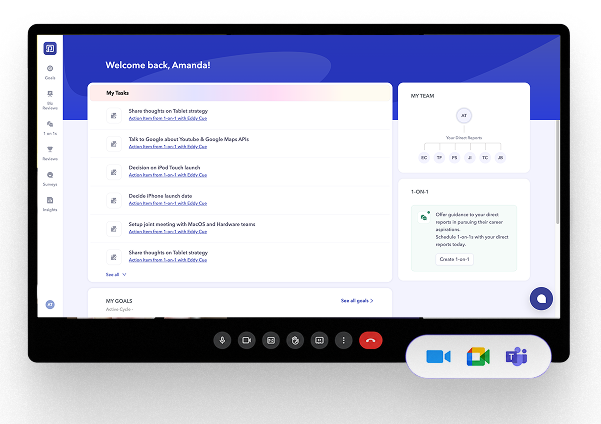
Top Picks




YOU'VE READ THE PLAYBOOK
Now see it running - live, on your org chart
A 30-minute walkthrough of reviews, goals and 1:1s inside Slack & MS Teams. No slides, just the product.
Request a Demo