

















Aditi




January 1, 1970
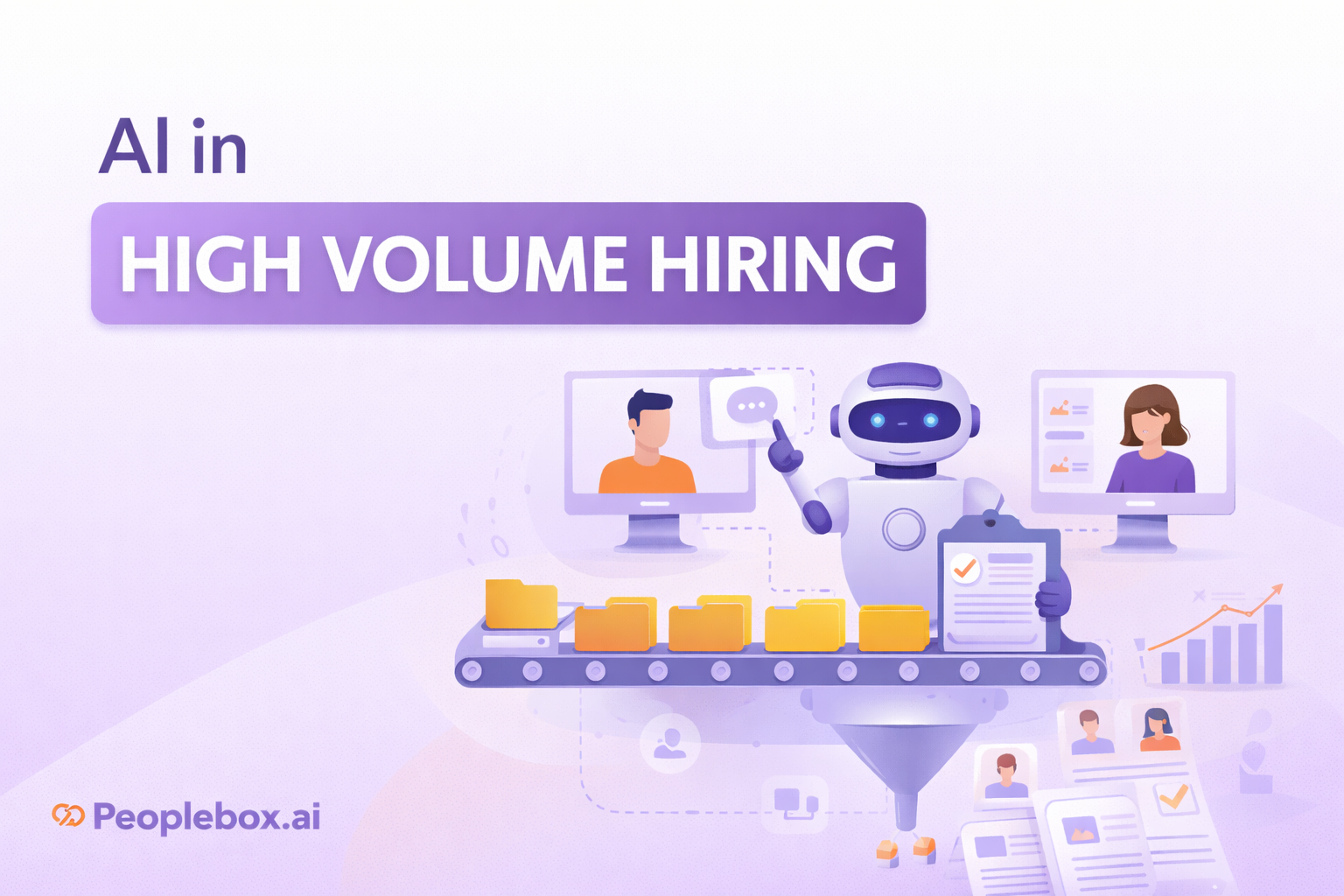
There’s a quiet revolution underway in high-volume hiring, powered by AI.
Not the sort of AI doing resume parsing or selecting candidates based on certain keywords on the resume.
AI is now transforming the earliest, high-volume stages of recruitment by automating tasks such as screening, conversational interviewing, and candidate evaluation, underscoring its strategic role in streamlining processes.
And it’s not hypothetical. According to SHRM’s Talent Trends research, AI is now among the top tools organizations use in recruiting, interviewing, and hiring workflows. Resume screening and recruitment communication are the most common use cases today.
In practical terms:
- Screening that once took days of recruiter time can now occur in hours or minutes, as AI assesses basic qualifications at scale.
- Instead of running one-by-one interviews, teams use conversational AI to engage applicants, ask follow-up questions, and capture responses in standardized formats.
- Rather than manually compiling shortlists, AI curates qualified candidates and presents them for human review.
So does that mean AI will replace recruiters?
Absolutely not. This isn’t about removing recruiters from the hiring process. It’s about redefining where and how recruiters add meaningful value, making them feel essential and appreciated.
Recruiters are no longer doing initial screens; they’re focusing on decisioning, candidate experience design, offer strategy, and high-impact interviewing.
What used to require dozens of initial calls can now be handled simultaneously through systems that sound like a human interviewer, adapt, and respond.
And that’s where things start to change, not just in speed and efficiency, but in quality, fairness, and accountability.
Why High-Volume Hiring Needed a Revolution?
High-volume hiring isn’t seasonal anymore; it’s a recurring operational need across retail, logistics, BPO, healthcare, and hospitality.
The traditional bottlenecks were brutal:
- Manual resume screening: Recruiters spending 80% of their time reviewing CVs for obvious qualifications
- Phone screening backlogs: Weeks-long delays to conduct first-round conversations
- Scheduling nightmares: Endless email chains coordinating interviews across shifts and locations
- Inconsistent quality: Different recruiters applying different standards, especially across locations
- Candidate drop-off: Losing qualified candidates during long, unresponsive processes
The global AI recruitment industry grew from US$590-662 million in 2023 and is projected to reach US$940 million to US$ 1.12 billion by 2030, with a 6-7% CAGR, underscoring its growing significance.
How AI is Transforming Bulk Hiring
Modern AI doesn’t just automate, it genuinely screens. Here’s what’s changed:
Resume Parsing and Skills Matching
AI extracts and evaluates experience, qualifications, and skills with accuracy that matches or exceeds human screeners, but at a massive scale. A single AI system can process thousands of CVs in the time it takes a human recruiter to read one.
Conversational Screening
Instead of rigid questionnaires, AI conducts adaptive conversations. It probes deeper into relevant experience, clarifies ambiguous responses, and adjusts questions based on the candidate’s answers. The result feels like talking to a knowledgeable recruiter, not filling out a form.
About 38% of companies using AI identify reduced time spent on manual sourcing tasks as their #1 benefit. Conversational AI and recruitment chatbots can lower candidate drop-off by up to 40% by engaging applicants 24/7 and guiding them through the process.
Skills Assessment and Soft Skills Evaluation
AI can now evaluate communication quality, problem-solving approach, and situational judgment, the soft skills critical for frontline roles. It assesses clarity of expression, professional tone, and customer-readiness through natural conversation.
24/7 Candidate Support
Advanced FAQ and chat systems now auto-resolve over 90% of candidate questions, freeing recruiter time and keeping pipelines warm at scale. Candidates get instant answers about benefits, work schedules, application status, and next steps, any time, any day.
The Efficiency Revolution: Real Numbers from Real Companies
The efficiency gains aren’t marginal, they’re transformational:
- Companies using AI report an average 40% reduction in time-to-hire
- In high-volume environments with heavy manual screening, reductions of 70-75% are documented
- One 2025 case study reported screening time dropping from weeks to minutes
- A bulk-hiring platform achieved a 40% reduction in the hiring cycle for campus recruitment
For example, a retail chain that previously took 8 weeks to hire 500 associates can now complete the process in 2-3 weeks, illustrating AI’s tangible impact on reducing hiring timelines. These gains aren’t theoretical, the 2026 State of AI Interviews report documents them across 50,000+ real interviews
Increase in Recruiter Productivity
AI doesn’t replace recruiters. It multiplies their capacity. In 2024, 86% of recruiters reported that AI tools enhanced their efficiency and reduced time-to-hire, in some cases by up to 70%.
What used to require a team of 10 recruiters can now be handled by 3-4 recruiters supported by AI:
- Resume screening that consumed 30 hours per week now takes 2 hours of review time
- Phone screens that required 40 hours become automated conversations requiring only final review
- Scheduling coordination that took 15 hours weekly becomes automated
- Candidate FAQ management that consumed 10 hours is handled automatically
This shift is structural, not temporary. 30% of companies have increased investment in automation and AI recruiting solutions over the past two years, encouraging decision-makers to feel confident about leading future change.
Better Candidate Experience at Scale
Traditional high-volume hiring often led to poor candidate experiences, causing frustration and concern for candidates’ perceptions of the employer.
AI flips this entirely:
- Instant engagement: Candidates can apply and complete initial screening within an hour
- 24/7 availability: Apply at midnight after your current shift, on weekends, during lunch breaks
- Always-on support: Questions answered instantly, not after waiting days for recruiter callbacks
- Transparent status: Real-time updates on where you are in the process
The results speak for themselves: Conversational AI platforms have demonstrated the ability to reduce candidate drop-off by up to 40%. When candidates feel engaged and informed, they stay in your pipeline.
Consistency Across Every Touchpoint
In traditional high-volume hiring, candidate experience varied wildly by recruiter, location, and time of day. Some candidates got a thorough, professional screening. Others got rushed, distracted, and received inconsistent treatment.
AI delivers uniform excellence. Every candidate gets:
- The same thorough evaluation criteria
- The same professional communication style
- The same comprehensive information about the role
- The same opportunity to demonstrate their qualifications
This consistency not only improves fairness but also enhances transparency. It strengthens the employer brand. Rejected candidates leave with respect for the process rather than frustration at being dismissed.
Where AI Adds the Most Value in High-Volume Hiring
AI isn’t equally transformative everywhere. Here’s where it delivers maximum impact:
Top-of-Funnel Sourcing
- Programmatic job advertising that automatically optimizes spend across channels.
- QR code job links and mobile-first application flows
- Chatbot-driven engagement that captures interest and pre-qualifies candidates
Resume Processing and Skills-Based Ranking
- Automated parsing of thousands of resumes in minutes
- Skills-based matching against job requirements
- Bias-controlled shortlisting that focuses on qualifications
First-Round Screening
- Automated initial assessments and video interviews
- Conversational screening that evaluates fit and availability
- On-demand video interviews that candidates complete on their schedule
Coordination and Logistics
- Automated interview scheduling across multiple time zones and shifts
- Bulk offer generation and delivery
- Onboarding automation and document collection
Research in 2024-2025 consistently finds that higher automation levels directly correlate with faster, more scalable recruitment, especially in large campaigns.
The Adoption Wave: Where We Are in 2026
Current State of Adoption
AI in recruitment has crossed the chasm from early adopters to mainstream:
- 30% of companies are already leveraging AI in recruiting, though many use it for only about 25% of their processes
- For companies doing high-volume hiring and using an ATS plus AI tools, usage jumps to 42%
- 81% of companies plan to invest in AI-driven recruiting solutions to automate and enhance hiring
- 78.9% of HR and TA professionals expect AI usage in the workplace to increase, with only 4% expecting a decrease
This isn’t experimental technology anymore. It’s becoming standard infrastructure for volume hiring operations.
Who’s Leading the Way
The organizations seeing the most success share common characteristics:
- Recurring high-volume needs: Retail, BPO, logistics, healthcare, hospitality, with continuous hiring demands
- Scale challenges: Organizations hiring 100+ people per month, where manual processes break down
- Multi-location operations: Companies needing consistent screening quality across geographies
- High application volumes: Employers receiving 50+ applications per open position
How Recruiters Win with AI: From Task-Doers to Strategic Partners
AI doesn’t eliminate recruiter roles. It elevates them. When AI handles the repetitive, high-volume screening work, recruiters move upstream to higher-value activities:
From resume screening to Strategic talent pipeline building
Recruiters shift from reviewing hundreds of CVs to identifying and nurturing passive candidates for critical roles.
From Phone screens to deep relationship management
Instead of conducting basic screening calls, recruiters focus on building genuine connections with high-potential candidates and hiring managers.
From coordination tasks to experience design
Rather than scheduling interviews and chasing candidates, recruiters design exceptional candidate journeys and represent the employer brand.
From process execution to quality oversight and optimization
Recruiters monitor AI performance, identify opportunities for improvement, and ensure consistently high-quality outcomes.
This is exactly what’s happening in practice. As automation expands, research shows that recruiters are shifting toward strategic and relationship-driven work while AI handles repetitive screening and coordination.
Making It Work: Implementation Realities
AI transformation in high-volume hiring isn’t plug-and-play. Organizations that succeed typically:
- Start with clear use cases
Don’t try to automate everything at once. Begin with one high-volume role or location where the bottleneck is obvious and the ROI is clear.
- Ensure technical readiness
- Clean ATS integration for seamless data flow
- Mobile-optimized experience (most frontline candidates apply via phone)
- Multilingual support if hiring across diverse populations
- Run parallel processes initially
Keep human screening running alongside AI for 2-4 weeks. Validate AI decisions, build team confidence, and identify issues before fully committing.
- Monitor and iterate obsessively
Track drop-off rates, screening quality, time-to-hire, candidate feedback, and diversity metrics religiously. AI isn’t set-and-forget; plan for continuous optimization.
- Invest in change management
Your recruiters, hiring managers, and even candidates need to understand and trust the new process. Communication, training, and involvement in design are critical.
Doing It Right: Compliance, Fairness, and Trust
The organizations getting AI right in high-volume hiring focus on three foundational elements:
Transparency
- Tell candidates upfront they’re being evaluated by AI
- Explain how decisions are made in plain language
- Provide clear evaluation criteria and decision factors
Auditability
- Maintain complete records of every screening conversation
- Document scoring and decision points with specific examples
- Track aggregate outcomes by demographic groups
Fairness Controls
- Regular adverse impact testing to ensure no systematic disadvantage
- Human review for borderline decisions and edge cases
- Clear escalation paths and candidate appeal mechanisms
Done right, AI can actually improve fairness compared to purely human processes by ensuring every candidate receives the same thorough, consistent evaluation.
Conclusion
AI isn’t coming to high-volume hiring. It’s already transforming it. Organizations that once needed weeks to screen thousands of candidates now do so in days or hours. Recruiters who spent 80% of their time on repetitive tasks are now building strategic relationships and designing exceptional experiences. Candidates who waited in black holes are getting instant, transparent engagement.
The question for TA leaders isn’t whether AI will change high-volume hiring, it’s whether you’ll lead the change or scramble to catch up. The organizations that will dominate high-volume hiring in 2026 and beyond are those that:
- Embrace AI transformation pragmatically, learning from early successes and failures
- Invest equally in technology and change management
- Maintain relentless focus on candidate experience, fairness, and quality
- Elevate recruiters from task-doers to strategic partners
- Continuously optimize based on real outcomes and real feedback
The efficiency revolution in high-volume hiring is here. The only question is: How quickly will you capture it?
TABLE OF CONTENTS
RELEVANT ARTICLES
Our Customers Love us