
15Five is a well-known name in performance management, especially among teams looking to build consistent feedback and check-in habits.
If you’re researching a 15Five review, you’re likely trying to understand whether it fits your organization’s performance model or how it compares to other platforms in the market.
This guide takes a practical look at 15Five: what it’s built for, where it works best, how pricing works in 2026, and what alternatives offer if your performance needs extend beyond continuous feedback.
15Five at a Glance
15Five is a platform for engagement and performance management that is based on regular check-ins and organized feedback.
Key competencies consist of:
- Weekly check-ins
- OKR tracking
- Performance reviews & 360 feedback
- Engagement surveys
- 1:1 meeting tools
- Peer recognition
Mid-market businesses frequently use it to formalize continuous feedback without depending on spreadsheets.
15Five is not an HRIS. It centralizes engagement data and performance conversations in conjunction with current systems.
Its main benefit is that it reinforces regular manager-employee feedback practices all year long.
Key Features of 15Five
Below are the primary capabilities that define how 15Five supports continuous performance management.
Continuous Check-Ins: Weekly check-ins allow employees to share updates on priorities and blockers, while managers respond with feedback. This creates ongoing visibility between formal review cycles.
Performance Reviews: Supports self, manager, and peer review cycles. Reviews are informed by documented check-ins and feedback captured throughout the year.
Goal & OKR Tracking: Teams can set and track goals alongside performance conversations, helping connect day-to-day work with broader objectives.
Engagement Surveys: Includes pulse surveys and engagement dashboards to monitor sentiment and manager effectiveness across teams.
Feedback & Recognition: Enables continuous peer feedback and lightweight recognition features like “High Fives.”
1:1 Meeting Tools: Shared agendas and notes help managers run more structured one-on-one conversations.
HR Reporting: Provides centralized dashboards for reviewing progress, engagement trends, and participation metrics.
Pros of 15Five
1. Strong Continuous Check-In Culture
15Five makes weekly check-ins a consistent habit rather than a one-off event. This creates steady visibility into priorities, blockers, and progress, helping managers stay informed between formal reviews.
2. Improves Manager-Employee Conversations
The platform nudges regular dialogue through 1:1 tools and check-ins, which reduces surprises during review cycles and supports ongoing coaching rather than reactive feedback.
3. Supports Both Formal & Informal Feedback
15Five combines structured review cycles (self, manager, peer) with continuous feedback and lightweight recognition tools like “High Fives,” making performance conversations more balanced.
4. Engagement Visibility for HR Leaders
Built-in pulse surveys and engagement dashboards give HR teams visibility into morale, alignment, and manager effectiveness across teams.
5. Goal Tracking Connected to Performance
OKRs and goals live alongside check-ins and reviews, helping tie day-to-day work to broader company objectives without requiring separate systems.
6. Centralized Performance Data
Feedback, recognition, and review inputs are stored in one platform instead of scattered across emails, docs, or chat tools improving transparency and record-keeping.
Cons of 15Five
1. Adoption Requires Behavioural Change
15Five only works if managers consistently read, respond to, and act on check-ins. In organizations where feedback isn’t already a habit, adoption can stall.
2. Can Feel Process-Heavy at First
Teams used to annual reviews may initially find weekly check-ins and structured workflows burdensome. Early implementation requires clear communication and buy-in.
3. Engagement & Survey Depth Is Moderate
While pulse surveys are useful for tracking sentiment, the analytics are not as advanced as specialized engagement platforms focused solely on workforce insights.
4. Review Configuration Takes Planning
Setting up structured review cycles, rating frameworks, and workflows requires upfront design. Smaller teams without dedicated HR support may find this complex.
5. Costs Increase with Scale
Pricing scales per user and per module. As organizations add features or grow headcount, costs can rise meaningfully.
6. Not a Full Talent Suite
15Five focuses on performance and engagement. It does not include compensation planning, advanced calibration tools, or broader talent lifecycle management.
7. Data Volume Can Become Noisy
Regular check-ins generate significant feedback data. Without disciplined review practices, insights can get buried in volume.
8. Value Drops Without Consistency
If employees and managers skip updates or treat check-ins as administrative tasks, the impact diminishes quickly. The platform depends heavily on sustained participation.
15Five Pricing
15Five uses a modular, per-user pricing model billed annually. Costs increase as additional performance and engagement modules are added.
- Engage (~$4/user/month): Focused on pulse surveys and engagement tracking.
- Perform (~$11/user/month): Covers performance reviews, continuous feedback, and OKR tracking.
- Total Platform (~$16/user/month): Combines performance and engagement features, adding HR dashboards and manager enablement tools.
Additional modules, such as manager coaching tools, AI support (Kona), and compensation, are priced separately and typically require a sales conversation.
15Five Integrations
15Five integrates with the essential systems needed for performance management, primarily HRIS platforms, identity providers, collaboration tools, and calendars.
It is not designed as a full HR ecosystem connecting recruiting, compensation, payroll, and learning out of the box. Instead, it focuses on syncing employee data and enabling feedback workflows.
HRIS Integrations: Employee data, such as role, department, and reporting structure, can sync from major HR systems, reducing manual updates during review cycles.
Single Sign-On (SSO): Supports identity providers like Okta and Azure AD for secure access management.
Slack & Microsoft Teams: Notifications and check-in prompts can appear inside collaboration tools, supporting continuous feedback habits.
Calendar Integrations: Google Calendar and Outlook integrations help align 1:1 scheduling and reminders with daily workflows.
Data Export: Performance and engagement data can be exported for further analysis in BI tools if deeper reporting is required.
15Five Reviews Snapshot (G2 & Capterra)
G2 rating : 4.6 / 5 ⭐
Capterra rating : 4.7 / 5 ⭐
While ratings are strong overall, most reviews reflect satisfaction with check-ins and feedback workflows rather than broader performance complexity.
What Users Like
- Ease of use for weekly check-ins and ongoing feedback
- Structured performance routines that reduce review-time surprises
- Goal tracking visibility across teams
- Simple recognition features like “High Fives.”
What Users Flag
- Limited customization for complex org structures
- Learning curve as features expand beyond check-ins
- Navigation friction in larger deployments
- Engagement features can feel repetitive without active refresh
15Five tends to receive strong ratings when teams commit to continuous feedback habits. Reviews are more mixed when buyers expect deeper configurability, broader HR coverage, or lighter operational overhead.
15Five Alternatives
15Five works well for structured check-ins and continuous feedback. But it isn’t built for every performance architecture. especially if you need deeper configurability, compensation alignment, or enterprise-grade calibration.
Below is a quick side-by-side comparison to help you understand how 15Five stacks up against other leading performance management platforms in 2026.
| Platform | Core Strength | Best For |
| 15Five | Continuous check-ins & feedback | Mid-market teams building performance habits |
| Peoplebox.ai | Full-cycle talent management | Teams needing OKRs, reviews, 360 and compensation in one system |
| Lattice | Structured performance + engagement | Growing companies formalizing reviews |
| Leapsome | Performance + learning integration | Development-focused organizations |
| Betterworks | Enterprise OKR alignment | Large orgs with goal cascading needs |
| Culture Amp | Engagement & people analytics | Companies prioritizing sentiment insights |
| Workday Performance | Native HCM integration | Enterprises already on Workday |
Each of these alternative approaches performs management differently. Some focus on engagement, others on enterprise OKRs, and some offer full-cycle talent management beyond check-ins.
1. Peoplebox.ai Talent Management – Full-Cycle Performance, OKRs & Compensation
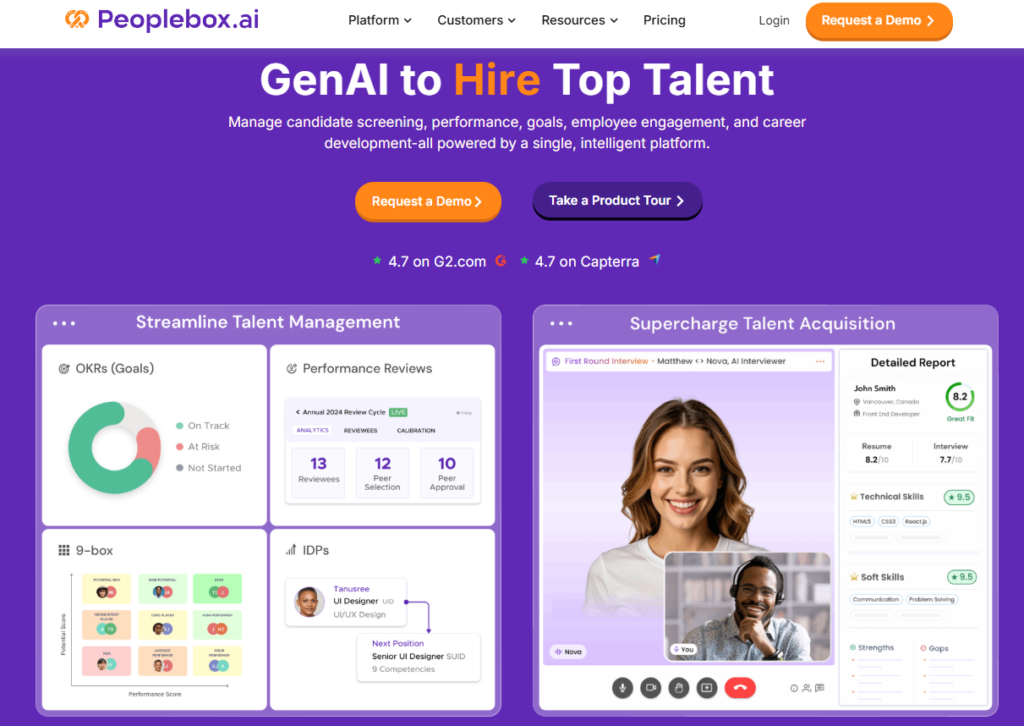
Peoplebox.ai is an all-in-one talent management platform that brings OKRs, performance reviews, 360-degree feedback, 1:1s, engagement surveys, compensation planning, and individual development plans into one deeply configurable system.
Unlike tools that primarily focus on weekly check-ins, Peoplebox.ai connects performance directly to outcomes.
What Makes Peoplebox.ai Different
Peoplebox.ai is built as a full-performance architecture, not just a check-in or review tool. It connects goals, reviews, calibration, compensation, and development into one structured system.
- Strategic Alignment from Top to Bottom
Goals cascade from company → department → team → individual with real-time visibility and AI summaries. This ensures performance conversations tie directly to business outcomes, not just activity tracking. - Performance Workflows Designed Your Way
Reviews, competencies, rating scales, probation cycles, and approval flows are fully configurable. HR teams aren’t forced into rigid templates, they can design performance frameworks that match their organization. - Built-In Calibration & 9-Box Grids
Performance and potential are evaluated using structured calibration workflows and 9-box grids, without relying on spreadsheets. - Compensation Linked to Performance
Increments, bonuses, and equity planning connect directly to review outcomes, with budget controls and multi-level approvals built into the system. - 360 Feedback with Actionable Insights
AI-generated summaries surface strengths, gaps, and development themes, making feedback easier to interpret and act on. - Development Loops, Not Just Reviews
Individual Development Plans pull directly from performance data, turning reviews into continuous growth cycles instead of isolated events. - Deep Workflow Integrations
Employees interact with goals, feedback, and reviews inside Slack, Teams, and Jira, reducing friction and improving adoption. - Enterprise-Grade Security & Compliance
SOC 2 Type II, ISO 27001, and GDPR compliance support enterprise deployment requirements.
Where Peoplebox.ai Wins Against 15Five
- Full-Cycle Platform vs Check-In Focus
15Five is strong in weekly check-ins and manager enablement. Peoplebox.ai covers the entire lifecycle goals, reviews, calibration, compensation, engagement, and development in one system. - Enterprise Readiness
Peoplebox.ai supports 9-box calibration, structured approval flows, compensation planning, and budget enforcement, which are critical for complex orgs. - Deep Configurability
Peoplebox.ai allows HR teams to design performance workflows the way they want. 15Five has more structured templates with less customization depth. - Performance-to-Compensation Visibility
15Five does not natively manage compensation cycles. Peoplebox.ai directly connects performance data to increment and bonus planning. - Integration Depth
Beyond reminders, Peoplebox.ai deeply integrates with Slack, Teams, Jira, HRIS platforms, and ATS systems, syncing data automatically.
If your goal is improving feedback cadence, 15Five works.
If your goal is to align performance, pay, promotion, engagement, and development into one structured system, Peoplebox.ai is built differently.
Looking for More Than Check-Ins?If your performance process needs deeper calibration, compensation alignment, and full-cycle talent management, not just weekly feedback, explore how Peoplebox.ai connects goals, reviews, 360s, and pay in one configurable platform. |
Other Notable 15Five Alternatives
2. Lattice
Lattice is a performance management platform that combines reviews, engagement surveys, and compensation planning in one system. It’s often used by growing and mid-sized companies looking for a more structured, configurable performance stack beyond basic check-ins.
3. Leapsome
Leapsome brings performance management and learning development together, offering reviews, goals, feedback, and built-in learning paths. It appeals to organizations that want development and upskilling tightly connected to performance processes.
4. Betterworks
Betterworks is positioned around enterprise OKR alignment and structured performance workflows. It’s commonly adopted by larger organizations focused on cascading goals and leadership visibility across complex structures.
5. Culture Amp
Culture Amp is primarily known for engagement surveys and people analytics, with performance management layered in. It’s typically chosen by companies prioritizing employee sentiment and culture measurement.
6. Workday Performance
Workday’s performance module is part of its broader HCM suite. It integrates directly with Workday HR data, making it attractive for enterprises already standardized on Workday, though configurability is tied to the Workday ecosystem.
Final Verdict: Is 15Five the Right Fit?
15Five is good for teams that want to have structured weekly meetings, easy OKR tracking, ongoing engagement monitoring, and a performance tool for mid-sized companies.
It helps to improve how often feedback is given and makes managers more responsible.
However, if your company needs detailed evaluation, better compensation planning, or more customizable performance processes, you might need a more comprehensive talent management platform.